Yeah, appliances are a really tough place to not just make money but stay afloat. What happens when you’ve saturated the market with good products that won’t need to be replaced for a long time? You’d end up having to charge an arm and a leg for them because you simply can’t sell enough to operate. You’d still get orders of course, but at a trickle.
Idk how to fix the problem either. Part of me says government subsidies for companies with proven manufacturing records, affordable prices, and customer satisfaction? Like an incentive to not enshittify and allow those companies to stay in business? Otherwise the consumer shoulders the cost, which defeats a lot of the purpose. The point is to improve lives, and being prohibitively expensive won’t work. But convincing any government to spend money like that for such intangible and long-term societal benefits instead of pure profit seems like an unrealistic proposition. Like, how do you sell peace of mind to people who already arent suffering and with no concept of true insecurity?
I’ve been wanting companies like the one described for a very long time, but fuck me does it seem unlikely and hard to pull off
How about: accept that we are, like as a society, able to just not work as much? We are able supply people with a reasonable level of comfort without everyone slaving away this many hours every day. Let’s just build what we need at minimum labour hours over the lifetime of the products and not worry about the products making a profit for anyone. The profit of not having to work but being able to pursue interests would be so worth it.
Oh, I mean the complete overhaul of the economic system is the goal to be sure, im just talking about the difficulties such a company would face right now. And im not talking about some shareholder value bullshit either. Employees need to and deserve to be paid for their time and labor. Materials cost money. Upkeeping current equipment costs money, and getting new or better equipment to improve the product or expanding to serve more people costs money. If you ever want to expand, and altruistically we’re talking expansion for the purpose of helping more people, not pulling a profit, you need a profit margin by definition, even a sliver of one. You could get by for a while by charging at-cost price plus a couple of pennies. But if that dries up, employees go home without getting paid. Equipment and properties get sold. Manufacturing licenses are lost. Eventually the company either dissolves or is sold off to pay its debts.
Operating a company like that means you need to be prepared for very long dry spells, and if you want to be able to hold out for those and be able to do things like pay employees and keep licenses, you need deep pockets to cover it.
All this to say the revolution would need to happen before practices like this can be a reality, at least for the long term.
Agree. I also want such manufacturers to exist, but life shows that anyone who tried such schemes either failed or reconfigured to a standard profit scheme. I have only seen mass produced items designed for long term usage in totalitarian countries like USSR.
Charge up front for appliance disposal if they aren’t independently rated for a certain amount of lifetime so you force people to pay what the actual cost is.
I recall they do this for something, forget what. I think it was like nuclear reactors to make sure you have money set aside to decommission it safely even if you go bankrupt.
It’s profitable. It’s just not as profitable as being a douchebag with business decisions - like enshittification and planned obsolescence. The moment you try to to publicly fund your company, you suddenly have a fiduciary duty to your investors to maximize returns. And let’s face it, appliance manufacturing has high up front costs that will likely require an IPO to satisfy your initial private investors.
Just because you make quality appliances doesn’t mean you can’t make money maintaining and manufacturing parts for quality appliances.
I’m not talking about companies trying to make a buck for investors. Fuck investors. I’m just talking financial sustainability. It’s more about maintaining inflow to keep up with outflow than building wealth. I’m trying to consider the viability for that kind of company, even privately owned. I mean, best case is you find investors who dont want a return, but want to do good. But that being nearly impossible (the rich got rich for a reason), private is probably your best bet. But still, I guess you’d want vertical integration and a commitment to long-term support and part recycling. If you make most of your parts, sustaining a commitment to support should be easier. That way, you have complete control over each part of the process and arent beholden to any more suppliers than you absolutely need to be. But you’re essentially running several businesses at that point instead of one, so some costs go up. You need a bunch of different kinds of licenses and certs, depending on your part variability. Like, your PCB manufacturing section will need completely different facilities, approvals, licenses, management skillsets (so extra employees, skills dont transfer) etc compared to milling metal, assembly, or casting plastic. It’s not something a lot of companies do because of the upfront cost and longer time to make it up. Going with 3rd party suppliers not necessarily always out of impatience, but because a reliable supplier is just cheaper. And if you get to the point of having to charge 3x your competitors because they can afford to undercut you, most consumers will not be choosing you. Sales drop to the point you can’t afford to operate and, again, unless you have deep pockets to cover it.
It’s a malicious environment for any kind of good-willed company to thrive. Price-undercuts work, and people dont always spend with long-term cost and company ethics in mind. They should, imo, but they simply dont always do that. And many can’t afford to save up for the better or more ethical version, because they need one today and payday isn’t for another week.
If you’re a good company, you’re already at a disadvantage because you have more lines you won’t cross to keep yourself going. Amd te simplest way to offset the disadvantage is either deep pockets or luck.


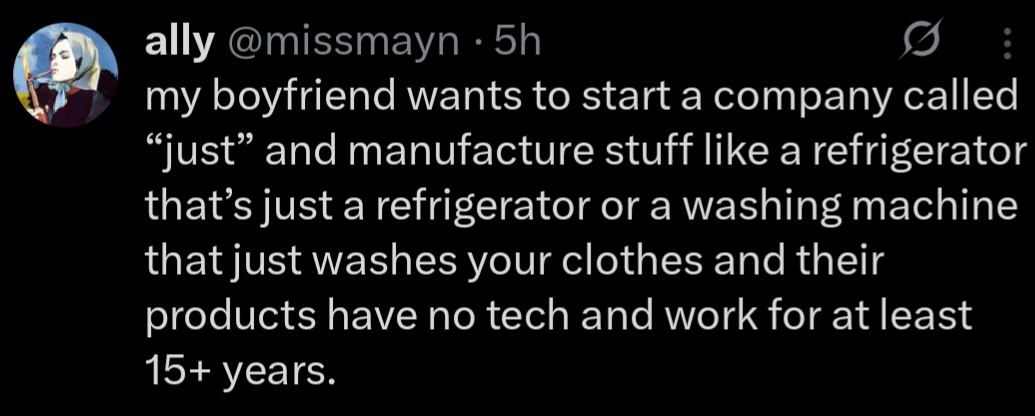
Yeah, appliances are a really tough place to not just make money but stay afloat. What happens when you’ve saturated the market with good products that won’t need to be replaced for a long time? You’d end up having to charge an arm and a leg for them because you simply can’t sell enough to operate. You’d still get orders of course, but at a trickle.
Idk how to fix the problem either. Part of me says government subsidies for companies with proven manufacturing records, affordable prices, and customer satisfaction? Like an incentive to not enshittify and allow those companies to stay in business? Otherwise the consumer shoulders the cost, which defeats a lot of the purpose. The point is to improve lives, and being prohibitively expensive won’t work. But convincing any government to spend money like that for such intangible and long-term societal benefits instead of pure profit seems like an unrealistic proposition. Like, how do you sell peace of mind to people who already arent suffering and with no concept of true insecurity?
I’ve been wanting companies like the one described for a very long time, but fuck me does it seem unlikely and hard to pull off
How about: accept that we are, like as a society, able to just not work as much? We are able supply people with a reasonable level of comfort without everyone slaving away this many hours every day. Let’s just build what we need at minimum labour hours over the lifetime of the products and not worry about the products making a profit for anyone. The profit of not having to work but being able to pursue interests would be so worth it.
Oh, I mean the complete overhaul of the economic system is the goal to be sure, im just talking about the difficulties such a company would face right now. And im not talking about some shareholder value bullshit either. Employees need to and deserve to be paid for their time and labor. Materials cost money. Upkeeping current equipment costs money, and getting new or better equipment to improve the product or expanding to serve more people costs money. If you ever want to expand, and altruistically we’re talking expansion for the purpose of helping more people, not pulling a profit, you need a profit margin by definition, even a sliver of one. You could get by for a while by charging at-cost price plus a couple of pennies. But if that dries up, employees go home without getting paid. Equipment and properties get sold. Manufacturing licenses are lost. Eventually the company either dissolves or is sold off to pay its debts.
Operating a company like that means you need to be prepared for very long dry spells, and if you want to be able to hold out for those and be able to do things like pay employees and keep licenses, you need deep pockets to cover it.
All this to say the revolution would need to happen before practices like this can be a reality, at least for the long term.
Agree. I also want such manufacturers to exist, but life shows that anyone who tried such schemes either failed or reconfigured to a standard profit scheme. I have only seen mass produced items designed for long term usage in totalitarian countries like USSR.
Charge up front for appliance disposal if they aren’t independently rated for a certain amount of lifetime so you force people to pay what the actual cost is.
I recall they do this for something, forget what. I think it was like nuclear reactors to make sure you have money set aside to decommission it safely even if you go bankrupt.
This is bullshit, IMO.
It’s profitable. It’s just not as profitable as being a douchebag with business decisions - like enshittification and planned obsolescence. The moment you try to to publicly fund your company, you suddenly have a fiduciary duty to your investors to maximize returns. And let’s face it, appliance manufacturing has high up front costs that will likely require an IPO to satisfy your initial private investors.
Just because you make quality appliances doesn’t mean you can’t make money maintaining and manufacturing parts for quality appliances.
I’m not talking about companies trying to make a buck for investors. Fuck investors. I’m just talking financial sustainability. It’s more about maintaining inflow to keep up with outflow than building wealth. I’m trying to consider the viability for that kind of company, even privately owned. I mean, best case is you find investors who dont want a return, but want to do good. But that being nearly impossible (the rich got rich for a reason), private is probably your best bet. But still, I guess you’d want vertical integration and a commitment to long-term support and part recycling. If you make most of your parts, sustaining a commitment to support should be easier. That way, you have complete control over each part of the process and arent beholden to any more suppliers than you absolutely need to be. But you’re essentially running several businesses at that point instead of one, so some costs go up. You need a bunch of different kinds of licenses and certs, depending on your part variability. Like, your PCB manufacturing section will need completely different facilities, approvals, licenses, management skillsets (so extra employees, skills dont transfer) etc compared to milling metal, assembly, or casting plastic. It’s not something a lot of companies do because of the upfront cost and longer time to make it up. Going with 3rd party suppliers not necessarily always out of impatience, but because a reliable supplier is just cheaper. And if you get to the point of having to charge 3x your competitors because they can afford to undercut you, most consumers will not be choosing you. Sales drop to the point you can’t afford to operate and, again, unless you have deep pockets to cover it.
It’s a malicious environment for any kind of good-willed company to thrive. Price-undercuts work, and people dont always spend with long-term cost and company ethics in mind. They should, imo, but they simply dont always do that. And many can’t afford to save up for the better or more ethical version, because they need one today and payday isn’t for another week.
If you’re a good company, you’re already at a disadvantage because you have more lines you won’t cross to keep yourself going. Amd te simplest way to offset the disadvantage is either deep pockets or luck.