You must log in or # to comment.
It’s actually quite straight forward. Inside the record player there’s a small group of highly trained goblins. They watch the needle move side to side and they perfectly recreate the music using their tiny instruments.
Simple.
Ah, very similar to the camera (iconograph) filled with fast painting imps.
That may or may not have been my inspiration
I got the knockoff version that had an understaffed team of mostly complacent fairies using thrift shop keyboards. I tried playing Hocus Pocus by Focus and they burned down my house and flew off with my neighbor’s cat.
It’s because you played the boring album version, instead of the one and only 1973 live version.
GNU Sir Terry
A man is not dead while his name is still spoken.
Death can’t have him.

I heard their team-building theme song was Madonna’s Into the Groove.
It’s so simple
Well sound is just wiggly air. You put the air wiggle onto the disk so later you can use the disk wiggle to make air wiggle.
He said never. That’s an order.
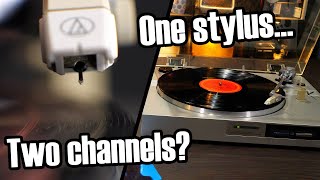 ](https://www.youtube.com/watch?v=3DdUvoc7tJ4)
The video explains how a single needle can play stereo sound, but in doing so explains how the basic idea works before going into the incredible design to do two channels.
Link is borked because of the ! at the beginning. It’s trying to pull a picture that doesn’t exist
As a general FYI, you can make a clickable YouTube thumbail like this
[](https://www.youtube.com/watch?v=3DdUvoc7tJ4)Just replace the videoID in the thumbnail and URL.
I tried to duplicate what you have (which works in your example) but it broke it badly, so I left it. One day all the Fediverse will be universal in how it works.
This is about Markdown, not Fediverse.
Some software clients parsing the Fediverse protocol treat some special markdowns differently. It’s gotten better as new versions are updated to recognize more, but it’s still a thing.
That was very informative, thanks!
Anything sufficiently advanced is indistinguishable from magic.
I’m convinced this is magic.
It’s only weird once electrons get involved.
things get weirder when your get rid of those electron bois
I agree, I’m still amazed that this shit works as well as it does.
Add quantum science to the list.
I’ve watched some yt videos about quantum mechanics. I am FAR too dumb to understand even a few words of what they were talking about lol
Quantum mechanics are the dreams that stuff is made of.
That’s Gold, Jerry!
Tat’s the neat part about it. Scientists dont understand it either.
How computers work is also some form of witchcraft. Even tho I understand the principles behind it, it still is literally magic that we get computers to execute stuff.
Computers run on magical smoke.
Proof: When the smoke comes out, the computer doesn’t work anymore.That’s how basically all electronics work
Computers are easy, they just do math really really fast. The weird part is how useful math is.
Ah well except it’s really rocks being excited enough to do math.
Nobody understand Quantum mechanics, scientifics only know what it do, but not how.
How about this one to blow your mind further:
Because of how it was made, they could play back the sounds around the potter who fabricated it.
I thought they had done the same with some Roman parchment, but all I can find are links to stories on that one.
Interesting, but I think this is largely discredited from the brief research I did?
https://en.wikipedia.org/wiki/Archaeoacoustics#Discredited_theories
Cool idea nonetheless.
Doesn’t really discredit it based on that, but thanks for the article
Holy crap that’s wild
What the hell are the sounds supposed to be?
Someone playing a recorder or flute like instrument?
Or some one was being tortured.
The description says it’s a violin
What’s crazy to me is that this technology was used for only a few dozen years before it was replaced and for thousands of years beforehand there was nothing like it
It’s also interesting that it has made somewhat of a comeback after some newer technologies have faded away
Sound is vibration. A record is a vibration frozen in place.
yhea, i can bs, those vynils are usually at room temperature
A cello is just a bit of wood with some stringy Bois, but it sounds like heaven and hell and everything in-between when played right.

Calvins’ dads’ explanations were very influential to my shitposting career
It’s 4:30am and thanks to this thread I’m listening to Dave Brubeck on vinyl…
Just count to five and you’ll be alright
No, it’s better to count 1,2,3,4 - 1,2,3 to keep the beat. (I’ve preformed Take 5 with a Jazz band).
It’s for science.
Records are very easy to understand. Even without a microscope, you can see periodic patterns on test vinyls with beeps. And sound being periodic motion is also obvious from string and percussive instruments.
You can even see tracks starting and ending on pressed CDs under the right lighting with your own eyes. I wonder, is the encoding of silence (approx. 2 seconds) really that different or does the density of grooves or pit/land pattern intentionally differ to help the player seek there faster? I know that uncompressed audio naturally results in a repeated pattern when silence is encoded but given the 8-to-14 modulation and other error correctiion techniques, I find it hard to believe it would result in significantly different density unless they specifically added a special mode just for encoding silence that makes the track brighter-colored for easier coarse seeking.
Theres a graphic somewhere I’ll try to find that shows a bird call as a sound wave then a picture of record topography of the same call that makes it fairly obvious.
Gramophones are also fairly illustrative given that the needle directly acts on a diaphragm that is directly connected to a bell shaped horn.
Would love to see that
Long runs of no changes is generally undesirable because it makes it harder to know where the reader is. So you’d want some type of coding to make sure you see changes occasionally regardless of where you are. For CDs, it seems like each byte is converted into 14 bits, where the longest run of zeroes is 10.
I know, among other things there is a time code inserted very frequently between audio data, without which seeking would not be possible at all. However, the audio uses over 90 % of the data so it’s largely responsible for the overall appearance of the track.
It doesn’t seem like there’s a pseudorandom coding applied, so repeated patterns should show up visibly. I’ve never really examined it myself though.
Welp, I remembered this post and it’s most likely valid CD-audio, just with awful noise.
Cool! Good to know this software is out there.
Consider this: every record I play has a faint recording of the room, every time it has been played, since no turntable or cartridge is perfectly isolated, and, being diamond rubbing against vinyl, will leave some trace of the room sound behind.
It’s really simple.
Sound is air vibrations at different strengths (volume) and frequencies (pitch). Taller waves are loud. Thinner waves are higher pitched. The math looks like this:
Volume * sin( Pitch * time)
Generally, low pitch sounds are louder and easier to see in a sound wave. A kick is really easy to spot. The rest of the weird janky movement of the sound wave is like a bunch of these equations added up to create the sound… generally.
The trick to understanding sound is that it’s a difference over time. The change in pressure is registered by your brain. A record player is literally just the physical transcription of this math and the speaker is just oscillating back and forth to reproduce the sound.
Okay maybe it’s not super simple, but I hope this helps.
tl;dr: magic
Digital music is just 1s and 0s.
Digital jazz man!
It be what it be.
Aww, c’mon - some digital music surely deserves a better rating than that!
Some is 10/10
I still only see two ratings.
Yeah, 10/10 or 01/10 which is 2/2 and 1/2 in decimal respectively.
And it must be converted to analog before it goes to a speaker
It’s vibes man.