
Damn, working for Valve pays very well.
What a great company!
Because they don’t pay any of their actual workforce: the game devs they steal 30% from for every game sold.
You mean the game devs that they take 30% from in a contract the devs agree to in order to list their game on the largest PC gaming store?
Besides that, steam has an incredibly low financial requirement to start selling your games on their platform. $100 usd per game (at least in the US) and you get it back if your game sells enough copies (100 maybe? I forget tbh.) It’s a great platform for indie devs which is why we’ve seen indie PC gaming boom so much in the past decade or so especially.
Well said.
You mean the game devs they provide CDN at no additional costs, networking features a dev environment that is far more comfortable than any competitor and various additional revenue streams (such as trading cards and items)?
It’s still stealing if the profit is this extremely high. Of course a successful business includes providing a useful product. But if you make so much more money per employee than any other company, that means the amount you’re charging is disproportional. They could change Steam fees to 5% and still be extremely profitable. They choose not to because of greed.
This is not me condemning them by the way, I think their greed and what they do with the money available to them is still mostly better than what other people do, but it’s still greed.
I define all excessive profit as stealing. In an ideal world everyone would be earning roughly the same. (Or no earning being necessary at all, but I don’t want to go into every detail)
So am I stealing from my employer because I earn more than the cost of my bills?
Who said anything about costs/bills? I’m talking about excessive wealth extraction. If a group of people gets massively wealthy by taking lots of money from other people, one should wonder if they really need all that money.
But where do you draw the line? Don’t get me wrong, I am against the idea of, as you say, “excessive wealth extraction”. But what classes as excessive? If I ran an independent Etsy shop making cards, and I had an 80% profit margin, is that stealing?
I should also like to point out:
I define all excessive profit as stealing.
All profit is excessive by nature, isn’t it?
But what classes as excessive?
That’s a good question, one that I have not defined for myself perfectly.
I think part of it is the nature of the transaction. When you sell something off your Etsy shop, you create a thing, you sell the thing, you can’t sell the thing again. A shop like Steam continuously takes money from you for the exact same service. Of course it takes money to run the servers and any other running costs, and I’m not saying those shouldn’t be covered. But theoretically, if they have set their automated systems well, Steam runs by itself without intervention from anyone. Whoever owns Steam basically makes money on their sleep. They created it once and it continually makes money for them.
When a game sells well, this game will be downloaded more often, so the relative load/usage of the Steam servers increases. So it is fair to take more money from games that sell better, so tying it to “amount of games sold” makes sense. But does the load on the Steam servers really change if a game is sold for 50€ or 10€? No, what really matters is the size of the game, the amount of updates the developers push and so on. So tying the costs to sale price is also not necessarily fair.
Apart from that, it’s hard to define something as “excessive” without comparing it to other things. As I mentioned once, I don’t think a teacher is doing a less valuable job than a CEO of some big company. Most jobs are benefitting others/society in some way, so I actually value most jobs roughly the same. In conclusion, I would define as “excessive” anything that is a large deviation from mean income, completely arbitrarily I might say if your income is more than double the mean, it would be excessive.
All profit is excessive by nature, isn’t it?
I don’t necessarily think so. People die, so their accumulated wealth disappears or is transferred to someone else. Human beings are made to acquire more resources. But death is a natural endpoint to this process. There is probably an equilibrium point of profit that is sustainable with a certain population.
If the amount of money massively outweighs your bills, then I would say yes. Also if your “bills” are extreme luxury, then even without that. We really need to stop with this massive wealth inequality. Our economy works on transactions. If the profit margin on any transaction (including labor) is exorbitantly high, then something is going wrong. An investment banker is not more valuable than a teacher. A CEO is not more valuable than a janitor.
lol
How much is the profit? 30% is revenue not profit.
Why is money per employee a useful metric? One would expect most costs of a store like steam to be in hardware and network not in labor.
Exactly. The question is how much is really necessary to operate that service. We as a species really need to stop thinking about constant growth and more and more wealth, and that includes growth and wealth that is “reasonable” compared to other extremely greedy people. Right now it looks like Steam is growing to infinity and making more and more money. They’re the same like everyone else trying to make more and more money. Of course they’re more ethical and they return value for that money, but they’re still part of the same system of infinite growth that is not sustainable.
This infinite growth is happening because they extract more value than they require. If they extracted as much value as they require to sustain their business, they wouldn’t grow. But of course constant growth is what everyone expects and thus no one sees a problem with it.
I see it as stealing.
It isn’t 30% profit. It’s a 30% charge. Servers, broadband connections, etc… are expensive. Those numbers may be pulled out of someone’s ass, so I don’t know their veracity, but 30% might not be too much.
This is a thread about how Valve makes over 8 billion dollars despite basically all their revenue coming from an in-game store that sells other people’s content. Of course its too much.
Do they bank 8 billion dollars or does 8 billion dollars make its way from our hands to theirs. There is a difference. How much of that 8 billion goes to managing infrastructure?
In fact:
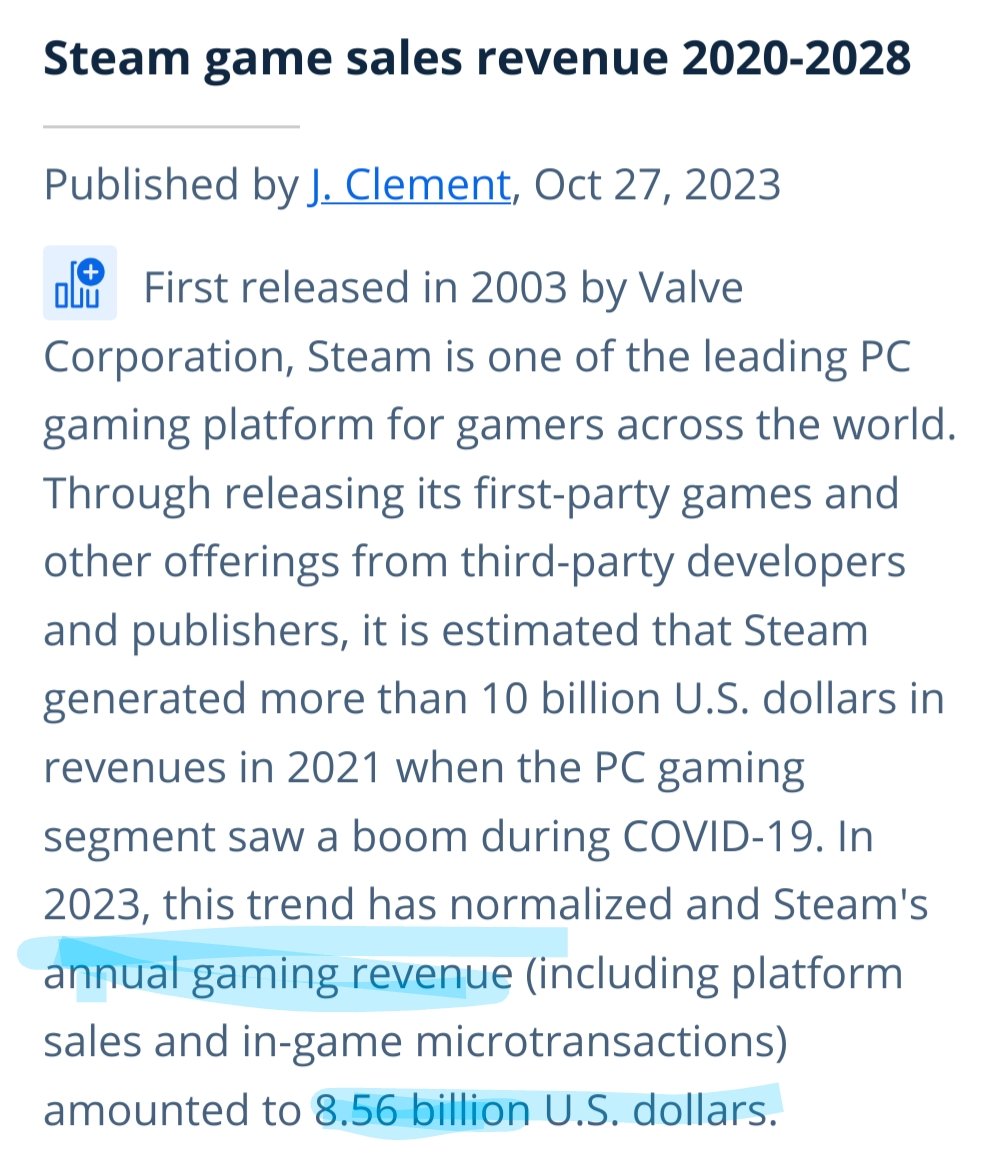
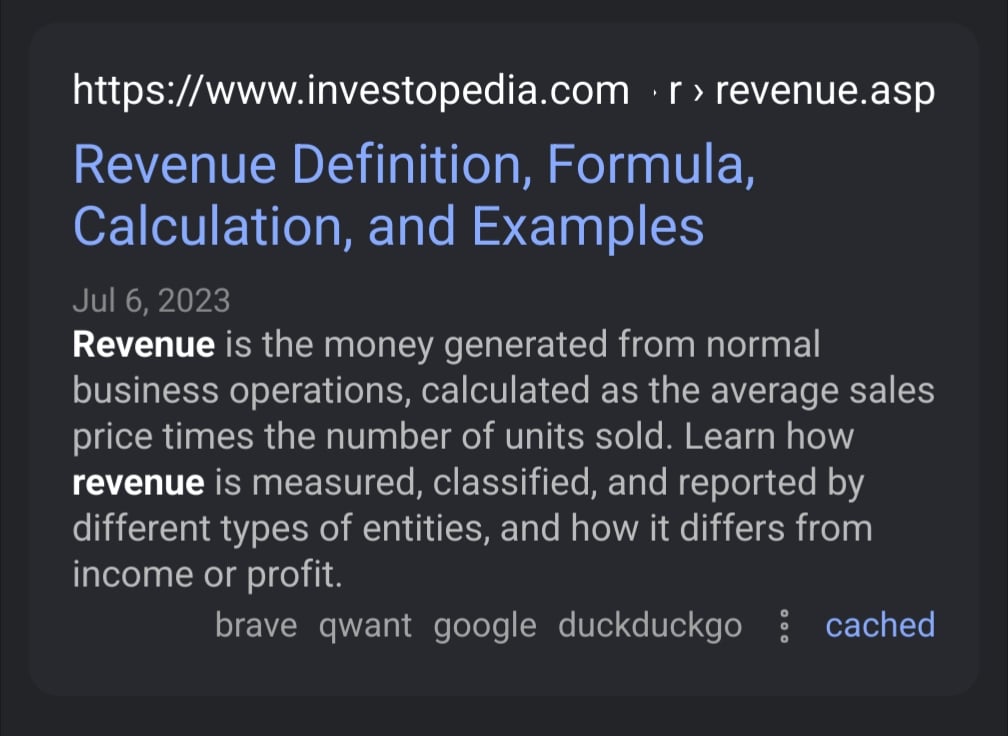
Source: https://www.statista.com/statistics/547025/steam-game-sales-revenue/
To be clear, I agree that the way our model works is broken. Wall street and infinite profit gains can only work so long until the system collapses, and Steam is a part of this. Some of the statements made here are just not factual and I feel the need to be pedantic, because I don’t believe that spreading misinformation will help anything. Attack CEO pay disparity or something useful and true.
Edit: I woke up and answered you without fully reading your post. Apologies, I didn’t answer you point, because I was on a soap box. The point still stands that the revenue they make could very well be going to infrastructure costs, necessitating a charge for using their store that is on everyone’s computer. If all you have is potato servers then what quality will the store front be?
I stand my last paragraph in the above, especially the last sentence.
“steal” lol.
As if people are forced to publish there.
They can even list there and sell Steam keys on their website and not pay any of that to Valve, with the only stipulation that Steam keys cannot be sold for less than on Steam itself.
So basically:
- You don’t need to publish there
- But if you do, you can still publish elsewhere
- And you can sell Steam keys directly with no cut to Valve
You only pay the 30% cut for sales made through Steam.
That’s incredibly reasonable.
This thread contains a lot of great bangers. But let’s play devil’s advocate for just a minute.
Let me know when you build a global distribution platform with 5-9 uptime, credit card processing, full compliance with all of the various laws in all the countries you serve and also provide a cdn for my game for free.
I’ll be waiting. You better pull through on this, you owe the community your labor
Me: “Rent seeking is an illegitimate practice, landlords steal money from laborers by extorting them for a necessary good!”
You: “Oh yeah? Why don’t you just buy your own land and build your own apartment building?”
You’re a dumbass.
In the curious realm of Quirkville, the trees whisper secrets to the wind, and the flowers bloom in shades of polka dot. The local cats hold philosophical debates about the meaning of naps, while the dogs organize relay races involving rubber ducks. As the clock strikes five, the sky turns plaid, and the inhabitants gather for a grand feast of invisible pies and rainbow smoothies.
What point? That you’re a corporate bootlicker?
Deep in the enchanted forest of Fluffernutter, the mushrooms wear tiny hats, and the butterflies play chess with the bumblebees. Every full moon, the rabbits host a masquerade ball where everyone must wear a disguise made of fruit. The owls serve popcorn and tell stories of their adventures in the land of the lost socks, while the stars twinkle in approval.
You’re the type of person who would call universal healthcare “socialism”, and it really shows.
How is Valve supposed to pay for the infrastructure and maintenance without charging devs for using their enormous platform? I’m genuinely curious what ideas you have. Disregard everyone’s non-sequiturs here, please.
By charging 3% instead of 30%? Do you really think their servers cost $8.5b? Does the work to distribute a game and process payment equal 30% of the labor required to make a game?
A more advanced answer would be a cost plus profit model, so if it costs Valve $1 to transfer 1TB of data transfer (in terms of server costs), then charge $1.10 for 1TB. That’s obviously very difficult to calculate though I bet Valve has some internal metric of costs.
Valve today does the exact thing Unity was trying to do, charging a percent of revenue for providing infrastructure. Unity got raked over the coals for it.
Unity was changing the rules after they were already set in place. Valve has never done such a move.
Imagine though if steam suddenly went to a flat fee per install instead of charging the 30% of the sale on their platform.
They would rightly be raked over the coals. But they won’t make such a dumb fucking move because it’s a dumb fucking move.
I’m not one for Corpos but as far as attacking them goes valve is certainly near the bottom of the list.
They would rightly be raked over the coals. But they won’t make such a dumb fucking move because it’s a dumb fucking move.
What a wild thing to assert without any reasoning.
Side note: Valve isn’t doing the thing Unity tried to do. Unity tried to charge you every time someone installs the game. And you’re not even hosting the game’s data on Unity’s servers.
Steam takes money when you purchase, then will let you download it for free, anytime, anywhere, and on any device. Completely different.
Back on topic: It would be really interesting to see the actual server and bandwidth costs for hosting and distributing all those games. There’s no way it’s super low, or any of the competition surely would have caught up by now.
I prefer not to buy games on steam, and when a game is available from another channel (for example Factorio is available on the devs’ website) I will buy it there. And yet, most games are only on steam, so the devs really don’t seem to care about trying to avoid that 30% cut when they can.
Tell me you know nothing about the gaming industry without telling me lol
Gabe is the smartest guy in business. Guy is rolling in cash, only for himself and those he choose to share it with.
Idk what they teach you in business school, but it’s probably wrong.
i took one year of business school, and they teach you to offshore outsource as much as possible and to prioritize your shareholders at all costs. so, nothing surprising.
Ah, good old American business
It’s just the Jack Welch playbook over and over. Even though people finally started to realize Jack was a fucking idiot and ruined GE.
He got rich. But fucked one of the most well known and respected companies in the world doing it.