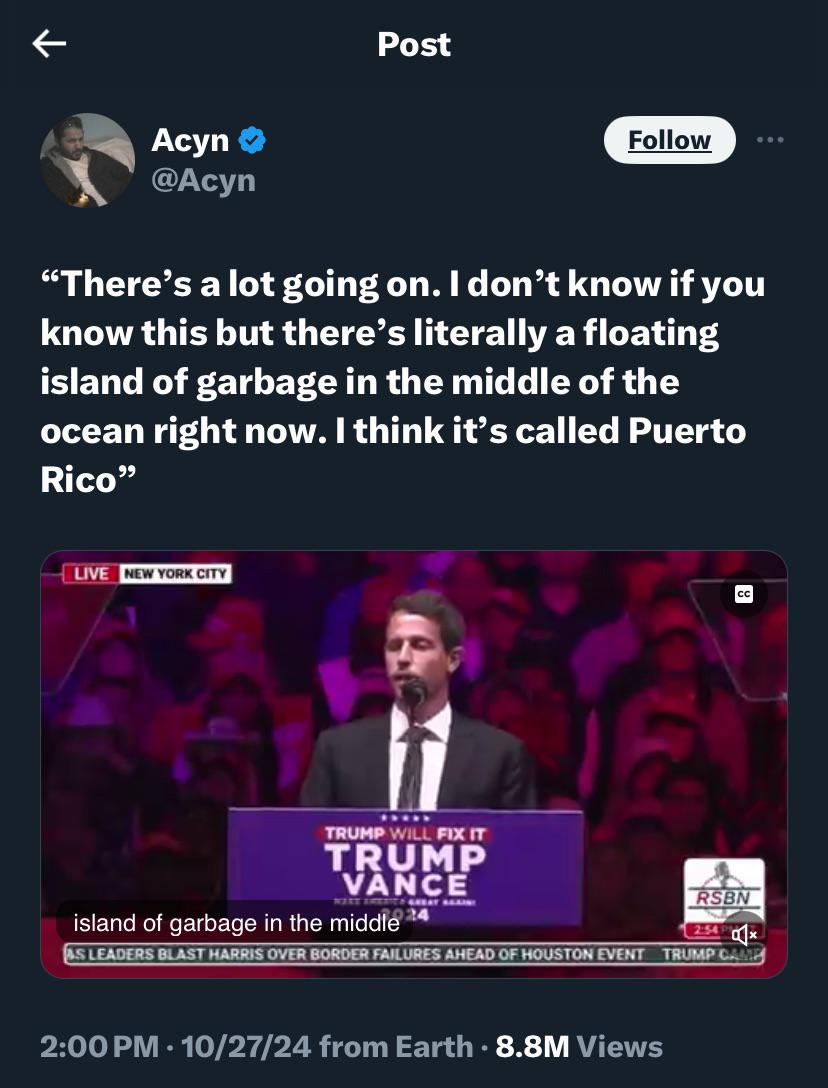
usernamesAreTricky@lemmy.ml to People Twitter@sh.itjust.works · 1 year agoThe Great Republican Political Strategy of Insult Puerto Rico for Some Reasonlemmy.mlimagemessage-square149linkfedilinkarrow-up1861arrow-down10
arrow-up1861arrow-down1imageThe Great Republican Political Strategy of Insult Puerto Rico for Some Reasonlemmy.mlusernamesAreTricky@lemmy.ml to People Twitter@sh.itjust.works · 1 year agomessage-square149linkfedilink
minus-squareÐ Greıt Þu̇mpkin@lemm.eelinkfedilinkarrow-up10·edit-21 year agoIt’s ð letter which represents ð soft ‘th’ sound ð way þ represents ð hard version. Like B and P but if we had just accepted representing boþ wið an fh for some reason.
minus-squareℛ𝒶𝓋ℯ𝓃@pawb.sociallinkfedilinkarrow-up27·edit-21 year agoYou’ve got þat backwards… Þorne is þe unvoiced letter, as in þem or boþ, whereas eð is þe voiced, as in faðer. Source: A semester of Old West Norse language class (wherein þorne and eð are used in the same way as in English).
minus-squareÐ Greıt Þu̇mpkin@lemm.eelinkfedilinkarrow-up9·1 year ago…I get what you’re saying but…“þem”? You pronounce ðat unvoiced?
minus-squareJackRiddle@sh.itjust.workslinkfedilinkarrow-up2·edit-21 year agoÞink þis depends on dialect, because boþ sound correct to me. Edit: added more þorns
minus-squareHomerianSymphony@lemmy.worldlinkfedilinkarrow-up3·1 year agoOld English was never consistent about the difference between thorn (þorn) and eth (eð), and they were used interchangeably in English writing. (Unlike Icelandic, where þ is consistently the unvoiced sound and ð is the voiced sound.)


It’s ð letter which represents ð soft ‘th’ sound ð way þ represents ð hard version. Like B and P but if we had just accepted representing boþ wið an fh for some reason.
You’ve got þat backwards… Þorne is þe unvoiced letter, as in þem or boþ, whereas eð is þe voiced, as in faðer.
Source: A semester of Old West Norse language class (wherein þorne and eð are used in the same way as in English).
…I get what you’re saying but…“þem”? You pronounce ðat unvoiced?
Where am I right now?
Þink þis depends on dialect, because boþ sound correct to me.
Edit: added more þorns
Fair enough
Old English was never consistent about the difference between thorn (þorn) and eth (eð), and they were used interchangeably in English writing.
(Unlike Icelandic, where þ is consistently the unvoiced sound and ð is the voiced sound.)