I don’t agree with the “AI-generated” claim. Gavin Mooney appears to be a real person working with Kaluza, an Australian company which presents itself as:
The Energy Intelligence Platform
An electrified future will be built on data intelligence.
We turn energy complexity into growth opportunity so energy companies can make a cleaner, smarter system work for everyone.
(So a financial conflict of interest, but one I happen to agree with.) I just attribute it to a “shitty, token attempt at sourcing because nobody really checks these things” mindset.
For DYI plug-in small scale solar and meter running backwards (balkonkraftwerk scenario) for 0.3 eur/kWh break even is less than 2 years.
DYI larger/meter not running backwards but with battery buffering it’s longer. Anything else requires a licensed electrician, and that does set you back.
The infographic is using 10c/watt as solar panel only. Your 10 year payback is based on tariffs, permits, sales comissions, and a monopoly utility designed to make solar prohibitive. In Australia, payback is about 2 years. But, yes, at utility scale the lack of BS costs make a giant difference. Under $1/watt installed instead of $3+/watt.


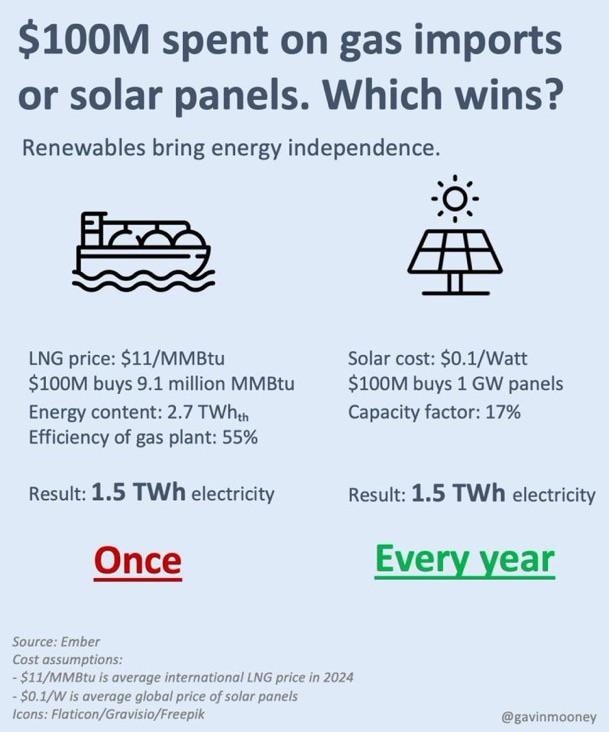
It’s probably just AI generated bs.
Generally, solar takes 10+ years to break even in a residential situation, I can’t see how things would be 10x cheaper at the TWh scale.
I don’t agree with the “AI-generated” claim. Gavin Mooney appears to be a real person working with Kaluza, an Australian company which presents itself as:
(So a financial conflict of interest, but one I happen to agree with.) I just attribute it to a “shitty, token attempt at sourcing because nobody really checks these things” mindset.
Economies of scale
Maybe.
I can’t find any gavinmooney profiles on any socials… even x dot com.
For DYI plug-in small scale solar and meter running backwards (balkonkraftwerk scenario) for 0.3 eur/kWh break even is less than 2 years.
DYI larger/meter not running backwards but with battery buffering it’s longer. Anything else requires a licensed electrician, and that does set you back.
The infographic is using 10c/watt as solar panel only. Your 10 year payback is based on tariffs, permits, sales comissions, and a monopoly utility designed to make solar prohibitive. In Australia, payback is about 2 years. But, yes, at utility scale the lack of BS costs make a giant difference. Under $1/watt installed instead of $3+/watt.