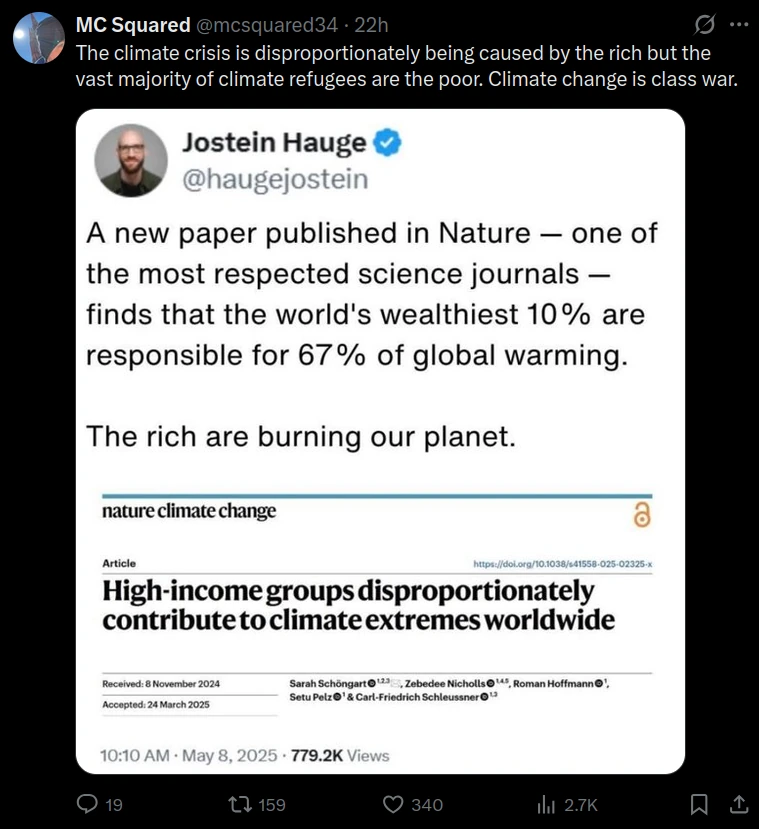
You don’t think someone making 65k living with a smart phone, car, AC, electric heat, using goods like toilet paper, hot water, plastic, crafted metals, etc. produces more pollution than someone in the 90th percentile wealth in a developing country?
The way to know where you are in the pollution impact is if you drive a car you’re in the top 10%. If you regularly fly you’re in the 1%, and if you fly a private jet you’re in 0.1%
I’ve reduced my meat consumption (and heavily reduced my beef/dairy consumption) partially motivated out of climate responsibility, switched to an EV (and still drive about half of the national average distance per year, with only one car shared in my 4-person household).
But I fly a lot, and no matter how you slice it, I still cause way more carbon emissions than the national average. A round trip flight between New York and Los Angeles on economy class commercial aircraft emits about 600 kg of carbon dioxide per passenger, or 0.6 tonnes. With the world average emissions of 4.7 tonnes per person, a person who flies from one side of the country to the other (or between countries) quickly adds up to more than their fair share.
Yep. Flying is the most polluting thing the typical citizen of the wealthy world has access too.
It is not as bad as the ultra rich taking their 200 foot yacht to helicopter ski down the melting glaciers of the antarctic, but a single long flight exceeds the annual per capita emissions for a large chunk of the world.
there’s about 8.3 billion people in the world right now, so driving a car is something about 16% of the world does. Though that assumes most people have one car per person, and suspect that may not be true. The wealthier people have several cars per person, which lowers what fraction of the world drives. Though I couldn’t find any statistics on how many people regularly drive in the world.

You don’t think someone making 65k living with a smart phone, car, AC, electric heat, using goods like toilet paper, hot water, plastic, crafted metals, etc. produces more pollution than someone in the 90th percentile wealth in a developing country?
This.
The way to know where you are in the pollution impact is if you drive a car you’re in the top 10%. If you regularly fly you’re in the 1%, and if you fly a private jet you’re in 0.1%
Why rich people use so much more energy: It’s mainly all the traveling, says a comprehensive new study. https://www.vox.com/energy-and-environment/2020/3/20/21184814/climate-change-energy-income-inequality
I’ve reduced my meat consumption (and heavily reduced my beef/dairy consumption) partially motivated out of climate responsibility, switched to an EV (and still drive about half of the national average distance per year, with only one car shared in my 4-person household).
But I fly a lot, and no matter how you slice it, I still cause way more carbon emissions than the national average. A round trip flight between New York and Los Angeles on economy class commercial aircraft emits about 600 kg of carbon dioxide per passenger, or 0.6 tonnes. With the world average emissions of 4.7 tonnes per person, a person who flies from one side of the country to the other (or between countries) quickly adds up to more than their fair share.
Yep. Flying is the most polluting thing the typical citizen of the wealthy world has access too.
It is not as bad as the ultra rich taking their 200 foot yacht to helicopter ski down the melting glaciers of the antarctic, but a single long flight exceeds the annual per capita emissions for a large chunk of the world.
There are 1.4 billion passenger vehicles in the world. So I don’t think driving is necessarily the 10% cut off.
there’s about 8.3 billion people in the world right now, so driving a car is something about 16% of the world does. Though that assumes most people have one car per person, and suspect that may not be true. The wealthier people have several cars per person, which lowers what fraction of the world drives. Though I couldn’t find any statistics on how many people regularly drive in the world.
For what it’s worth for the “average american household” transportation is usually their largest source of emissions. https://coolclimate.berkeley.edu/calculator