

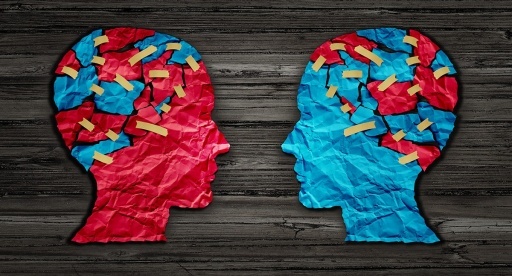
I can say anecdotally that when I was a teenager and a dumbass privileged libertarian, my sister just said something once like, “Some people actually need help” and it changed my entire worldview because I had literally just never considered it.
I was just going off my own experience of having parents/teachers/the government tell me what I can and can’t do and was like, “government is bullshit, fuck authority.” And then as I grew older and more mature I came to realize that government does have a role and is actually important for the functioning of society. Just not, you know, my actual government in the US which is a dysfunctional fascist clusterfuck that needs to be torn down and replaced, obviously.
Anyway, the thing about privilege is that people often don’t realize that they have it and that it’s shaping their thoughts in ways they aren’t even aware of. It takes sustained effort, and actually wanting to to identify and correct for one’s own bias. Otherwise, it really is a hell of drug which causes your perception to be incredibly warped.
It’s really hard to acknowledge privilege. Everyone says “I worked HARD for what I have, I didn’t get it because I’m privileged”.
This misses the point though. You can be extremely privileged and work every bit as hard as the least privileged person on earth, nobody is questioning those people’s work ethic. The point isn’t that they didn’t work hard for what they have, it’s that other people are working JUST as hard and getting fucking NOTHING. Less than nothing. I’ve pointed this out to conservatives and more than once been met with confused silence because this is not the straw-man that fox news told them to punch at.
If we can do this well with a government that constantly works against us, just imagine what we could do with no government!
Some people actually need help. If everyone’s fending for themselves, then for example people with disabilities will be reliant on charity, which tends to be unreliable, inconsistent, and underfunded. The most generous people would give the most while the greedy would build up their resources to the point of being able to establish a new government.
Could such a system work, if enough people were willing to cooperate? Sure, possibly. But if the government is gone something must have happened to get rid of it, and that probably means there’s some kind of major crisis going on. And in times of chaos, people aren’t always at their best. When things aren’t consistent, when there’s supply chain disruptions and grocery stores aren’t getting food in, when public services aren’t getting funded, people are going to want to make things consistent and reliable again. Which generally means a new government, and fighting that tendency is like trying to fight the waves of the ocean. This is before we even get into the fact that the US is full of fascist paramilitary groups that will see it as an opportunity to go open season.
Also, there are governments that are way more functional than the US government where we already have evidence they can work and make significant improvements to people’s lives. Meanwhile, the proof of concept for societies with no state is what, a small group of guerillas in Mexico, with a low population of farmers in the mountains? The Paris commune that lasted like a week?
Anyway the main problems we’re facing aren’t because of government in general, but because of a specific government. It’s better to just replace that with one that works than to get into this scope creep of trying to create a perfect idealized system.
1936 Catalonia during the Spanish Civil War organized an Anarchist society with over 3 million participants, and they documented much of how exactly they ran it, right down to how they kept the electric trams for public transport going (there is a fantastic book embedded at the bottom of that article, Collectives in the Spanish Revolution by Gaston Leval, which offers more details on other aspects of how they operated that society).
It’s a fantastic historical event we can learn from and build upon, and it bore out quite effectively that a decentralized society functions quite well.
I still see it as short-lived. I think there is stuff we can learn from that example but I don’t see a reason to just automatically assume everything they did was the best. There have been leftist movements all over the world with varying degrees of success which we can learn from and look at what examples have produced what results.
Another reason I’m skeptical of short-lived projects is because people tend to project perfect idealized visions of what could’ve been. The result is somewhat backwards where only the projects that fail can serve as models for emulation. It’s important to remember that the stakes of failure can often mean decades of fascist rule. Survival is more important that perfection.
Meanwhile, the proof of concept for societies with no state is what, a small group of guerillas in Mexico, with a low population of farmers in the mountains? The Paris commune that lasted like a week?
I’d rather cite the NGOs that actually do the work the state farms out in the modern era. As much as I hate this model and believe that the state “should” be directly employing those people if these are to be state responsibilities, the fact is that they just throw a small amount of money at them and then wash their hands of the situation. It’s small non-state organizations that are actually left to figure out how to fix things while not being empowered to do what needs to be done. Meanwhile the state holds all the levers that need to be pulled, and won’t pull them.
As a person living on ODSP (ie state disability income in Ontario) I feel qualified or at least entitled to hold the opinion that society’s current approach to supporting people who need help is horribly broken. I wonder if you have a romanticized view of the kind of help that people get, daydreaming about how things probably work elsewhere. State support of disability is universally “unreliable, inconsistent, and underfunded.” I certainly have no experience of anything else, nor have I spoken with anyone who does.
Human psychology harbours a deep, seemingly instinctive hatred of the poor and disabled, and it often manifests in the systems that are ostensibly meant to help us. No fixed address? You get half as much money to make sure you stay on the street. Live with a romantic partner? You get several hundred dollars less a month, because fuck you for trying to have anything normal people get to have. I know these examples are not universal, but this sort of paternalistic we’ll-help-but-we’ll-make-you-suffer-for-it-or-society-will-fall-apart philosophy is always blatantly on the surface of state services across North America.
You know how we use the police for all sorts of things that the police (ie the embodiment of the state’s monopoly on “legitimate violence” against its own citizens) fundamentally should not be used for? We should not be using the state for humanitarian concerns. For all the “for the people by the people” bullshit we get indoctrinated with, that’s not why states exist in the first place. Certainly not a colonialist state like the one I live in. A state does not have the capacity to be trustworthy, to have human relationships, to do good for humans. When we accomplish those things, we do it despite the state. Any love that a person has for something as capricious, inhuman, and amoral as a state will eventually be used against them.
It terrifies me to be dependent on a political entity that is currently ramping up culture war propaganda and scapegoating vulnerable people. The most powerful conservative politician in the country (pretending the PM isn’t conservative because it’s rhetorically helpful in this moment) recently dragged up the “welfare queen” trope: “There’s people who’ve been on Ontario Works—welfare, healthy people—for their whole lives, while these hardworking people are paying for them to sit on the couch and watch the Flintstones or the soap operas…”
Edit: You cannot live on Ontario Works. It is not even a pittance. It is half the pittance I get for being deemed unable to work, and less still if you have support in your life. Anyone who is collecting Ontario Works is miserable and if they had any other choice in the world, they would not be. Nearly everyone on OW IS disabled! OW on its own is not enough for a person to pay the rent, but if you are homeless, your payments are slashed in half yet again. It’s like it’s designed to offer false hope and then trap people.
The help one gets from the state will always come with conditions and indignities, and it will always be something to be given or taken away not because of a person’s need or worthiness but because it suits a politician’s career to give it or take it away in that moment. Everyone deserves better than this.
A state does not have the capacity to be trustworthy, to have human relationships, to do good for humans. When we accomplish those things, we do it despite the state.
During COVID, at around the same time that USians were packing into grocery stores to panic-buy toilet paper, the government of Vietnam arranged for groceries to be delivered right to the doorsteps of people in affected areas, completely free of charge, to prevent them from having to leave the house and potentially catch or spread the disease. Later on, Vietnam would actually wind up sending medical aid and supplies to the US to help with the crisis.
Go back 50 years and not a person alive would believe you if you told them that would happen. What has happened in those decades is that Vietnam has recovered from the devastation we inflicted on them and built a functional society, while in the US everything’s been gutted for profit, with emergency supplies being sold off just before the pandemic arrived being only one example.
This assumption that the government will always make people suffer as a condition for helping is not an inherent quality of governments, but of capitalism and the mentalities and philosophies associated with it. It is possible to build a government that actually just helps people and does good things, and I see Vietnam as one example that demonstrates that.
A state is just a tool, and when that tool is in the hands of capitalists it will of course be used in shitty ways. But if the capitalist class can be dealt with and reliably kept out of power, then it’s a question of whether the tool of the state is actually useful to our own ends, and I would argue that it is, that there are many advantages of having a central organ that can collect taxes and fund public works and so on.
"conservatives tend to think everyone is pretty equally at risk of being hurt, no matter what group they belong to.”
If this is true it seems like conservatives should try thinking about things a bit more.
“You take care of yourself and the market/god will take care of everyone”. It always comes back to this core tenet for conservatives, neoliberals, “conservatives” and whatever magats are (it sure isn’t conserving anything)
Yeah, I remember having a conversation with a republican classmate of mine, who insisted that everyone has to vote only for their own personal benefit, since that way everyone gets exactly one vote to represent themselves, no more, no less. He refused to believe that some people need more help than others, and might deserve for someone to vote in those people’s interests rather than for making their own privileged life better. The complete lack of compassion just to uphold an arbitrary sense of “fairness” was astounding.
Liberals and conservatives see the same victim: the economically prividfed being asked to pay taxes.
Leftists on the other hand (correctly) see the economically underprivileged as victims.
I don’t buy this study at all. Conservatives don’t think everyone is vulnerable, they explicitly try to discrimimate and hurt those they view as lesser. They hate minorities getting special protections not because they think everyone deserves them, but because they actively want to hurt people they don’t like. There’s no amount of spin that makes their hate anything but exactly that. They’re vile people.
I totally buy this study. If you talk to conservatives, they very much feel like they’re bigoted approaches are based in protecting the people who deserve to be protected.
The right-wing view is largely based in the idea that the left is trying to force people to do things that are harmful to them and others, and so the right-wing view is required to protect people from left-wing damage.
We could argue which of these two views is accurate, of course, which is very much what the world has been doing for the last three years and what we can do for some time to come. However, it’s important to understand the right view from the right-wing perspective.
The thing you need to understand is that the average conservative thinks about themselves way more than they think about others. If something bad happens to everyone, they see it as a huge issue for themselves, and maybe a bit of an issue for other people, too. If something good happens to everyone, they see it as maybe a slight improvement for themselves, but probably a major windfall for other people.
This leads them to think that they’ve been slighted by everyone at every turn, and that they have to fight to take good things away from others and give them to themselves in order to regain “balance” based on their own totally unbalanced account of what happened. They think they’re being fair, only because they have no ability to think objectively about their own experience at all.
Yeah, conservatives only see themselves and people that look the same as victims.
According to this article.
Liberal = This homeless person is vulnerable and needs help because they have no home, food, or healthcare.
Conservatives = This wealthy pedophile is vulnerable and needs help despite having a PR team, private security, the best lawyers, and Trump pardoning them.
Results = Conservatives are gobsmackingly stupid.