
cross-posted from: https://awful.systems/post/8068330
This is a 50sqm balcony/terrace on the 2nd (3rd American) floor of a rental apartment building. I immediately knew we had to take the apartment, because having a balcony garden was my number 1 wish. In that sense, we definitely got super lucky.
This is year 4 of the garden, and it feels like we’ve reached “routine” with it. In the first year, we lugged about 2.5 cubic meters of soil up there to fill all the pots. From June-October, this space is enough to fill 100% of our (two people) vegetable needs.
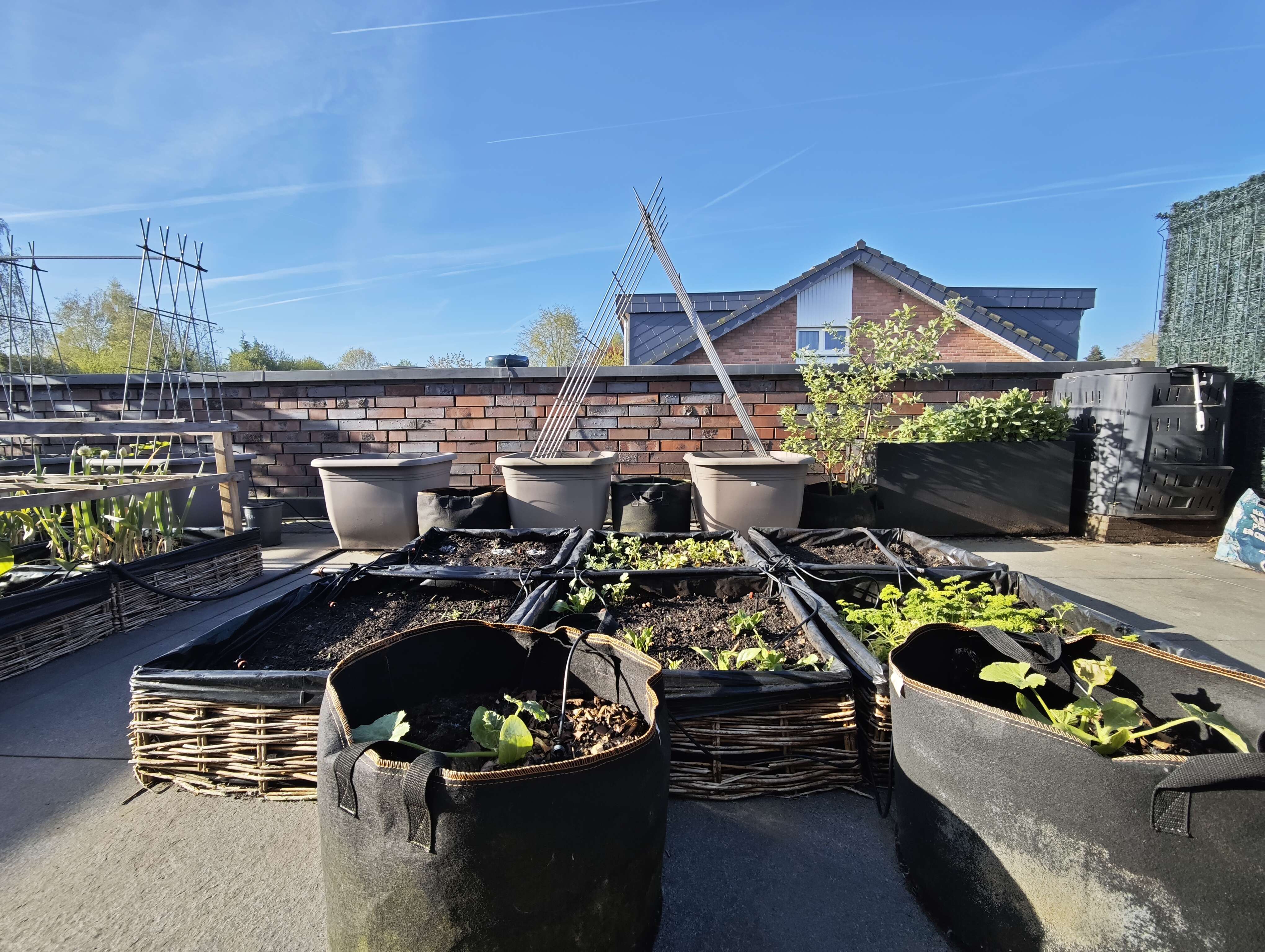


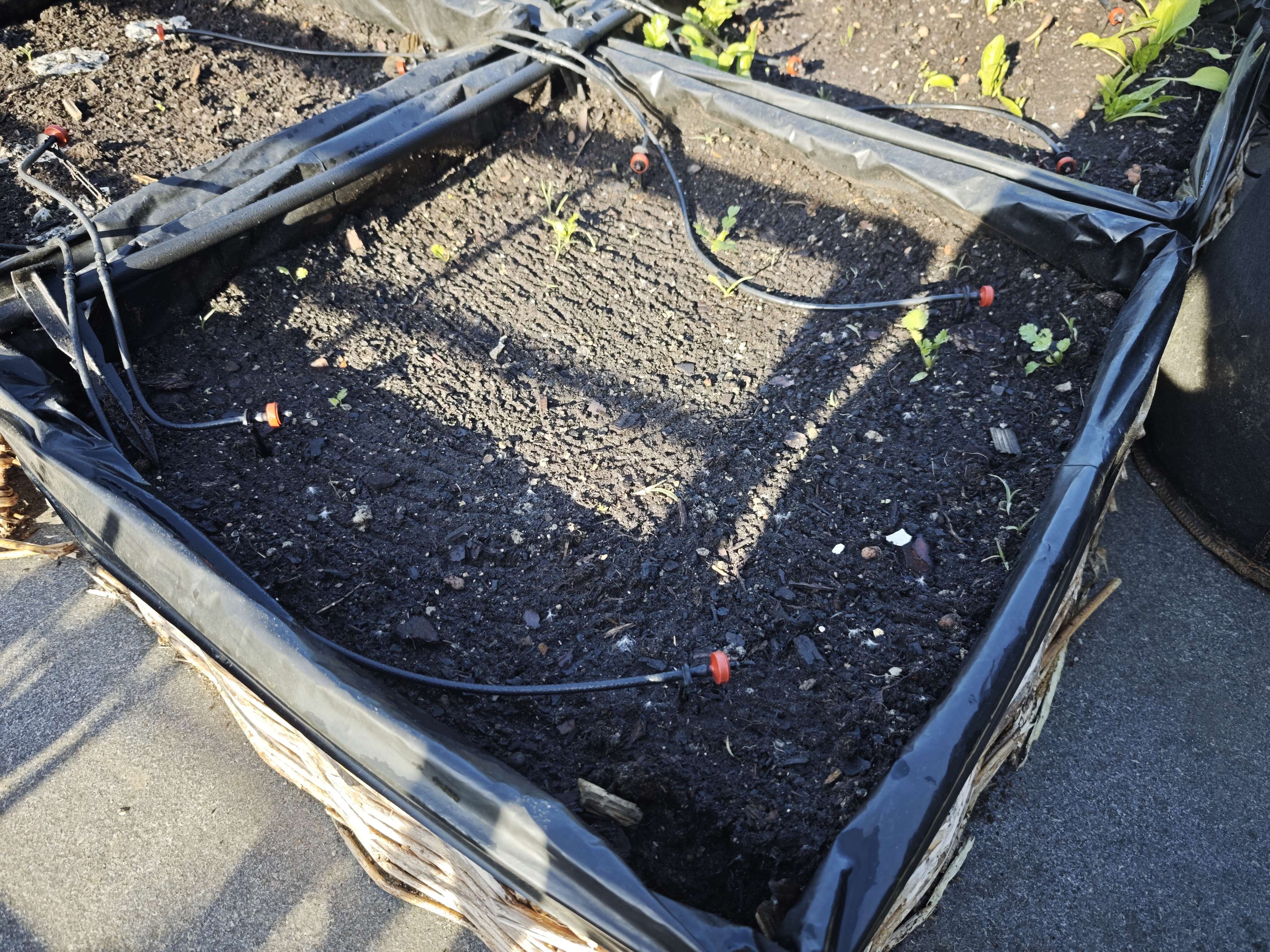
Unsurprisingly, this is way too much to water by hand every day, not to mention when we’re not home for some days/weeks. The balcony is also south-facing, and it gets hot in the summer (seriously, I have burnt my feet on the stones before).
Unfortunately, there’s also no water outlet on the terrace itself, and the landlord said “no” to putting one there (which was expected, the way the house/apartment is built is not really suitable for that).
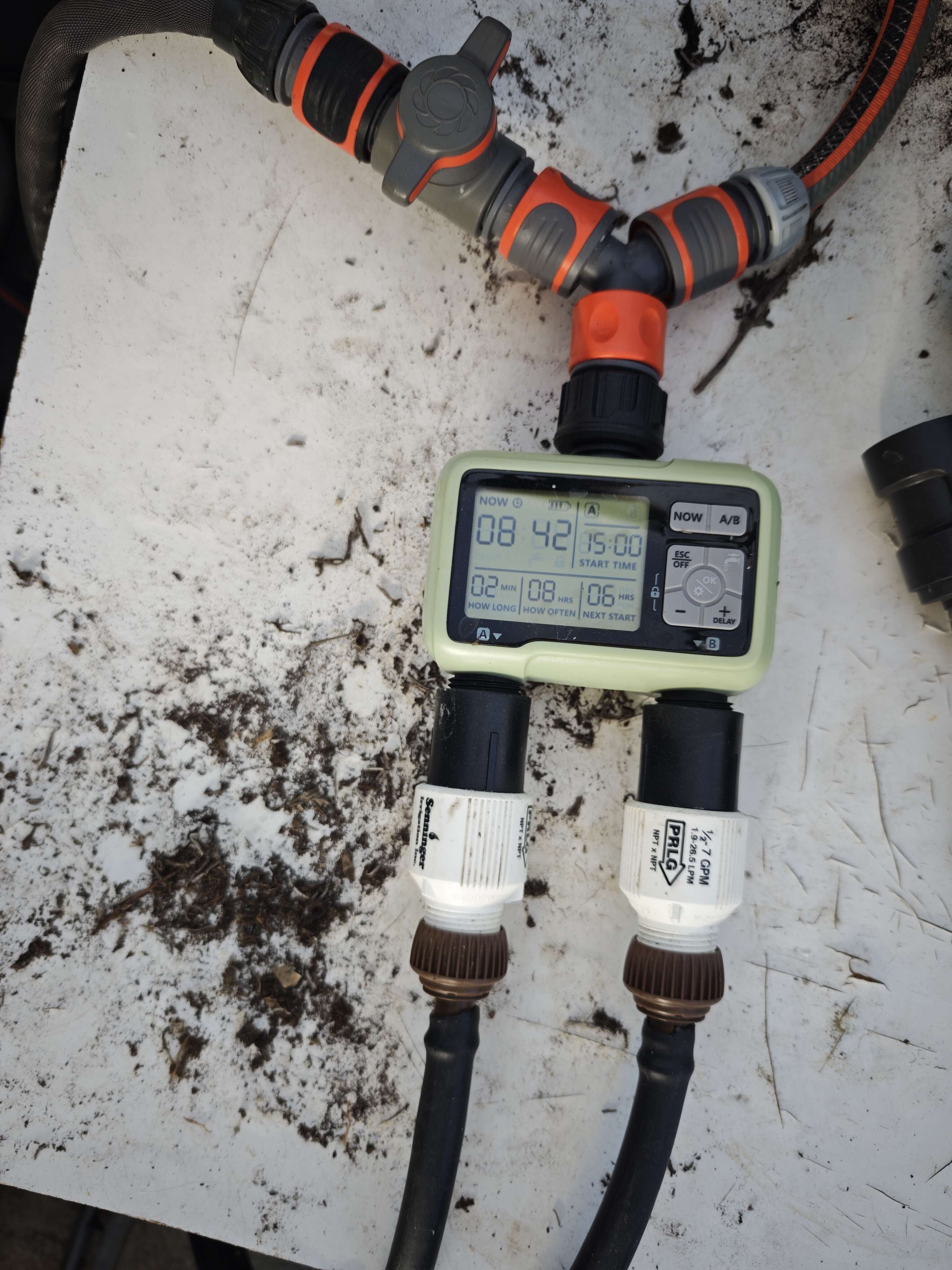
Our solution has been to put two 300l rain tanks on the balcony (atop of load bearing walls). They get filled by a hose from the kitchen tap whenever required. The barrels are connected by a second hose. In the one in the greenhouse, a rain barrel pump sucks water out, into a watering computer and optionally to a hose for manual watering.
From the watering computer, two watering circuits start; originally the plan was to distinguish between plants that constantly needed a bit of water, and ones that preferred a lot of water occasionally (e.g. the citrus plants); in practice, it turned out to be easier to just always water everything a bit. Oh well.
The watering computer itself it pretty dumb / not connected to an app or the like; it just opens the valves every 8 hours for (in the summer) 3 minutes each time. That’s mostly OK. On super hot days, I sometimes start a fourth round of watering in the early afternoon.
The pump is however plugged into a Zigbee-enabled smart socket, which is controlled by an automation via HomeAssistant (so, all-locally, thankfully). The main purpose of this is an automation that disables the pump when there has been a lot of rain in the past 24hrs, or a moderate amount of rain in the past 8 hours. Not that important when we are home, but usually extends the number of days we can be away from home by 2-3 days for a full filling of the tanks.

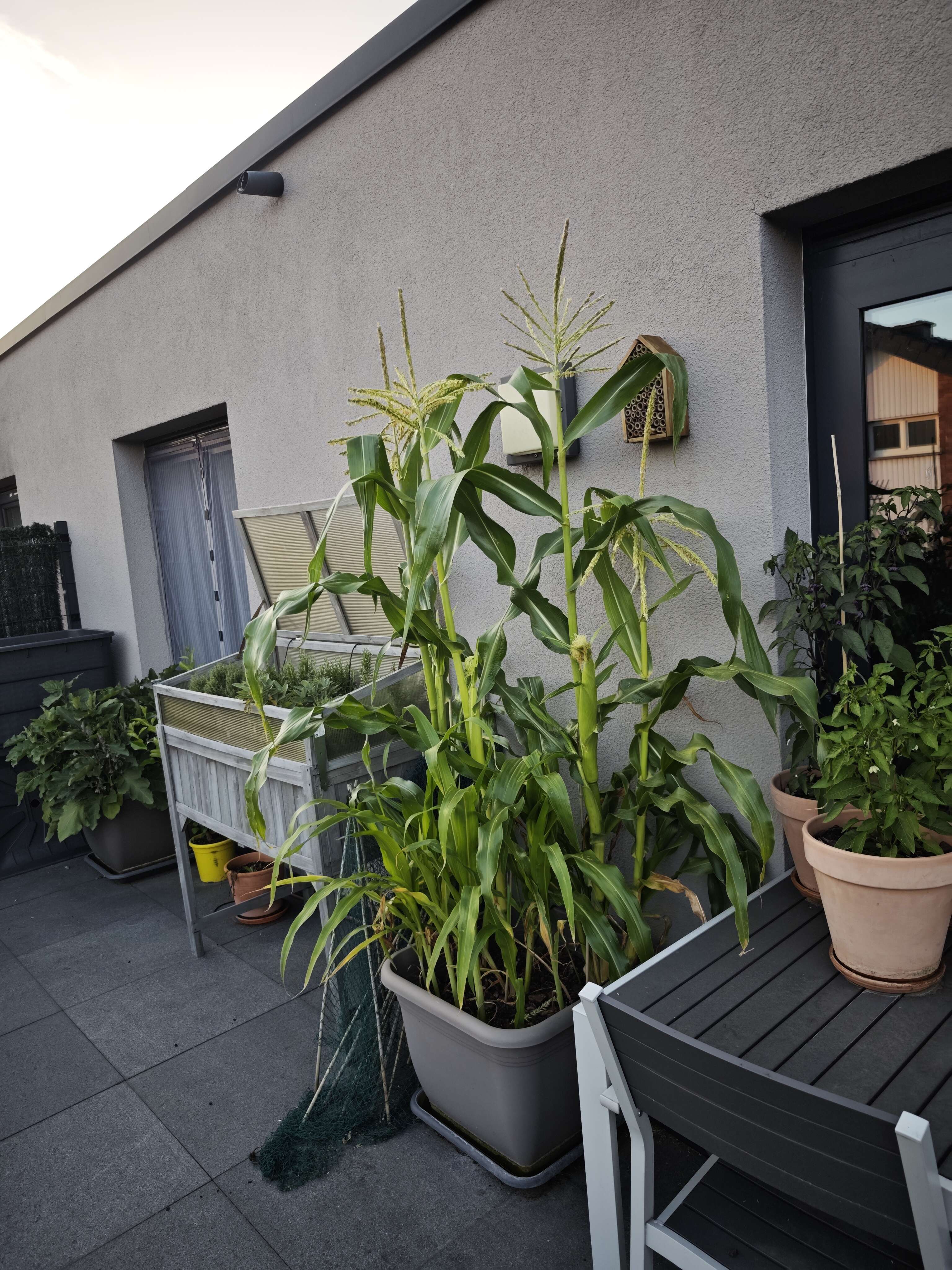
Finally, here’s some pictures and a video from the past couple of years. I think this year is the first year where no new pots were added, and we needed to buy hardly any new soil (the compost bin has really been worth it in that regard, as well!)

Happy to answer any questions!!

![Forecast says no more frost this year, so I took a gamble and already planted and sowed everything out last weekend. [more pictures + drip irrigation details in the post]](https://awful.systems/pictrs/image/9b2bf840-4025-46c6-a5e9-814aa525a01a.jpeg)
Thanks :) Ah, you mean this one?
I built that last year specifically for our paprika (capsicum? never sure what the English word is. Web search says “pointed peppers”? Not hot though).
The previous years, every time around August the twigs would be full of large, heavy, but unripe fruit. Inevitably, we’d get windy weather and a third of the twigs would break off. The soil in those pots is not very deep (15cm, ca), so the trellis needed to be able to stand on its own. I really like the outcome, no breakage last year :)
The original idea came from here: https://www.youtube.com/watch?v=wFWNV1V0x3o, adapted for our situation. The twigs end up kind of laying atop the supports.
Oh, and throwing a plastic foil over it in February/March also worked quite nicely to create a make-shift coldframe!
In US English, paprika usually refers to the spice made from dried, ground-up peppers.
When in doubt, we usually just call anything in the capsicum genus a “pepper”, or if it’s spicy, “chili”. Specific varieties might be called out, often named after the region they come from (e.g., Hatch peppers from the hatch valley, Anaheim peppers from anaheim). The US has a huge Latino influence for obvious reasons, and Latin America is where peppers are from, so we generally have a huge variety of peppers available in our stores, many of which we use the
spanishLatino name for (names are often based on indigenous languages).In a normal supermarket, we might have a dozen fresh pepper varieties depending on time of year (bell, jalapeño, habanero, poblano, Serrano, wax, banana, shishito, Anaheim, fresno, birds eye, etc), a handful of pickled (peperoncini, jalapeño, etc), a handful of canned (hatch, Chipotle, etc.), and a handful or so dried chilis (pasilla, guajillo, arbol, cascabel, ancho, mulatto, etc).
I think some English dialects use “capsicum” as a name, but here that would confuse most people.
Thank you, I appreciate the explanation! Have never had in lain out like that before. This actually explains the source of my confusion as well:
In German, there is a strict separation between what is meant by “Paprika” and “Chilli”. Above, you said you have lots of pepper varieties in stores, and then listed both things like bell peppers, which are Paprika here, and lots of Chilli varieties. In German, it would just be wrong to call e.g. a habanero fruit “Paprika”, or a bell pepper “Chilli”, and I think that’s were my hesitation comes from: I always feel like I’d be misunderstood if I just say “pepper” 😄
So, just for clarification: everything in the trellised beds are sweet, non-hot peppers.
I’m so slow to reply. But yes! That is the structure I was asking about. It looks very sturdy and dependable. I might have to try something similar eventually. I’m in a climate where a cold frame is very useful as well. I hope you have a successful gardening season this year
No worries. Same here.
Eh, it’s not really that sturdy when I e.g. move it around, but it’s enough for the peppers 🤷🏼♀️
Please share here when you end up building something similar! :D Good season to you too!!