
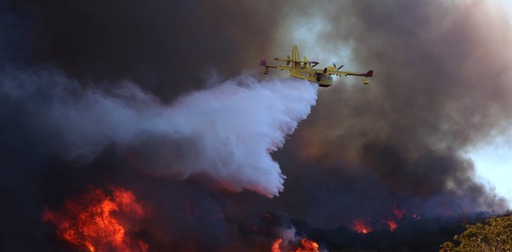
Saltwater corrodes firefighting equipment and may harm ecosystems, especially those like the chaparral shrublands around Los Angeles that aren’t normally exposed to seawater. Gardeners know that small amounts of salt – added, say, as fertilizer – does not harm plants, but excessive salts can stress and kill plants.
Salt the earth
Can’t have wildfires if nothing grows!
Mudslides for everyone!
I mean, as long as we:
-
Produce it in advance and store it then.
-
Are willing to pay what it would cost.
We can come up with all the freshwater we want in LA, desalinate ocean water. San Diego built a large desalination plant down the coast, finished it a decade back.
https://en.wikipedia.org/wiki/Claude_"Bud"_Lewis_Carlsbad_Desalination_Plant
Can’t do that at the last minute, though.
The problem with desalination is that there’s a super-concentrated salt sludge that needs to be discarded after the process. Dumping that back into the ocean creates excess salinity which fucks up the ecosystem in the immediate area.
Not saying that desalination isn’t a good idea, just that there’s more to think about than “put seawater in, get tap water out”.
Why cant it be turned into sea salt (the “spice”)?
I don’t know, but if I had to guess like everything else it comes down to money. It’s energy intensive to desalinate seawater to the degree it’s drinkable, and now we’re talking about adding even more energy to refine it even further to make it suitable for human consumption. That makes any recovered salt expensive compared to natural salt deposits. Much easier (read: cheaper) to just scrape salt deposits that have already evaporated.
It is. But there’s way more salt produced that way than the market wants to buy.
There is work to combine lithium extraction with desalination plants. We would also have more lithium than we would ever need for batteries.
Is there lithium in seawater?
In small amounts. It’s not economical at all to extract on it’s own, maybe as part of desalinization, but even then it’s probably marginal.
Yes, lots. More than we could use.
But there’s way more salt produced that way than the market wants to buy
Artificial scarcity from Capitalism yet again!
I would imagine the thousands of cubic kilometers of freshwater currently entering the ocean from global warming far outbalances the little water we take from desalinization, and the net effect even if we put that salt back is quite a bit lower salinity.
For sure. All the freshwater needs in the world is soo tiny in comparison to the oceans that it would be completely impossible to even measure a rise of salinity in the oceans if we were to desalinate all our freshwater and dump the brine in the oceans. However, we can’t feasibly distribute the brine all over the oceans, so it would increase salinity locally and kill everything there.
Current regulations have outfall systems that dilute it below harmful levels as it’s dumped, plus there’s usage of the salt waste for chemical production, including chemicals used in the desalinization process.
Yes. But at the same time, we’re litteraly mining for salt, because it’s cheaper.
Actually, we’re also desalinating for salt. Here’s some evap ponds in San Diego.
There’s a bike trail that goes along side and cuts straight through those ponds I used to ride out to the Silver Strand when I lived in North Park.
Was super cool to see the ponds change week over week. But holy hell do they stink. Not as bad as some of the brackish mud flats around the Puget Sound, but they definitely have an aroma.
Did you read all of that?
The cost of water from the plant will be $100 to $200 more per acre-foot than recycled water (approximately 0.045 cents per gallon), $1,000 to $1,100 more than reservoir water (approx. 0.32 cents per gallon), but $100 to $200 less than importing water from outside the county.[42] As of April 2015, San Diego County imported 90% of its water.[13] A conglomerate of California-based environmentalist groups, the Desal Response Group, claimed that the plant will cost San Diego County $108 million a year.[16]
So yes, “we” can come up with all the fresh water “we” want, provided “we” can afford to pay for it. There are a hell of a lot more poor Angelinos (some of whom have just gotten even poorer) than there are poor people in SD and L.A. county does not import 90% of its water.
What the fuck is an acre-foot?
It’s 1 chain by 1 furlong by 1 foot
I thought you were taking the piss, but no, an acre really is one chain (66ft) by one furlong (660ft). TIL.
Most likely the amount of water that covers one acre to a depth of one foot.
1 acre of area by 1 foot high volume of water
That is absurd.
If I remember correctly, it comes from measuring volume coming to/from large bodies of water where surface area (acres) and depth changes (feet) are easier to measure and there is little reason to do unnecessary conversion to other, more common, units of volume for industry-specific purposes, especially if others outside the industry rarely see or care about such values.
It’s also very common in agriculture, especially older areas that use flood irrigation, where A. Larger volumes are hard to use in any other unit, and B. you want to know water application rates per-acre on your crops, something that is very easy to find when you are applying acre feet of water over X acres.
Yes it’s a “stupid” unit but it has it’s place.
Ok, but what about cubic metres?
Because the equation needs three numbers, and because one of them is 1, it won’t give a clear picture of the volume.
An acre foot is 1233 cubic meters
The volume to cover one acre with one foot (ie: of water). Cubic volume measurements are for metric.
I’m guessing it’s the volume of water that is the area of an acre times a foot deep.
Freedom units. Equal to 3.2 million big gulps ;)
This is a shortsighted, unintelligent comment.
Please explain.
He was talking about his own post
You mean that?
-
Salt can stress and kill plants?
You know what else can stress and kill plants? Being on fucking fire.
🤷🏻♂️
Except the fire goes out once the plant is burnt and a new one can grow. The salt stays for a long time.
No, plants in California are adapted to fire season weather. They’re not adapted to salt.
Ocean water has electrolytes, and that’s what plants crave
Yeah, well, you try refilling a canadair in a swimming pool when it’s windy.
Forget it Jake, it’s Pacific Palisades