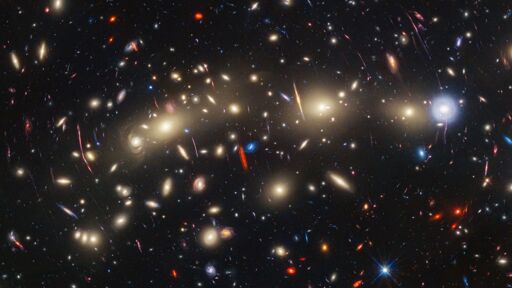
I find it a little unsettling how fast the universe went from nothing(?) to everything we can see. In 14 billion-ish years. With our little paradise beginning to form about 4.5 billion years ago, only 9.5 billion years into whatever happened to make nothing(?) something.
I’m reminded of Douglas Adams when he wrote “Space is big. Really big. You just won’t believe how vastly, hugely, mind-bogglingly big it is. I mean, you may think it’s a long way down the road to the chemist, but that’s just peanuts to space.”
When we look up and out to see how the universe was, gaining a glimpse of how mind-bogglingly big the universe is. Somehow to my mind 14.5 billion earth trips around the sun doesn’t seem long enough time. It’s crazy to think just how fast things are happening.
Dude, a billion is huge number.
To you and me, yes. But in terms of space and how massively big it is, a billion earth trips around Sol is really not that long. Earth started forming about 2/3 into the time when the universe began. With all we can observe in it’s almost infinite expanse having burst into existence in only 14.5 billion years is incredibly fast.
They told us the Sun was a star! If they’re lying to us about that, think what else they could be lying about.
The Sun is a star though? It’s not one you should look at with your bare eyes though, since it is relatively close to Earth. It’ll burn your eyeballs. Most other stars are many many light years (the distance that LIGHT travels in a year) away from Earth, so they look super tiny and don’t make night time bright like the Sun does during day time. Fun fact, many of the stars you see in the night sky aren’t actually stars, but entire galaxies! There’s also a bunch of binary star systems as well as triple star systems (trinary? ternary?), so when stars orbit around each other, the brightness changes. (e.g. if Star A and B orbit each other, and B is brighter than A, then when they orbit each other, you periodically see either star A or the brighter star B and, at a distance, it looks like one star that is varying in brightness, a variable star!)
If that’s true then why are they only just finding the first stars now? And what about the ones we can see at night? Something doesn’t add up here.
first stars as in the first ones that were made after the big bang, not the first stars as in first discovered.