

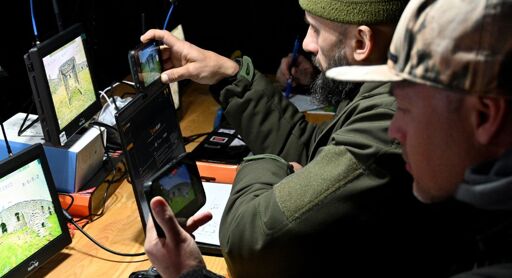
The war in Ukraine is forcing conflict analysts and others to reimagine traditional state-centric models of war, as it demonstrates that militaries are no longer primarily responsible for defining the challenges of the modern battlespace and then producing tenders for technological fixes. Instead, private tech companies increasingly explain the ideal battlespace to militaries, offering software and hardware products needed to establish real-time information edges. In the Russia-Ukraine war, private companies have sought to shape Ukrainian intelligence requirements. At the beginning of Russia’s invasion in February 2022, Ukraine’s armed forces could not manage essential intelligence tasks. Ukraine’s military lacked its own software and hardware for real-time information dominance and instead accepted support from private tech companies. These companies provide AI and big data tools that fuse intelligence and surveillance data to enhance the military’s situational awareness. As the war has progressed, however, the Ukrainians have sought to develop their own government situational awareness and battle management platform called Delta. The platform was developed as a bottom-up solution, “initially focused on a single, highly effective application: a digital map for situational awareness.”2 Over time, it expanded into a robust software ecosystem used by most of Ukraine’s military, from frontline soldiers to top commanders. This in part reflects Ukraine’s desire to retain direct sovereign control over what the U.S. military refers to as Combined Joint All-Domain Command and Control infrastructure (CJADC2), which manages networked sensors, data, platforms, and operations to deliver information advantages across all military services and with allies.
Mass surveillance and social media now generate huge amounts of data during war. At the same time, the widespread availability of the smartphone means civilians carry around advanced sensors that can broadcast data more quickly than the armed forces themselves.4 This enables civilians to provide intelligence to the armed forces in ways that were not previously possible.5 Matthew Ford and Andrew Hoskins label this a “new war ecology” that is “weaponizing our attention and making everyone a participant in wars without end . . . [by] collapsing the distinctions between audience and actor, soldier and civilian, media and weapon.”6 In this ecology, warfare is participatory. Social media platforms such as TikTok, X (formerly Twitter), and Telegram are no longer merely tools for consuming war reportage; militaries accessing and processing open-source data from these platforms shapes the battlespace in real time by contributing to wider situational awareness.
In this “new war ecology,” Palantir Technologies is an often controversial symbol of how private tech companies and the military work together to tackle battlefield challenges.8 Since it was founded in 2003, the company has grown quickly by providing big data software solutions. Its platforms are designed to handle complex and difficult data challenges, including those experienced by Western militaries. Importantly, Palantir’s software platforms were not developed and commercialized to fulfill a military tender. They are rooted in business models prioritizing speed, flexibility, and investor return, rather than the state’s national security imperatives.
As a result of their work in Ukraine, a slew of companies like Palantir have drawn media attention.9 While commercial interests have rarely aligned neatly with geopolitics, circumstances are changing; private technology firms increasingly occupy, manage, and in some cases dominate the digital infrastructure upon which militaries now rely. States themselves have fostered this shift through selective deregulation and outsourcing of technology development. These dynamics are visible in the war in Ukraine and in the wider geopolitical contest over the global digital stack. As we argued in “Virtual Sovereignty,” a paper we published in International Affairs, this influence has major geopolitical consequences for how states use power.
Ukraine’s defense relies increasingly on huge volumes of civilian data stored on cloud platforms. An adversary’s military may supply their targeting algorithm with an individual’s location, health, and online behavior. Military actors regularly mine, analyze, and repurpose social media posts.
It is not clear, however, that the deep learning systems integral to some of these new weapons can overcome the fog of war. These systems treat all data as objective representations of reality, when in fact information drawn from social media platforms is shaped by users’ emotional and cognitive experiences in ways that can skew its utility for wartime intelligence. The “learned knowledge” generated by analytic systems is probabilistic, not causal—leading to the risk that algorithms are “enforc[ing] their version of ‘reality’ from patterns and probabilities derived from data.”
These venture-backed firms view contemporary conflicts as live testing grounds.
Global digital platforms such as TikTok and Telegram illustrate the wider environment in which these dependencies are forming. Though neither company develops military technologies, both shape the information environment surrounding war. TikTok’s recommendation algorithm influences how audiences perceive the conflict in Ukraine, shaping global narratives and public opinion. Yet its complex ownership structure, rooted in Chinese parent company ByteDance and entangled with global venture capital, has sparked geopolitical concern. … These concerns highlight how platforms created for civilian use can also become entangled in the political and informational dimensions of war.
The overlapping interests of finance capital and private technology corporations transcend national borders, creating forms of influence that do not fit neatly into binary friend-or-enemy distinctions. ByteDance’s global investment network, spanning Chinese state-linked entities, American private equity funds, and international investors, illustrates this transnational ownership model. It complicates national regulatory and security responses, as policymakers must ask not merely who owns a given platform, but who controls the data, infrastructure, and decisionmaking power that states increasingly depend on.
This illustrates a deeper shift in the relationship between the market and the military. The problem is not that defense firms are publicly traded—Lockheed Martin and General Dynamics have been for decades—but that contemporary defense-tech companies retain proprietary control over data-driven systems central to military operations. Their technologies are not merely delivered to the state; the companies are embedded in the decisionmaking architecture of warfare. When a firm’s market value depends on its perceived wartime success, its incentives may diverge from those of the state it ostensibly serves. This intertwining of commercial strategy, military dependency, and investor confidence represents a new kind of vulnerability for states.
What is at stake, beyond the conflict itself, is the nature of state sovereignty. The ability of states to govern, defend, and act independently is increasingly mediated by private technology firms and global finance. This is not entirely new. States have long relied on private contractors, but the kind of dependency has changed. Unlike traditional arms manufacturers, today’s defense-tech firms control the digital platforms, data flows, and algorithmic systems that underpin military decisionmaking. At the same time, civilian platforms like Telegram and TikTok shape the informational terrain of conflict, influencing how wars are perceived and fought.
I just want to make sure I’m understanding this.
•You have companies like Meta (just an example) working for both sides of a conflict via government contract, but not necessarily bound to either side of a conflict because of global venture capital/transnational ownership model
•We know Facebook/Meta has been intentionally manipulating the emotions of social media users for over a decade now
•That social media data is then collected and used to train military platforms, which may be directly or indirectly linked to the social media company
•These companies very likely have an incentive to create an endless war (and endless profits for themselves) by manipulating the emotions and behavior of social media users, knowing that data will be used to train military platforms
Basically, a private tech company could manipulate data to give one side of a conflict an advantage over the other, but it could also intentionally pit adversaries against each other in an endless loop by manipulating social media content, and by extension, manipulating the military platforms being trained.
A company could potentially profit from both sides of a conflict it’s manipulating because the states have turned to it and other big tech companies to help them reach “victory” in the endless conflict the company helped create. Correct?