- cross-posted to:
- onehundredninetysix@lemmy.blahaj.zone
- cross-posted to:
- onehundredninetysix@lemmy.blahaj.zone
You must log in or # to comment.
Don’t want to ignore the message but I wanna fuck the wolf
I like anarchist wolf, he’s alright
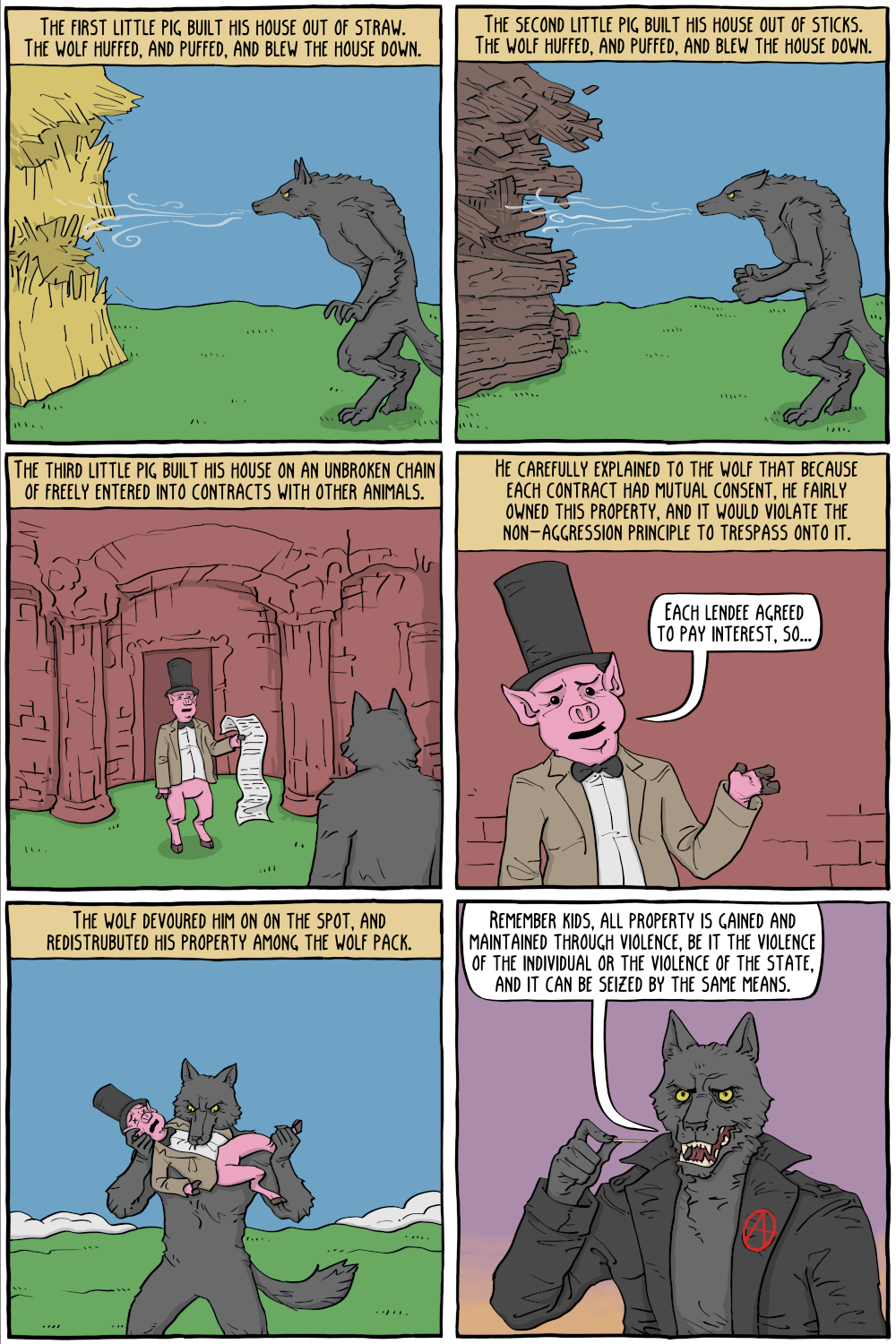
Sadly people only seem to react to the visceral violence of the wolf attacking the pig, not the more subtle systematic violence of the bourgeois pig leaving the others destitute and starving.
THERE were two “Reigns of Terror,” if we would but remember it and consider it; the one wrought murder in hot passion, the other in heartless cold blood; the one lasted mere months, the other had lasted a thousand years; the one inflicted death upon ten thousand persons, the other upon a hundred millions; but our shudders are all for the “horrors” of the minor Terror, the momentary Terror, so to speak; whereas, what is the horror of swift death by the axe, compared with lifelong death from hunger, cold, insult, cruelty, and heart-break? What is swift death by lightning compared with death by slow fire at the stake? A city cemetery could contain the coffins filled by that brief Terror which we have all been so diligently taught to shiver at and mourn over; but all France could hardly contain the coffins filled by that older and real Terror—that unspeakably bitter and awful Terror which none of us has been taught to see in its vastness or pity as it deserves.
- Mark Twain
That’s one hell of a quote. Thanks for the reminder of what a great thinker Clemens was.
dude knew who he was and what he was about. today his works are treated as if he wrote in our time. districts want to pull his books because he used the n-word, missing that through the course of the Adventures of Huck Finn he was writing about a man whose society didn’t see him as fully human. but how does the author’s protagonist see him? he loves him. he’s his friend.
the book has been labeled by modern audiences as racist despite in its context being a rebuke of racism. the fact that we read Huckleberry Finn and feel uncomfortable is a demonstration that it succeeded. someday books from our time will have the same effect on audiences.
i think today, Mark Twain would write things inspired by people like Ursula K Le Guin, Becky Chambers, or Sarena Ulibarri
People (all of us) are emotional creatures. Logic and reasoning is a hacky patch on top of that, and some people seem to be running older versions.
not just older versions. some people have processes bashed and burned out and have had to reprocess around those fucked areas. and the beauty of the human organism is that a lot of them can still get their systems functioning rather well even with the systemic nervous damage. we are alarmingly adaptable
[Half-drunk ramblings with a dozen edits, feel free to ignore]
I don’t know. I think logic and reason (L&R) were intended to make up for our shortcomings. Our minds don’t write down facts, they remember in hazy patterns. L&R were first codified by Descartes (to my knowledge) but used in practice back to the ancient Sumerian engineers if not further. I think the fact that they have been wildly successful despite not being universally adopted just indicates how fundamentally different they are than the naturally workings of the wet brain hardware we evolved across aeons for survival and basic propagation. And while it’s certainly no end unto itself, of course it’s not hard to imagine the additional progress that would come from broader acceptance and application of L&R and the scientific process.
So yeah I wouldn’t call it a hacky patch; there’s genuine value in concrete and self-consistent philosophy. But we have to wrestle against our nature to embrace it.
my dude i enjoy your semi-drunken ramblings. not just because they make me feel better about my high ramblings :3, but because they give me a peek into who you are. so y’know, feel free.
Haha, thanks amigo 👍
Not to defend the landlord here, but is all private ownership violence then?
Yes, this is a long established left-anarchist position. A foundational text is Proudhon’s 1840 What is Property? if you’re curious.
Current property regimes were established illegitimately by violence: manifest destiny in the US, the Norman conquest in Britain, the Frankish conquest in France, etc. Even back then they were to the detriment of the many and the benefit of a few, and since property tends to accumulate (through inheritance and moral persons) this only amplified over time. Today this regime is backed by the state’s monopoly on violence. So effectively most of us are born in a world where violent gangs stole all the land for themselves hundred of years ago and any attempt to overturn this is met by violence from their legal descendants.
Note this doesn’t apply to personal property (legitimized by usage: your home, clothing, toothbrush, etc), but only to the state-backed legal regime of property such as owning land or companies.
this doesn’t apply to personal property (legitimized by usage: your home, clothing, toothbrush, etc), but only to the state-backed legal regime of property such as owning land
What’s the distinction between owning your home being okay and owning land not being okay? I can have a house, but if someone wants to dig a latrine in my garden then it’s up to me to personally chase them off, because the idea of that not being okay is state-sponsored violence?
Also, who enforces the distinction? There might be a general concept that my toothbrush is my toothbrush, but what if someone decides that they don’t agree with that philosophy, and instead that everything they can grab is in fact theirs? Aren’t we just back to every man for himself at that point, and then of course people would naturally form tribes to consolidate and cooperate in their violence, and oops, we’ve reinvented feudalism all over again.
What’s the distinction between owning your home being okay and owning land not being okay?
The commenter above gave you a very long answer that I think can be summarized more effectively.
The difference between personal property and private property is that private property is used for its potential for earning money, and personal property is used for its practical purpose by a person to satisfy their needs. You owning a DVD and watching it at home for pleasure is personal property, a cinema owning a DVD and playing it for profit makes it private property.
There’s no agreeing or disagreeing about philosophy anymore, whether something is used for profit or not is self evident if you apply this distinction.
The idea is the land belongs to everyone, and each is entitled to make use of their fair share of it by simple virtue of being human. You wouldn’t “own” your home in such a society, merely be the current inhabitant of it. If you are familiar with these legal concepts, think of the entirety of humanity having naked ownership of the entire planet, and people having usufruct of what they can actually use.
An example that might help clarify: imagine a trucker working for a logistics company that lends her a truck for long hauls. This trucker might tell people “yeah, it’s my truck” in that she drives it and maintains it and sleeps in it and uses it all the time. Yet legally speaking, the truck belong to the company, which itself belongs to its shareholders — people who might not even have ever seen the truck in question, and only care for the profits it might bring through the work performed with it. One is ownership through usage and the other the current legal concept of propriety; they are in fact quite different.
People coming to your home and changing stuff without your agreement wouldn’t be OK since the freedom of one person stops where that of another begins. How that would be enforced is a an open question — left-anarchism advocates organization without hierarchy, which means it would be possible to form citizen courts and militias, which might belong to a federation for nation-wide or world-wide coordination without a state body. But we should remember the main point of all this however is to remove the main reasons theft is a thing in the first place (along with rectifying the greatest theft of all time), so it can be questioned how much enforcement would be necessary. Certainly not to the current extent where society must bear the weight of the state maintaining a land registry, escrow officers, dedicated justice system, police force, and army to defend it all.
These concepts of “fair share” and deserving of material wealth by mere existence are very weak or absent in our current system, which is built on the core idea that only immaterial things (rights) are granted by default to everyone, and material wealth is only acquired through contracts (work, inheritance, purchase — all these from people who do have all the material wealth one seeks).
You are correct in pointing out that, without a critical mass of adherents, left-anarchism cannot function. However this simply means that rather than being an ideology imposed from above by politicians, it is one that must be adopted by actual people. For this reason left-anarchists usually believe in contributing to local free associations (not necessarily political), promoting horizontal organization there through example, and therefore building a “revolution” from the bottom up rather than from the top down as advocated by some leftist groups.
I appreciate the admission that how to prevent rule violations isn’t fully set in stone yet. I’ve heard a lot of people try to argue for anarchist stances without giving an honest answer about that.
It’s definitely tricky. I spent some time in an Occupy camp when that was going on, and the way they functioned was anarchist. Daily meetings were held where everyone could speak and vote on rules, and we were actively encouraged to ensure that a diversity of viewpoints were addressed, ie if it’s your turn to speak and you notice that the last few people were all of the same race/gender/age range/etc., you were to choose someone who wasn’t part of that group to say their share next. This was to prevent any one group from overpowering the others. It required a lot of cooperation.
The problem was, some people didn’t care what was said in those meetings. They either didn’t attend, didn’t speak up, or didn’t care at all. I ended up leaving the camp after a guy wouldn’t stop smoking wherever he felt like. There were children, asthmatic people, and others who were sensitive to smoke participating, and as a group we decided to reserve some areas for smoking. I even used my work discount to get some buckets and sand to create ashtrays for those spots.
But this one guy, a self-professed libertarian, ignored all the rules. He didn’t care that tents are breezy and if someone smokes outside them, they’re basically getting fumigated. I spoke up, my partner spoke up, others spoke up, but nothing happened. There simply wasn’t any way to enforce the rule or kick the guy out. I commuted to work every day I was there, and thanks to this guy I ended up with raging headaches because I inadvertently breathed second-hand smoke all night. Eventually I just couldn’t take it anymore, and that’s when I left the camp for good.
the most stupid thing in opposing this is that what are you going to even lose? The factory that you didnt own? The apartment that you dont own?
I mean, plenty of people have differing views on this.
I think I would support the idea of private ownership, but owning things like land should pay a land tax. Ownership means that improvements that you make to your property come back to benefit you, and that it cannot be arbitrarly re-assigned away from you by your co-operative/government (taking this further, a veto right against a democratic majority taking your non-commodity property).
All regular work and production should be paid back to the workers in the form of voting shares in the democratic co-operative that owns the factory, to prevent authoritarian capitalists from embezzling labor like the billionaires do today.
But I understand that many disagree with these statist ideas.
People tend to equate ownership with protections. So they think “owning” land (e.g. property with a house) allows them safety from things like “other random people living too close to me”.
Therefore, if they didn’t own their property, another person might start cohabiting with them, steal from them, harm them, etc, and they would be powerless to prevent this scenario.
This isn’t to say that this is correct, but this is the reality people have bought into. So even if they don’t own their workplace, nobody technically “owning” the workplace feels less secure (to them) than if it were “owned”.
Again, this is not my disposition, but one that I have come to understand many people hold.
but if no one owns it, everyone owns it
deleted by creator
Got it boss, heading out to surround my home with minefield and barbed wire.
*redistributed
Redisturbed
Love me existential comics. I dont think I have seen them miss once.