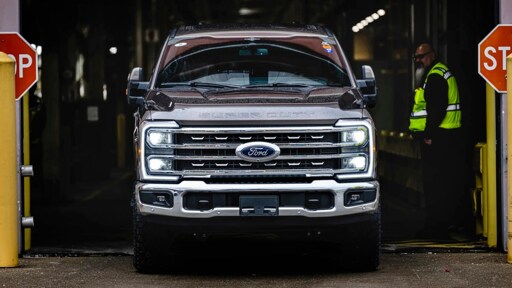
A new NYT analysis found that anyone shorter than 5-foot-6 — about half of American adults — would frequently be knocked to the ground in front of today's average vehicle.
Bigger in the context of vehicles means not only heavier, but also a higher point of impact. It could be the difference between getting hit in the legs vs the torso. Or the difference between rolling onto the hood vs knocked down and run over.
You have it backwards. Larger vehicles of course have more energy, but pedestrians are too light for that to make a difference.
If you get hit by an oil tanker ship going ~1 kmh, that ship has orders of magnitude more kinetic energy than a car at highway speed, yet, unless theres a wall or something, the ship will merely push you harmlessly aside.
Its about the manner of delivery, not the vehicles energy.
Larger cars are more dangerous because they hit you higher up, where you have more vital organs.


Thats not how kinetic energy works, no pedestrian is heavy enough to stop any car, small or large.
Bigger in the context of vehicles means not only heavier, but also a higher point of impact. It could be the difference between getting hit in the legs vs the torso. Or the difference between rolling onto the hood vs knocked down and run over.
I agree, large cars are generally much more lethal to pedestrians, due to their shape, not kinetic energy.
Force= Mass X Acceleration, so any any given speed, more mass nets more force. More force = more trauma.
if you get hit by a wall with infinite weight, moving at 1km/h, it has infinite energy, yet it will merely push you away
Kinetic energy is related to mass and the square of velocity
A heavier vehicle absolutely has more killing power against a pedestrian…
You’re right. The mass of the pedestrian makes no difference… any vehicle is going to turn them into a red mist
You have it backwards. Larger vehicles of course have more energy, but pedestrians are too light for that to make a difference.
If you get hit by an oil tanker ship going ~1 kmh, that ship has orders of magnitude more kinetic energy than a car at highway speed, yet, unless theres a wall or something, the ship will merely push you harmlessly aside.
Its about the manner of delivery, not the vehicles energy.
Larger cars are more dangerous because they hit you higher up, where you have more vital organs.