• 4 Posts
  • 37 Comments
Joined 5 months ago
cake
Cake day: July 13th, 2025

help-circle

  • This article is framed from a capitalist CEO, and while it touches on reality, feels incredibly lost in it’s point.

    Cassandra Cummings, CEO of New Jersey-based electronics design company Thomas Instrumentation. …

    Both the cellular and internet infrastructure has to operate to be backwards compatible in order to support the older, slower devices. Networks often have to throttle back their speeds in order to accommodate the slowest device

    I’d Boohoo, if they actually were thinking about rebuilding the network stack to consider something like MultiPathTCP and reframed the devices to actually use all the networks they were on rather than a single one… But no they want you to by a single provider and depend on that plan… For the economy.

    Further Telecoms choose not to upgrade towers (to save costs). In 2023, AT&T/Verizon spent $10B less on network upgrades than projected. Because they were being profit-driven underinvestment.

    She does go on to say:

    To ease the transition to new technologies, she says there should be designs that are repairable or modular rather than the constant purge and replace cycles. “So perhaps future devices can have a partial upgrade in say ethernet communications rather than forcing someone to purchase an entirely new computer or device,” Cummings said. “I’m not a fan of the throw-away culture we have these days. It may help the economy to spend more and force upgrades, but does it really help people who are already struggling to pay bills?” she said.

    So slightly redeeming.

    The article also makes note of repairing:

    He adds that when people hold onto their phones or laptops for five or six years, the repair and refurbishment market becomes an active part of the economy. But right now, in both European, American, and global markets, too much of that happens in the shadows.

    But this attempt to point out that productivity is lost on old devices:

    The price to the organization is then paid in lack of productivity, inability to multitask and innovate, and needless, additional hours of work that stack up. Workplace research conducted by Diversified last year found that 24% of employees work late or overtime due to aging technology issues, while 88% of employees report that inadequate workplace technology stifles innovation. Kornweiss says he doesn’t expect there’s been any improvement in those numbers over the past year.

    There’s a disconnect between the numbers and behavior. Many workers report that aging devices stifle productivity, but like a favorite pair of shoes or an old sweater, they don’t want to give them up to learn the intricacies of a new device (which they’ll learn and then have to replace with another). Familiarity can trump productivity for many workers. But the result of that IT clinginess is felt in the bottom line.

    Fails to point out the waste of resources and it’s impact on climate, health, and the economy; loss of privacy and it’s impact on democracy, health, and yes the economy; and also how often new things don’t actually help productivity…

    Some how the “Upgrade to help the economy” falls flat when you consider Windows 11 and it’s non-upgrade upgrade. Or MS Office which is still producing Word/Excel/PowerPoint/etc decades later with the same shortcuts. Your ‘productivity lag’ is your boss refusing to train you not your laptop

    I mean if upgrade = economy, why does Apple sit on $165B in cash? They should spend it — not you!

    Profit-driven innovation that wants to sell us the same iPhone with a new camera, is not helping the economy. We need real innovation that disrupts big tech as much as it disrupts everything.

    Oh and that ‘business equipment investment’ from the fed was about factory robots and large capital investments, not phones.

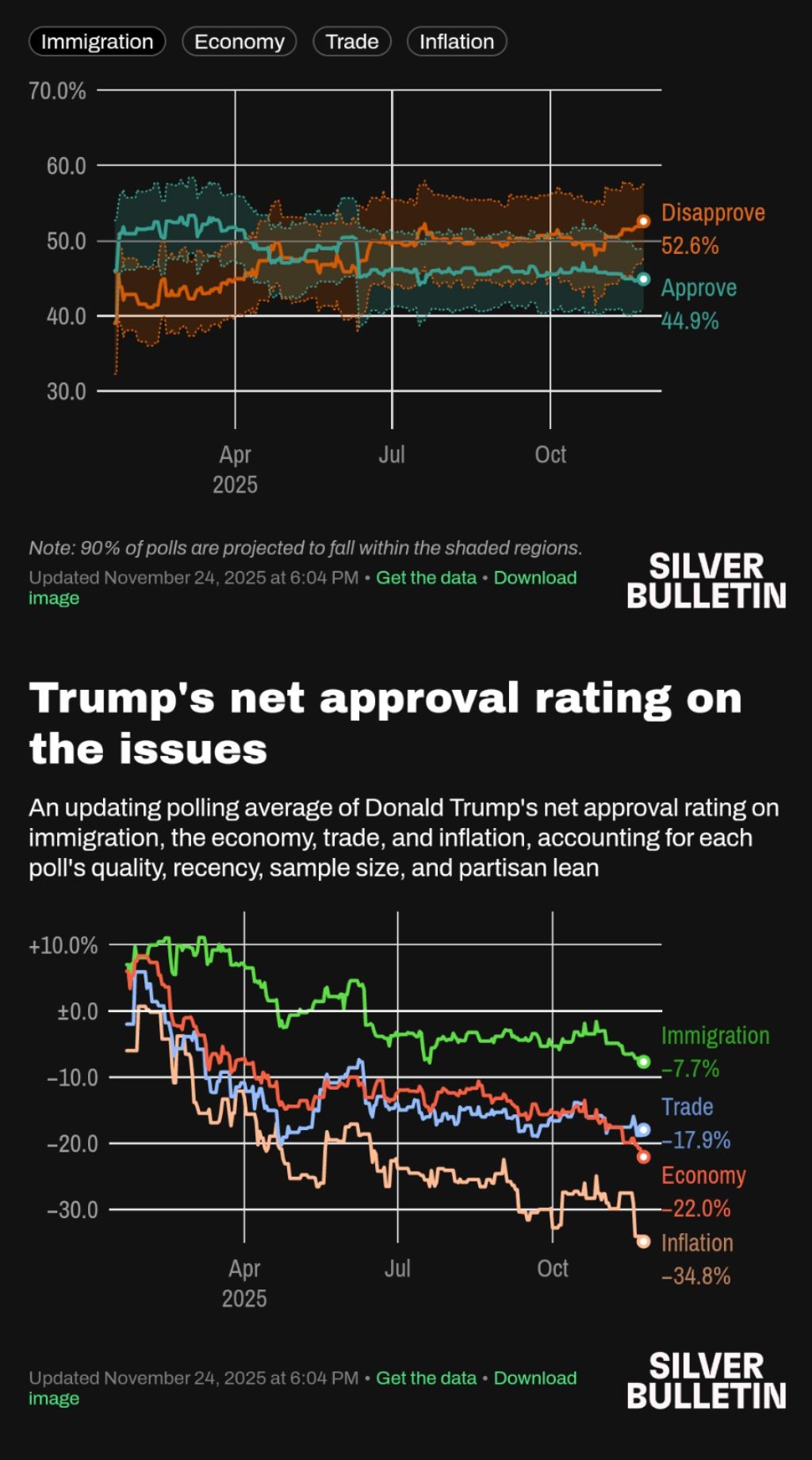
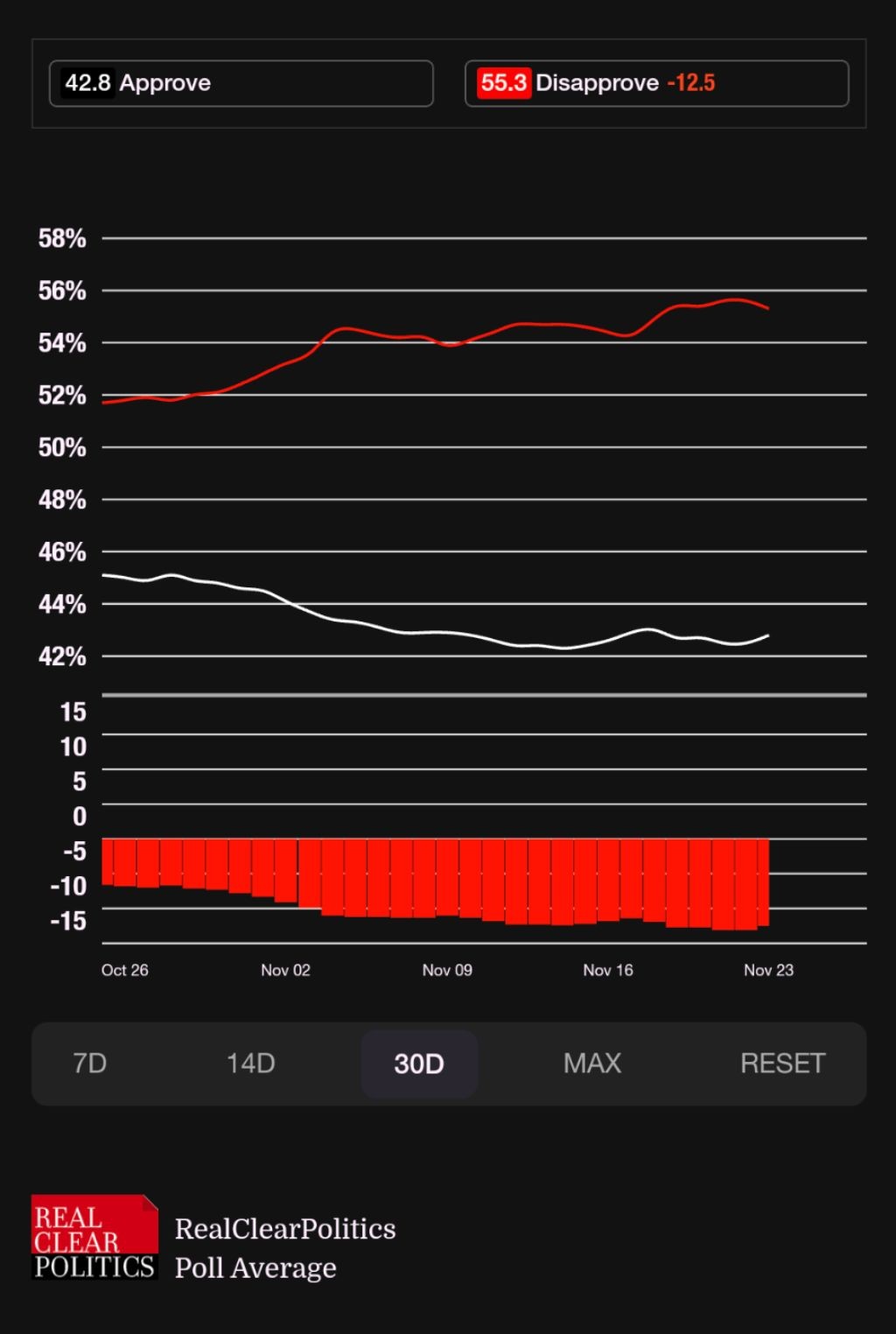
  • I agree with the sentiment, but disagree with the polling.

    https://www.natesilver.net/p/trump-approval-ratings-nate-silver-bulletin Show’s the Cheeto down

    RCP shows him at least level with a few weeks ago, and way down overall.

    https://www.realclearpolling.com/polls/approval/donald-trump/approval-rating

    There are others as well, but basically, he’s beginning to hurt hard on some of the issues and that’s making midterms looks difficult for the Republican next year. It’s telling to me that he’s stopped his tariff crusade, especially lifting ones on food. Also did the ACA extension, in spite of being so against it that he wanted to remove the filibuster. His staff is desperate for big wins and he’s been stymied in finding them when the courts reject his deployments, curtail or.monitor his ICE raids, and even reject his parties gerrymandering attempts. Many many people are beginning to just ignore his histrionic, such as Ukraine and Europe, as well as China.

    In essence, while I am not as optimistic as the article, as I think he’s got lots of damage to be done under the news radar (like gutting the edu dept), I do think the middle ground who voted him in (the middle 20% of voting Americans, not the conservative 40%, or progressive 40%) has come to realize the folly of their choice… Or begun to.


  • What the fuck is with this article? All over the place. Horrible read. Two relevant paragraphs.

    Eight Senate Democrats caved to Donald Trump and voted to approve a budget deal with Republicans to end the government shutdown, angering their colleagues in Congress as well as their own party’s base.

    These eight senators, including independent Angus King who caucuses with the party, are all either retiring or up for reelection years from now. They likely feel that they won’t have to pay an electoral cost for failing to stand up for Democrats’ goal of extending health care subsidies, instead settling for a future vote on the matter.

    The full list of these Democrats is below:

    Senator Richard Durbin (Illinois, retiring) Senator Angus King (Maine, term ends in 2030) Senator Catherine Cortez Masto (Nevada, term ends in 2028) Senator Jacky Rosen (Nevada, term ends in 2030) Senator Maggie Hassan (New Hampshire, term ends in 2028) Senator Jeanne Shaheen (New Hampshire, retiring) Senator John Fetterman (Pennsylvania, 2028) Senator Tim Kaine (Virginia, 2030)


  • How can a company with $13 billion in revenue make $1.4 trillion in spending commitments?

    Sam then goes on an unhinged rant, claiming OpenAI makes “way more revenue than that” and defensively telling Gerstner what he can do next.

    In the past few months alone, OpenAI has racked up commitments of nearly $1.5 trillion, including:

    $250 billion with Microsoft - using Azure cloud platform capacity

    $500 billion with Oracle - for cloud computing capacity

    $38 billion with Amazon - for use of AWS data center capacity

    $22.4 billion with CoreWeave - for GPU cloud capacity

    $100 billion - in general data center buildout, committed to using Nvidia GPUs

    “tens of billions” with AMD - to deploy AMD Instinct GPUs

    “undisclosed” with Broadcom - to design and produce in-house AI accelerators

    OpenAI literally does not have the money to pay for these commitments. Its estimated top-line annual revenue of $13 billion doesn’t even cover its costs, let alone provide for profit. In fact, OpenAI is currently incinerating cash, reporting a net loss of $11.5 billion in the past quarter ending September 30, 2025. That is insane. That is not a company prepared to spend a trillion dollars on infrastructure buildout.


  • Thank you for actually answering the question with a source, rather then hearsay or conjecture without sources.

    To answer from a quote:

    Examining trends over a longer timeframe, violent crimes are below levels seen in the first half of 2019, the year prior to the onset of the COVID pandemic and racial justice protests of 2020. There were 14% fewer homicides in the study cities in the first half of 2025 than in the first half of 2019. Similarly, reported aggravated assault (-5%), gun assaults (-4%), sexual assault (-28%), domestic violence (-8%), robbery (-30%), and carjacking (-3%) were lower in 2025


  • Beyond my frustration at this being buried in a video podcast, I also would rather promote why people should be worried about privacy in a concrete and direct way.

    The Cascading Impact of Privacy Loss

    Concrete Example: A 10-Year Timeline

    Year 0: You’re a healthy middle-class person who “has nothing to hide”

    Year 3: Your insurance premiums inexplicably rise. You don’t know your fitness tracker data was sold and correlated with your grocery purchases.

    Year 5: Passed over for promotion. Algorithm flagged social media posts about work stress as “low resilience indicator.”

    Year 7: Attend peaceful protest. Face-recognition adds you to databases. Now randomly selected for “additional screening” at airports.

    Year 9: Can’t get affordable loan. Your zip code + purchase history + social network = high risk score. The specific formula is proprietary.

    Year 10: Chronic condition develops. Can’t get treatment covered - insurer says it’s “pre-existing” based on data you didn’t know they had from a DNA test you took for fun in Year 2.

    Your lifespan: Statistically reduced by 5-10 years compared to privacy-protected cohort.


    Privacy isn’t about “having something to hide.” It’s the immune system of human dignity, economic fairness, political freedom, and literally - survival.

    Without it, you become a data object to be optimized for others’ profit and control, not a human with agency over your own life.


  • From the NYT article:

    According to the patrol report, one officer described what sounded like pebbles hitting his motorcycle and the area around him, and two others saw a two-inch piece of shrapnel hit the hood of their patrol vehicle, leaving a small dent. The report says shrapnel was also found on the road near the motorcycle.

    Mr. Newsom had warned that the Marine Corps’ plans to fire artillery shells over Interstate 5, the West Coast’s main north-south artery, could pose hazards for motorists on the stretch between Los Angeles and San Diego. The closure he ordered on Saturday caused significant backups on the portion of the interstate, which is used by approximately 80,000 people daily.

    “We love our Marines and owe a debt of gratitude to Camp Pendleton, but next time, the vice president and the White House shouldn’t be so reckless with people’s lives for their vanity projects,” Mr. Newsom said in a statement to The New York Times.

    https://www.nytimes.com/2025/10/19/us/politics/shell-interstate-5-marines-california.html

    (My emphasis added)


  • Like other affected federal workers, controllers are worried about how they will pay their bills during the shutdown when they won’t get paychecks. Duffy and the union’s president have acknowledged the unfairness of their situation, which only adds more stress to their already stressful jobs.

    NATCA President Nick Daniels said controllers might have to take time off to work a second job just to make ends meet during the shutdown. But Duffy said that right now, he thinks the controllers who are missing work are “lashing out” in frustration.

    “It’s going to eventually be that when people don’t have money, they have time to start making life choices and life decisions. And it shouldn’t be waiting for air traffic controllers to break because of having to take out loans, credit card debt, paying bills, gas, groceries, mortgages. Those things aren’t going to stop,” Daniels said.

    So… What if they are actually sick…? I mean not getting paid and still having to show up let alone the stress of being a air traffic controller seems likely to make people prime candidates for low immune systems. Oh, but that’s right sickness doesn’t exist under RFK, right?


  • While the article itself is a great intro into the engineering history of conductors, this is what the title refers too and is sensationalist at the least. IMO scientists are searching for a bunch of things and don’t necessary think of it as a holy grail.

    This non-peer-reviewed preprint, boldly titled “The First Room-Temperature Ambient-Pressure Superconductor,” ignited a firestorm last month—both online and in physics departments around the world—as experts and laboratories rushed to recreate the material and reproduce these amazing results. But even from the very beginning, most condensed-matter physicists, including Mason and Greene, were skeptical.

    “Even though they’ve shown levitation and resistance versus temperature curves in their paper … none of those measurements seem to have the reliability that a typical paper reporting superconductivity would have,” Greene says. “For example, one of the papers shows electrical resistance versus temperature, and when it comes to superconductivity there’s a very sharp drop in the resistance … the drop is much too sharp. It wouldn’t happen that quickly.”

    Greene and Mason also mention some graph inconsistencies that make it hard to discern if this material is even a superconductor at all.

    “I think one thing that’s exciting about this paper is that they were very clear about how they made the material. It’s a material that many people can make and reproduce,” Mason says, but he also points out a few red flags. “The resistivity plot is troublesome to me … if you took their plot of a superconductor, and just put gold on the same plot, gold would look like there was also zero resistance.”

    At first, for every validation study that showed promising results, another study took the wind out of Ahab’s metaphorical sails. Finally, two weeks after its arrival, the International Center for Quantum Materials—an influential Chinese superconductor lab—confirmed that LK-99 wasn’t a superconductor at all, but instead displayed a kind of ferromagnetism.

    So for now, the dream of room-temperature superconductors is on pause. But despite LK-99’s unfortunate fate, the dream has never been so tantalizing.


  • John Durham, the former special counsel who spent nearly four years examining the origins of the FBI investigation into President Donald Trump’s 2016 presidential campaign and its alleged ties to Russia, told federal prosecutors investigating James Comey that he was unable to uncover evidence that would support false statements or obstruction charges against the former FBI director, sources familiar with the matter told ABC News.

    Federal prosecutors in Virginia met remotely with Durham in August to understand the findings of his investigation, according to sources familiar with the meeting, and his conclusions raise the prospect that Durham – who was once elevated by Trump and other Republicans believing he would prosecute high-level officials involved with the investigation of the president’s 2016 campaign – could now become a key figure aiding Comey’s defense.

    The prosecutors also met with a team of lawyers at the U.S. Attorney’s Office in Washington, D.C., who had investigated Comey for years – including calling him to testify before a grand jury in 2021 – but were unable to identify any chargeable offenses committed by Comey, sources familiar with the meeting said.