

Includes pluto
Ignores Eris and Ceres.
JAIL! JUSTICE FOR ERIS AND CERES.
Pluto is a dwarf planet. “Planet” is right there in the name, so yes, it’s literally a planet.
Ceres is also a planet. You’ll be including that one too, right?
Planet is in the name, but it’s there in the same way “democratic” is in the name of various dictatorships, or “socialist” is in the term “Nazi”.
A dwarf planet is not a type of planet. “Dwarf Planet” is its own category of solar system object, not a subtype. It’s the same way that comets and asteroids are “minor planets”.
If you want Pluto to be a planet with no modifier adjective, you can’t then just have the nine that were taught in schools for decades as “the planets of the Solar system”, because we’ve discovered several out there beyond Neptune that qualify in the same way that Pluto does.
Most pro-Pluto arguments boil down to “there are nine because I was taught nine and nothing will ever change that (but maybe I could be convinced to allow one extra one at the end because the newspapers love a good planet X story)”.
The mnemonics, whatever they’d be (or become) would need to account for the letters MVEMCJSUNOPSHQMGES and there would be the expectation that it could change at any minute if something new is discovered due to the rate of progress that simply didn’t exist when the nine were set in stone.
And most arguments against Ceres being in the list would rule out Pluto for the same reason (and there’s at least one that would qualify Ceres and not Pluto - orbiting along the ecliptic.)
I think they prefer to be called “little planets” now.
We stan Ceres rights in this spaceship. Beltalowda!
The easier term to use is “planette”
This would imply that planet is the masculine form and both mean “small plan”
I thought the term was “planetoid”.
That’s a term, sure, but it’s even less likely to make the anti-demotionists happy.
Well I don’t care about making them happy.

If you count dwarf planets, that puts our count at 13.
And we can’t do 13 planets. It’s unlucky.
Dwarf what?

There are nine planets!
This is what they took from us
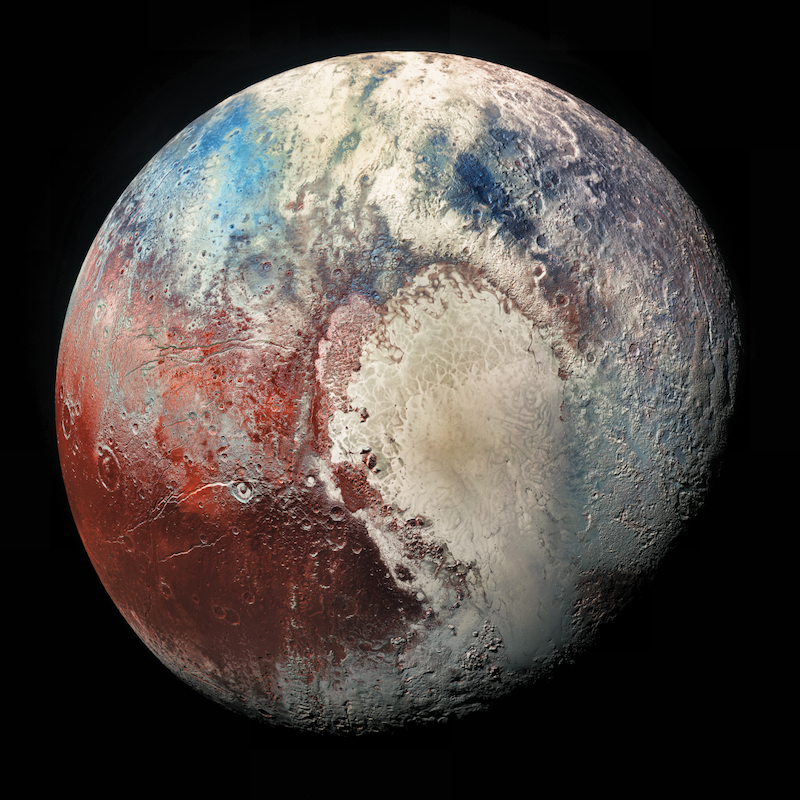
(Actual colors not as depicted.)
Why are the colours different?
Cameras.
as a human you (most likely) have 3 types of photo receptors. Green, blue and red. That’s why digital pictures mostly use RGB to save color data. They save how much red light, how much green light and his much blue light each pixel should have. For this reason the sensors of digital cameras use the same pixels , just for capturing light instead. So the camera only captures Red,blue and green light from the visible spectrum and discards all else because we as humans can’t see that other light. But for scientific cameras, what the scientists look for might not be visible RGB light. So often the cameras capture ultraviolet light or other wavelengths instead. To display the image they have to shift the colors, because a) you can’t see ultraviolet light and b) your screen can’t display ultra violet light either. So they just transform to the RGB color space. What is blue in the image now is not blue in real live but actually ultraviolet. What is red is not red in real live but actually a different wavelength you can’t see.
This is true for basically all space images with long range telescopes like Hubble or James Webb. And for most satellites.
Interesting, thanks for the explanation
Maybe long exposure picture? (Guessing, I don’t know either)
That was a friendly neighborhood OPA representative to talk about why Ceres should also be included
Remember the Cant!!!
ALWAYS HAS BEEN
I remember looking at an astronomy book at school and seeing Pluto’s weird ass slanted orbit and thinking that it shouldn’t be counted amongst the others. Felt really vindicated when Jim Carrey’s kids in Me, Myself and Irene argued about Pluto not being a planet. The official definition was just cleanup.
If you’re counting Pluto then you also need to count Ceres, Eris, and Sedna.
says who? I can’t just accept pluto because I’m emotionally attached? 🥺
if red pandas can be pandas without actually being pandas than Pluto can be a planet dadgummit!!
You can, but people picking and choosing what science they accept based on feelings is how science denialism becomes a thing
you are objectively correct and I don’t like it :(
Well I fuckin want Ceres to be a planet, fuckin damnit!
I imagine nasa would be perfectly fine with Pluto still categorized as a planet. It was just a handful of people at a IAU conference(many had left by the time the vote happened) that made the change.

You know that’s right.
Scorpio
No, I think I’m a Gemini.
So close, that is a constellation!