


You must log in or # to comment.
Another one is levelling.
A lot of people can see a picture frame is about 0.5° out of level and their fucking eye twitches until they fix it
Me included
That’s nuts when you think about it
I purposefully slightly tilt most my wall hangings. I like watching guests squirm when they mention it and I do nothing
Sorry cousin, unfortunately I will get the flu this Christmas and won’t be able to come visit.
I respect and hate this. I could never
Madlad
See, I live in an old apartment. The corners aren’t 90°, the wall a picture is hanging on is convex. When I’m lying in bed and look at the picture it looks like it’s crooked but I used a level several times on it and it’s as straight as can be. It’s driving me insane.
But “level” isn’t what you need. If the floor and ceiling aren’t level, it’ll look wrong.
I worked on an industrial robot once, and we parked it such that the middle section of the arm was up above the robot and supposed to be level. I could tell from 50 feet away and a glance that it wasn’t, so we checked. It was off by literally 1 degree.
Degrees are bigger than we think, but also our eyes are incredible instruments.
When my wife was pissed at me she would go to my office before I got to work and tilt every picture/award and move my books about.
She knows what buttons to push and my sous chefs just let her do it… ungrateful pricks
/S
When sharpening knives, with practice you can tell when you are done by sliding your fingertips along (not across) the sharpened bevel. It’s possible to feel imperfections measured in micrometers this way.
If the earth were shrank down to the size of a golf ball, you could feel houses.
That seems wildly unnecessary. I can already feel houses.
I’m sure there’s some actual science thing they’re referencing here, but I don’t understand it. Who can’t feel houses?
Both a house and a golf ball are unbelievably tiny compared to the size of the Earth. The idea that you can shrink the Earth many thousands of times over and be able to feel a house parallels with our ability to feel micro imperfections on knife blades.
Oh! As in, should you be an outside observer, and grabbing the whole planet, you’d be able to feel houses on its surface if it were the size of a golf ball?
Presumably you’d feel like crushing under your fingers like the hairs on a kiwi lol
It would be a lot more smoother, smoother than a marble. But thoose detection of micro imperfections might be possible
People without fingers, I guess
We have equipment to measure down to microns, and my students often test how fine details they can feel.
Worked at a machine shop for a while, it’s funny how the easiest way to gauge surface finish is to run your nail trough it
At one of the places we worked at we would know when the rough cut was deep enough just by feel
Source??
my half a finger
If you’re about to walk into a bar with you head, or like the top of a doorpost or smt. You’ll instinctively pull back and avoid the obstacle, inches before it hurts, because your brain notice the hairs on your head moved. That’s why men who have recently gone bald, often have bumps and bruises on their head. My bald colleague told me that for him, that was the hardest thing about going bald.
Wow super interesting
Thank you hair! I only cut you out of love!
Maybe I’m understanding wrong but hair don’t have nerves. Is our brain detecting the micro movements of hair follicles inside the skin?
Nerves in the scalp.
Not advanced maths per se; neural networks are amazing! Fuzzy matching based on experience - taken to an incredible level. And, tuneable by internal simulation (imagination).
Don’t be fooled to think computer neural networks is how the brain is structured. Through out history we’ve always compared the brain to the most advanced technology at the time. From clocks, to computers with short and long term memory, and now to neural networks.
That is a good point, though the architecture of computer neutral networks is inspired by how we think the brain works, and if I understand correctly there is some definite similarity in the architecture.
Lots of difference though, still!
I would guess that every statement made is kind of true. It is a clock, a computer and a LLM,…
I would even go as far as LLM is the closest to a functioning brain we can produce from a functional perspective. And even the artificial brains are to complex to understand in detail.
I reckon we can get a lot closer than an LLM in time. For one thing, the mind has particular understanding of interim steps whereas, as I understand it, the LLM has no real concept of meaning between the inputs and the output. Some of this interim is, I think, an important part of how we assess truthfulness of generated ideas before we put them into words.
I experimented with rules like : “Summarize everything of our discussion into one text you can use as memory below your answer.” And “summarize and remove unnecessary info from this text, if contradictions occur act curious to solve them”… simply to mimic a short term memory.
It kind of worked better for problem solving but it ate tokens like crazy and the answers took longer and longer. The current GPT4 models seem to do something similar in the background.
I think that’s still different from what I’m thinking of of interim steps, though.
…but as I think how to explain I realize I’m about to blather about things I don’t understand, or at least haven’t had time to think about! So I’d better leave it there!
I would really like to get into LLM and AI development but the math…woosh right over my head.
deleted by creator
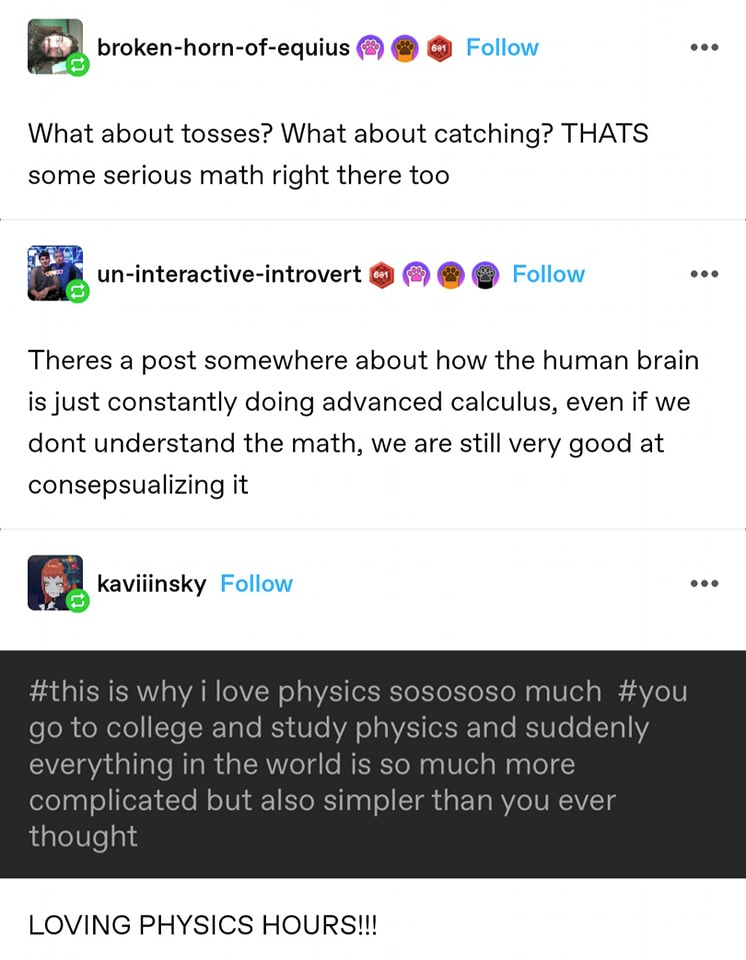
I was always amazed at how we can catch objects in flight.
Compared to how long it takes me to calculate projectile momentum in Physics 1
Or tiny birds that can expertly navigate wind currents with an almond sized brain using real-time force feedback. The computational power at their disposal is very well optimized for what they do.
Hummingbirds are fucking incredible. They can literally hover, fly backwards, fly inverted, fly silently, or flap their wings loud enough to generate sound waves as a mating ritual. They’re like miniature f-18s dog fighting constantly.
And they can even do that in sync with thousands (and even millions) of other small birds.

Birb Borg Cloud
Plus they have hollow bones and weigh almost nothing
Throwing and catching always amaze me. And it’s not something that everyone is always great at, for sure, but anyone can try to toss a wad of paper into the waste basket. Whether or not you make it, the calculations under the hood, happening so quickly, always astound me to think about.
What’s amazing is our ability to calculate the path of something in the air.
There’s a test they did with Cristiano Ronaldo where someone kicked a ball to him so he could head it. They shut off the lights before the ball was in the air and somehow from the body shape of the person kicking it, he was able to know how to make contact with it without being able to see it.
I’m not a fan of Ronaldo but that was very cool to watch, thanks for sharing!
Ronaldo’s ego is incredible, and he’s almost always looking out for himself in everything he does. But, you can’t deny that he’s one of the best ever players. And his charisma means he’s a great choice for something like this where he has to perform and interact with all the “scientists”. Someone like Messi could do the same kinds of moves, but he wouldn’t be able to chat with the presenters and “scientists” between events in a natural way. (P.S. I love that they got someone named Ronald to be the ordinary guy who couldn’t do anything useful, that was just funny.)
I also think Ronaldo genuinely cares about all the biomechanics and all that, as long as it’s something that applies to him, and that he could use to make himself better. A lot of other players just play on instinct and don’t want to have to think about it.
Pretty impressive. I think they’re underestimating/ignoring the input from hearing, especially with the second one where he probably (subconsciously, of course) heard the ball bounce near his foot. Plus the subtle changes in air pressure around his legs to tell where the ball is, etc.
Cool video, thanks.
Edit: Still watching as they’re analyzing his free kick. Cool shit. The human body is wild.
One thing I don’t really see people talk about is how Ronaldo (and other soccer/football players) use their opposing leg to kind of hop up and dissipate any energy that they didn’t transfer into the ball. Fucking cool. You don’t even realize it’s happening.
I haven’t seen any videos on it, but I remember doing kinematics problems in school involving baseball pitchers and how they throw, and it is actually insane. Each joint and section of the pitcher’s arm is like perfectly timed to provide the most velocity to the projectile. So you add up the momentum from the swinging shoulder to the momentum from the elbow to the momentum from the wrist, to the momentum and spin from the fingertips. Baseball is boring as shit, but the physics behind pitching is cool af.
Hearing is definitely part of it, but I imagine it’s only hearing the sound of the ball being kicked. After that it’s going to be far too quiet to hear until it gets close, and he’s obviously reacting long before that. Maybe hearing helps him adjust in the last tenth of a second, but he’s not hearing the ball’s entire flight.
As for the body mechanics of a pitch or a kick, it is amazing. Like, a proper powerful punch involves leg muscles, hip muscles, waist muscles, chest muscles, and only then do you start to get to the arms. For most of us, the best way to realize how coordinated everything has to be is to try to do something with your wrong arm/leg. Everything that flows naturally on your strong side is just completely wrong on your weak side.
I remember when I was younger and would lay on my back throwing a baseball up in the air and catching it, that I could watch it go up and not follow it with my eyes as it goes down and still have my hand in the right spot to catch it
I always imagine it more like neural networks. simply based on a lot of training and experience. As an example think of times when you step onto a non moving escalator. Your mind definitely knows its not moving but you still can’t defeat the trained expectation of jerk.
Layered as well. Little bits process very specific things and simplify it for the beast.
Take shrooms and watch as the divisions between the little bits break down into absolute chaos :D
Acid, too. Dissociatives for the body as well, to some extent.
Have you ever swiped on your phone, but the screen doesn’t move (due to end of content, or unknowingly being an unswipable screen), and you feel your eyes jerk automatically in reflex, predicting the movement that didn’t happen?
A lot of it is less math and more just approximations using old data, just fitting a complex statistical model neural nets suck ass at math
Yeah, your brain is not doing projectile motion equations in real time, it’s the same process as teaching a neutral network to approximate a parabola.
Don’t get me wrong, it’s incredibly impressive that this prediction in our brain requires the visual processing of data from eyes to identify an object flying through the air, moving our hand in a perfect intercept course to catch it. All without having to have a ton of data points to ‘train’ on.
Yeah there is a lot of neural networks, but i don’t think that is the only thing in brain. There could be calculators and integrator circuits
Most people who’ve been juggling for awhile don’t need too much additional practice to be able to do at least a few blindfolded catches just because of how consistent your throws get after awhile.
The other thing that’s interesting is how pattern recognition in flying things people aren’t generally used to seeing develops. I used to play ultimate, and when people start learning how a frisbee flies they might be susceptible to chasing it down by following along the path of the disc rather than moving directly to where it’s going to end up. This is sometimes called dogging the disc because (many) dogs do the same thing. But then you learn to “read” the disc and you can tell by the flight path and angle of the disc where it’s going to land.
microslippages: some of us just call it what it is … masturbation
A lot of it is the difference between learning practically and learning theoretically. You don’t have to understand the underlying mechanics in practice to know how to keep getting the same result. Your brain doesn’t have to be doing any math, it just has to have shaken a bottle enough times to have a good comparative basis formed.
Learning to calculate the current remaining volume in a container when observing someone else shake it… that would use all that theoretical knowledge and math.
It’s like knowing how hard you have to throw an egg at a wall for it to break instead of bounce off. You do it 100 times, you just get a good feel for it. Doing all the math, and then trying to learn it practically is barely gonna affect how quickly you learn it in practice. But if you wanted to make a robot that throws it exactly hard enough without wasting any energy, practical knowledge will have almost no value, and theory and math will be incredibly valuable.
This is coming from someone who does indeed have the whole “passive trajectory analysis of every moving object around me” thing. I can’t do crowds or drive at busy times. But, for moving through a minor crowd while reading a book, or pulling into a tight parking space while other cars are moving around near me, it’s very helpful. I have good spatial awareness in general, like parking in my garage with only an inch of clearance on the far side of my car has never been an issue in 14 years so far. Or when doing it with someone else’s borrowed car every now and then too. When I shrug off the difficulty of doing something like that, people seem to be amazed. Otherwise, I would have assumed it was normal, feels normal to me.
I always thought about how interesting it is that handing things to people is so reliable. We just kind of know exactly when the other person has grabbed something enough for us to let go.
And then there’s the rare moment when you think they have it so you let go and it falls to the floor 😭
_
Yes and no. Jugglers do benefit from getting very consistently thrown objects. However they still need to make small adjustments every time. On very limited information in this case.
I also remember an experiment with professional football (soccer) players, where balls would be shot towards them and the lights would be switched off while the ball was in the air. The rate at which they were able to position themselves and kick the ball back in complete darkness was pretty impressive.
I would say there is still some complicated stuff going on in the brain with knowing where your arm, hand, elbow and shoulder are in space as well how much force you need to apply (the precise amount of motor neurons to activate at the exact time) so you can toss the ball in the arc you need to catch it on the other side.
Sure. I myself am not good a coordination, can’t juggle shit.
Then you’re getting into things like muscle memory. I’m not a neuroscientist, but I imagine that could also be boiled down to math being done subconsciously and instantaneously in your brain.
Almost like if you do a thing enough times, you just look it up in a chart instead of deriving it from the equation every time…
deleted by creator










![[Thread] Mental Math](https://mander.xyz/pictrs/image/4a605b7b-7272-471f-ac11-37366ac7d8bd.png)