The majority of “AI Experts” online that I’ve seen are business majors.
Then a ton of junior/mid software engineers who have use the OpenAI API.
Finally are the very very few technical people who have interacted with models directly, maybe even trained some models. Coded directly against them. And even then I don’t think many of them truly understand what’s going on in there.
Hell, I’ve been training models and using ML directly for a decade and I barely know what’s going on in there. Don’t worry I get the image, just calling out how frighteningly few actually understand it, yet so many swear they know AI super well
And even then I don’t think many of them truly understand what’s going on in there.
That’s just the thing about neural networks: Nobody actually understands what’s going on there. We’ve put an abstraction layer over how we do things that we know we will never be able to pierce.
I’d argue we know exactly what’s going on in there, we just don’t necessarily, know for any particular model why it’s going on in there.
But, more importantly, who is going on in there?
And how is it going in there?
Not bad. How’s it going with you?
That’s what we’re trying to find out! We’re trying to find out who killed him, and where, and with what!

The real question is where it’s going on?
Excellent opportunity for a “that’s what she said” joke.
Ding ding ding.
It all became basically magic, blind trial and error roughly ten years ago, with AlexNet.
After AlexNet, everything became increasingly more and more black box and opaque to even the actual PhD level people crafting and testing these things.
Since then, it has basically been ‘throw all existing information of any kind at the model’ to train it better, and then a bunch of basically slapdash optimization attempts which work for largely ‘i dont know’ reasons.
Meanwhile, we could be pouring even 1% of the money going toward LLMs snd convolutional network derived models… into other paradigms, such as maybe trying to actually emulate real brains and real neuronal networks… but nope, everyone is piling into basically one approach.
Thats not to say research on other paradigms is nonexistent, but it is barely existant in comparison.
Il’ll give you the point regarding LLMs… but conventional neural networks? Nah. They’ve been used for a reason, and generally been very successful where other methods have failed. And there very much are investments into stuff with real brains or analog brain-like structures… it’s just that it’s far more difficult, especially as have very little idea on how real brains work.
A big issue regarding digitally emulating real brain structures is that it’s very computationally expensive. Real brains work using chemistry, after all. Not something that’s easy to simulate. Though there is research in this are, but that research is mostly to understand brains more, not for any practical purpose, from what I know. But also, this won’t solve the black box problem.
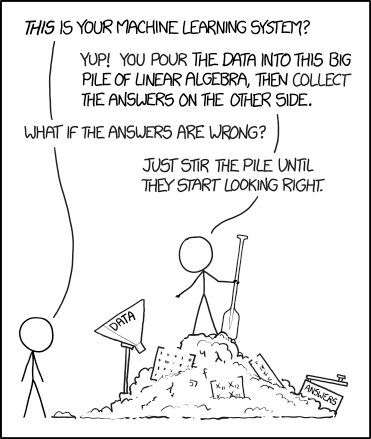
Neural networks are great at what they do, being a sort of universal statistics optimization process (to a degree, no free lunch etc.). They solved problems that failed to be solved before, that now are considered mundane. Like, would anyone really think it would be possible to have your phone be able to detect what it was you took a picture of 15 years ago? That was considered to be practically impossible. Take this xkcd from a decade ago, for example https://xkcd.com/1425/
In addition, there are avenues that are being explored such as “Explainable AI” and so on. The field is more varied and interesting than most people realize. And, yes, genuinely useful. And not every neural network is a massive large scale one, many are small-scale and specialized.
I take your critiques in stride, yes, you are more correct than I am, I was a bit sloppy.
Corrections appreciated =D
Hopefully I don’t appear as too much of a know-it-all 😭 I often end up rambling too much lmao
It’s just always fun to talk about one’s field ^^ or stuff adjacent to it
Oh no no no, being an actual subject matter expert or at least having more precise and detailed knowledge and or explanations is always welcome imo.
You’re talking to an(other?) autist who loves data dumping walls of text about things they actually know something about, lol.
Really, I appreciate constructive critiques or corrections.
How else would one learn things?
Keep oneself in check?
Today you have helped me verify that at least some amount of metacognition is still working inside of this particular blob of wetware, hahaja!
EDIT:
One motto I actually do try to live by, from the Matrix:
Temet Nosce.
Know Thyself.
… and a large part of that is knowing ‘that I know nothing’.
Way back in the 90s when Neural Networks were at their very beginning and starting to be used in things like postal code recognition for automated mail sorting, it was already the case that the experts did not know why it worked, including why certain topologies worked better than others at certain things, and we’re talking about networks with less than a thousand neurons.
No wonder that “add shit and see what happens” is still the way the area “advances”.
I have a masters degree in statistics. This comment reminded me of a fellow statistics grad student that could not explain what a p-value was. I have no idea how he qualified for a graduate level statistics program without knowing what a p-value was, but he was there. I’m not saying I’m God’s gift to statistics, but a p-value is a pretty basic concept in statistics.
Next semester, he was gone. Transferred to another school and changed to major in Artificial Intelligence.
I wonder how he’s doing…
I have a bachelor’s and master’s in computer science, specialised in data manipulation and ML.
The problem with AI is that you don’t really need to understand the math behind it to work with it, even with training. Who cares how the distribution of the net affects results and information retention? who cares how stochastic gradient descent really works? You get a network crafted by professionals that gets X input parameters, which modify the network’s capacity in a way that’s given to you, explained, and you just press play in the script that trains stuff.
It’s the fact that you only need to care about input data quality and quantity and some input parameters that freaking anyone can work with AI.
All the thinking on the NN is given to you, all the tools to work with training the NN are given to you.
I even worked with darknet and Yolo and did my due diligence to learn Yolov4, how it condensed info and all that, but I really didn’t need to for the given use case. Most of the work was labelling private data and cleaning it thoroughly. Then, playing with some Params to see how the final results worked, how the model over fitted…
That’s the issue with people building AI models, their work is more technical that that of “prompt engineers” (😫), but not much.
When you’re working at the algorithm level, you get funny looks… Even if it gets to state of the art results, who cares because you can throw more electricity and data at it instead.
I worked specifically on low data algorithms, so my work was particularly frowned upon by modern ai scientists.
I’m not doxxing myself, but unpublished work of mine got published in parallel as Prototypical Networks in 2017. And everyone laughed (<- exaggeration) at me researching RBFs which were considered defunct. (I still think they’re an untapped optimization.)
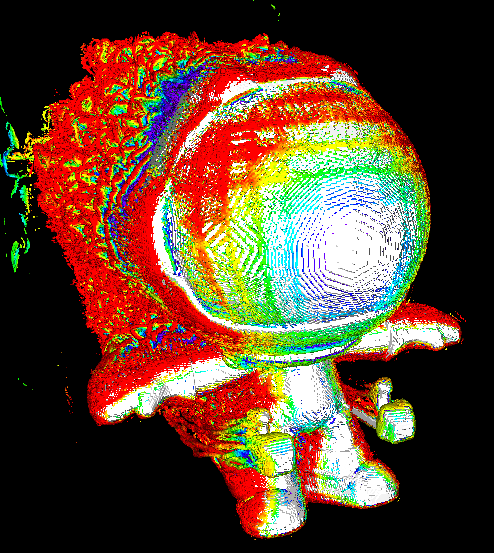
Feature Visualization How neural networks build up their understanding of images
This method is definitely a great way to achieve some degree of explainability for images, but it is based on the assumption that nearby pixels will have correllated meanings. When AI is making connections between far-away features, or worse, in a feature space that cannot be readily visualized like images can, it can be very hard to decouple the nonlinear outputs into singular linear features. While AI explainability has come a long way in the last few years, the decision-making processes of AI are so different from human thought that even when it can “show its work” by showing which neurons contributed to the final result, it doesn’t necessarily make any intuitive sense to us.
For example, an image-identification AI might identify subtle lens blur data to determine the brand of camera that took a photograph, and then use that data to make an educated guess about which country the image was taken in. It’s a valid path of reasoning. But it would take a lot of effort for a human analyst to notice that the AI is using this process to slightly improve its chances of getting the image identification correct, and there are millions of such derived features that combine in unexpected ways, some logical and some irrationally overfitting to the training data.
deleted by creator
Yeah, I’ve trained a number of models (as part of actual CS research, before all of this LLM bullshit), and while I certainly understand the concepts behind training neural networks, I couldn’t tell you the first thing about what a model I trained is doing. That’s the whole thing about the black box approach.
Also why it’s so absurd when “AI” gurus claim they “fixed” an issue in their model that resulted in output they didn’t want.
No, no you didn’t.
Love this because I completely agree. “We fixed it and it no longer does the bad thing”. Uh no, incorrect, unless you literally went through your entire dataset and stripped out every single occurrence of the thing and retrained it, then no there is no way that you 100% “fixed” it
I mean I don’t know for sure but I think they often just code program logic in to filter for some requests that they do not want.
My evidence for that is that I can trigger some “I cannot help you with that” responses by asking completely normal things that just use the wrong word.
It’s not 100%, and you’re more or less just asking the LLM to behave, and filtering the response through another non-perfect model after that which is trying to decide if it’s malicious or not. It’s not standard coding in that it’s a boolean returned - it’s a probability that what the user asked is appropriate according to another model. If the probability is over a threshold then it rejects.
I once trained an AI in Matlab to spell my name.
I alternate between feeling so dumb because that is all that my model could do and feeling so smart because I actually understand the basics of what is happening with AI.
I made a cat detector using Octave. Just ‘detected’ cats in small monochrome bitmaps, but hey, I felt like Neo for a while!
business majors are the worst i swear to god
They are literally what’s causing the fall of our society.
Objectively, per Ed Zitron.
Didn’t you know? Being adept at business immediately makes you an expert in many science and engineering fields!
adept
I think you’re giving them a little too much credit there
My wife is a business major.
I always tell her that the enemy is in my bed.
(I have no clue why she does not think that this is funny. ;))
I have personally told coworkers that if they train a custom GPT, they should put “AI expert” on their resume as it’s more than 99% of people have done - and 99% of those people didn’t do anything more than tricked ChatGPT into doing something naughty once a year ago and now consider themselves “prompt engineers.”
Absolutely agree there
I’ve given up attending AI conferences, events and meetups in my city for this exact reason. Show up for a talk called something like “Advances in AI” or “Inside AI” by a supposed guru from an AI company, get a 3 hour PowerPoint telling you to stop making PowerPoints by hand and start using ChatGPT to do it, concluding with a sales pitch for their 2-day course on how to get rich creating Kindle ebooks en masse
Even the dev oriented ones are painfully like this too. Why would you make your own when you subscribe to ours instead? Just sign away all of your data and call this API which will probably change in a month, you’ll be so happy!
Hell, I’ve been training models and using ML directly for a decade and I barely know what’s going on in there.
Outside of low dimensional toy models, I don’t think we’re capable of understanding what’s happening. Even in academia, work on the ability to reliably understand trained networks is still in its infancy.
Which is funny considering that Neural Networks have been a thing since the 90s.
… 1957
Perceptrons. The math dates back to the 40s, but '57 marks the first artificial neural network.
Also 35 years is infancy in science, or at least teenage, as we see from deep learning’s growing pains right now. Visualizations of neural network responses and reverse engineering neural networks to understand how they tick predate 2010 at least. Deep Dream was actually built off an idea of network inversion visualizations, and that’s ten years old now.
I remember studying “Probably Approximately Correct” learning and such, and it was a pretty cool way of building axioms, theorems, and proofs to bound and reason about ML models. To my knowledge, there isn’t really anything like it for large networks; maybe someday.
NONE of them knows what’s going on inside.
We are right back in the age of alchemy, where people talking latin and greek threw more or less things together to see what happens, all the while claiming to trying to make gold to keep the cash flowing.
The image feels like “Those who know 😀 Those who don’t know 😬”
I’ve been selling it even longer than that and I refuse to use the word expert.
And the number of us who build these models from scratch, from the ground up, even fewer.
This image is clearly of my hands with an elastic band at the back of class two decades ago
Yeah but why am I arguing with them?
Maybe it’s because they were stretching.
OK but what actually is this image?
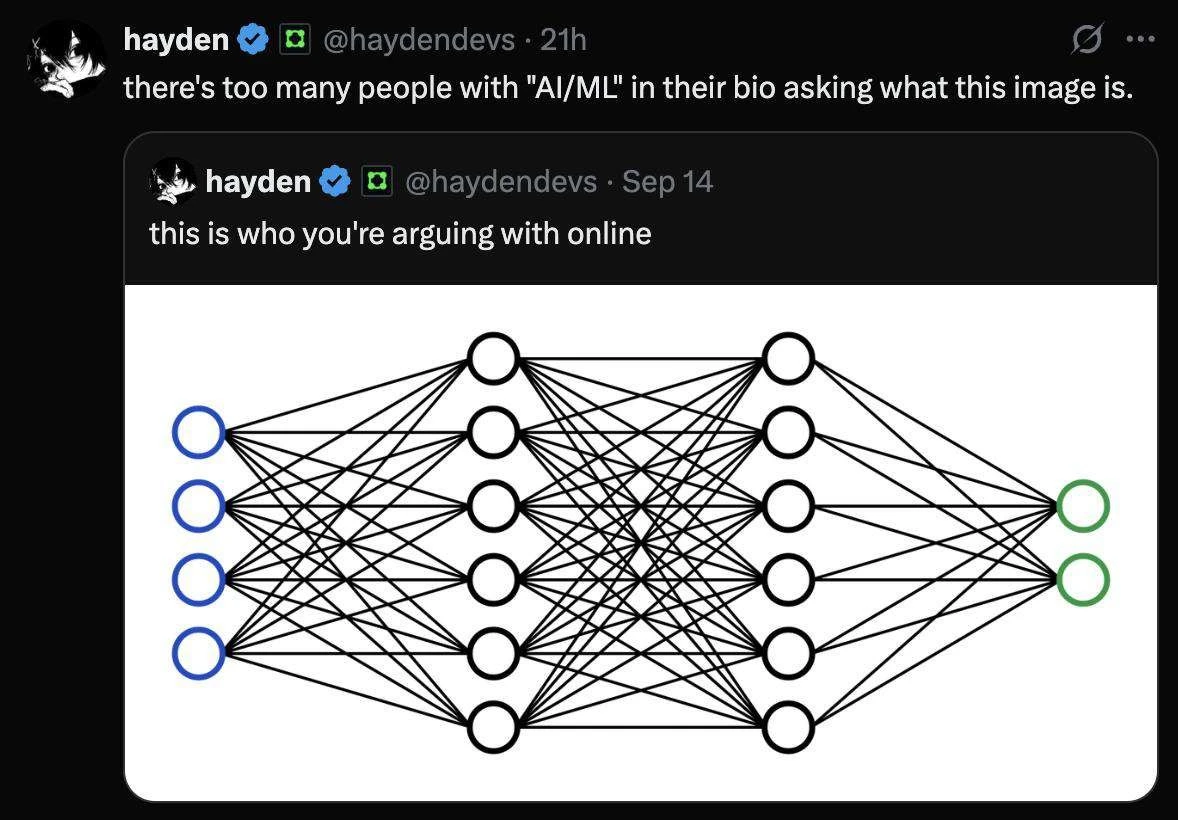
Basic model of a neural net. The post is implying that you’re arguing with bots.
https://en.wikipedia.org/wiki/Neural_network_(machine_learning)
Wouldn’t a bot recognize this though?
A bot might, but this post is pointing out how common it is for people who consider themselves AI experts to not recognize this diagram that is basically part of AI 101
They’re not saying that the bots are asking what the image is, but users (may be bots or not) that sell themselves as AI/ML experts.
they’re just robots Morty!
Would you recognize if someone made a block diagram of your brain?
The post is implying that you’re arguing with bots.
Maybe, but it also might be suggesting that people are not fundamentally different.
Illustration of a neural network.
Multilayer perceptron
Logic.
Many player cat’s cradle
Hot take : Adding “Prompt expert” to a resume is like adding “professional Googler”
I’d trust the latter any day.
Probably bc they forgot the bias nodes
(/s but really I don’t understand why no one ever includes them in these diagrams)
isn’t this the Trial of the Sekhemas in PoE2?
As a data scientist who also plays POE2, I laughed at this a lot longer than I should have
Even I know what this is and I don’t have a background in AI/ML.
Same as if you’d ask a crypto bro how a blockchain actually works. All those self proclaimed Data Scientists who were able to use pytorch once successfully by following a tutorial, just don’t want to die.
Being the devil’s advocate here.
Do you guys really understand all of your tools down to the technical level? People can make good use of AI/LLM without the need of understanding NN, weights and biases. The same way as I make good use of a microwave or a rangefinder without understanding the deep levels of electromagnetic waves and so on. Fun meme tho.
This is an extremely basic intro level ML topic. If you cannot even identify a fully connected network (or “MLP”) then you don’t know anything about the subject. You don’t need to know how to hand compute a back prop iteration to know what this is.
This is like claiming to be working as an electrician and not knowing how electricity works.
Someone who uses AI to code or make images isn’t doing machine learning anymore than a pilot is doing aerospace engineering. And someone claiming to be an aerospace engineer can’t say that they don’t understand fluid dynamics.
If someone is claiming to be in the machine learning field, not recognizing a fundamental technique of machine learning is a dead giveaway that they’re lying. This kind of diagram is used in introductory courses for machine learning, anyone with any competence in the field would know what it was.
Sure but if you make your living with microwaves somehow you should know what a magnetron is/be able to recognize one. You don’t have to know exactly how it works but like… This is fundamental stuff.
To further the analogy, if you make your living cooking using a microwave, you better know how one works, how micro-waves propagate, how they interfere with each other (superposition), creating either constructive or deconstructive interference, creating hot and cold pockets, how they are generated and where they come from in a microwave, as well as ideally how heat works… And so on. Otherwise you’re just gonna end up with mushy food that has hot and cold spots, and not know why or how to fix the problem.
You’re not a “microwave expert”. Claiming to be one would imply that you do understand the inner workings. I write code in Java everyday for my job, but I wouldn’t claim to be a “Java expert” because I don’t have exceptionally deep knowledge of its inner workings.
Usage of a tool does not make someone an expert of a tool. An expert can describe, at least at a high-level, why the tool works the way it does.
If I’m claiming expertise (not just proficiency), then yes, I would make it a point to know my tools down to the technical level.
That particular network could never put up a good argument. At best, it might estimate, or predict numbers or 1-2 discrete binary states.
import tensorflow as tf
I’ve never had it well explained why there are (for example , in this case) two intermediary steps, and 6 blobs in each. That much has been a dark art, at least in the “intro to blah blah” blogposts.
Probably because there’s no good reason.
At least one intermediate layer is needed to make it expressive enough to fit any data, but if you make it wide enough (increasing the blobs) you don’t need more layers.
At that point you then start tuning it /adjusting the number of layers and how wide they are until it works well on data it’s not seen before.
At the end, you’re just like “huh I guess two hidden layers with a width of 6 was enough.”
All seems pretty random, and not very scientific. Why not try 5 layers, or 50, 500? A million nodes? It’s just a bit arbitrary.
In practice it’s very systematic for small networks. You perform a search over a range of values until you find what works. We know the optimisation gets harder the deeper a network is so you probably won’t go over 3 hidden layers on tabular data (although if you really care about performance on tabular data you would use something that wasn’t a neural network).
But yes, fundamentally, it’s arbitrary. For each dataset a different architecture might work better, and no one has a good strategy for picking it.
There are ways to estimate a little more accurately, but the amount of fine tuning that is guesswork and brute force searching is too damn high…
Something to do with Large Language Models?
It’s a neural network diagram
Oh
Glorious.