The industry keeps echoing ideas from bleak satires and cyberpunk stories as if they were exciting possibilities, not grim warnings.
In a recent article published in the New York Times, author Casey Michael Henry argues that today’s tech industry keeps borrowing dystopian sci-fi aesthetics and ideas – often the parts that were meant as warnings – and repackages them as exciting products without recognizing that they were originally cautionary tales to avoid. “The tech industry is delivering on some of the futuristic notions of late-20th-century science fiction,” writes Henry. “Yet it seems, at times, bizarrely unaware that many of those notions were meant to be dystopian or satirical – dismal visions of where our worst and dumbest habits could lead us.”
You worry that someone in today’s tech world might watch “Gattaca” – a film that features a eugenicist future in which people with ordinary DNA are relegated to menial jobs – and see it as an inspirational launching point for a collaboration between 23andMe and a charter school. The material on Sora, for instance, can feel oddly similar to the jokes about crass entertainment embedded in dystopian films and postmodern novels. In the movie “Idiocracy,” America loved a show called “Ow! My Balls!” in which a man is hit in the testicles in increasingly florid ways. “Robocop” imagined a show about a goggle-eyed pervert with an inane catchphrase. “The Running Man” had a game show in which contestants desperately collected dollar bills and climbed a rope to escape ravenous dogs. That Sora could be prompted to imagine a game show in which Michel Foucault chokeslams Ronald Reagan, or Prince battles an anaconda, doesn’t feel new; it feels like a gag from a 1990s writer or a film about social decay.
The echoes aren’t all accidental. Modern design has been influenced by our old techno-dystopias – particularly the cyberpunk variety, with its neon-noir gloss and “high tech, low life” allure. From William Gibson novels to films like “The Matrix,” the culture has taken in countless ruined cityscapes, all-controlling megacorporations, high-tech body modifications, V.R.-induced illnesses, deceptive A.I. paramours, mechanical assassins and leather-clad hacker antiheroes, navigating a dissociative cyberspace with savvily repurposed junk-tech. This was not a world many people wanted to live in, but its style and ethos seem to reverberate in the tech industry’s boldest visions of the future.

Literally the story of Monopoly the board game.
This is why I don’t watch It’s Always Sunny in Philadelphia. The writing is brilliant, hilarious satire that I think America is far too stupid not to take as an instruction manual.


I watched “Her” and “Simone” go from being science fiction to docudramas in real time.
I just read The Circle and parts of that feel true to life.
Haven’t seen the movie and didn’t know it was a book.
Thanks for the information.
Also, look up “Network” Not about tech, but when it came out it was a cutting edge satire
Yup. When it came out, people laughed. Now, they sigh and nod.
I haven’t read the book and it’s been years since I’ve watched the movie but iremeber leaving disgusted because it just felt like propaganda for big brother. Like, “you don’t need privacy, because not having privacy makes you safer”.
Maybe I misunderstood it but I left the theater pissed off lol
I haven’t watched the movie, but the book is alright. 3 stars for me.
Did you read The Every yet? It’s a sequel, but instead of anti-privacy, it leans more into greenwashing, and how only the powerful corporations can save us from a climate disaster.
Is it good? I only consider the first book only ok for me.
IMO not as good as The Circle. Although it follows one character, they move between so many departments, it reads more like a collection of short stories.
Ok. I’ll check if the library has a copy. I have two other books in queue right now.
Writer thinks “What could I do with technology if I had no morals and just wanted to make a lot of money fast?”
Business people think “What can I do with technology?”
For people who know they would be the average guy in that future, they were warnings.
For the tech lords who believe they’ll be in the penthouse suite with sex droids serving sushi, they were advertisements for cool toys.
I imagine that the Elon’s of the world see these movies only from the perspective of the rich oligarchs who are running those dystopian societies and think, “That is so cool! I want that world!”
Art mimics life mimics art mimics life mimics art mimics life mimics art…
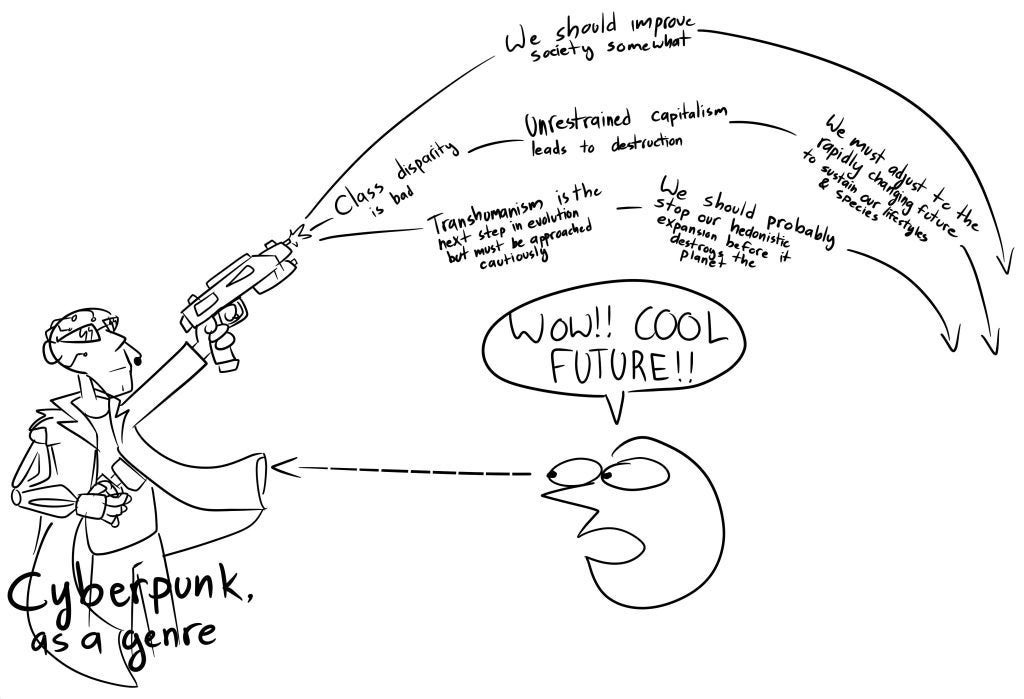
“Yet it seems, at times, bizarrely unaware that many of those notions were meant to be dystopian or satirical – dismal visions of where our worst and dumbest habits could lead us.”
They are very aware. They’re just counting on the bulk of John Q. being unaware, because they’ve steadily been dismantling the already woefully inadequate public school system and replacing people reading books with short-attention span, dopamine hit inducing low-brow social media and television programming.
With a few exceptions, you’re confusing cause and effect.
Exactly, Sci Fi writers almost never invent an entirely new technology for their books, they just look at current technology, think a bit about where it might head, think about how that could interact with broader societal forces, realize some flaw there-in, and write about it.
Technologists are doing basically the same thing, looking at current technology, thinking about where it might head and what might be useful and/or profitable, and then start trying to overcome current obstacles to develop and build it.
But one of them takes a single person a year or two to write a book, and the other has to start trying to do research and building things and testing them and breaking them and getting funding and overcoming the current obstacles etc. etc. If they start at the same time it will look like the technologist has just built what they were warned not to, when in reality they’ve been building it the whole time on a parallel path.
Because it’s designed by businesspeople, not engineers.
All……that……because Sora can create funny videos that people ask it to 😂