Why don’t you just buy a few senators and do something about it, if you’re so upset?
Yup. Donors get policies, voters get apologies.
Donors get policies, voters get
apologiesfined.
Rich Americans have money and buy senators.
Poor Americans have guns and take fascism sitting down.
MMW the midterm results will enshrine DNC Incumbents as the fascist enablers they are.
MMW the midterm results will enshrine DNC Incumbents as the fascist enablers they are.
Can’t wait for Dems to take both the House and Senate … and then always be just one vote short of being able to do anything meaningful. As usual.
If only Americans would learn from MAGA primarying GOP incumbents until the party moved in the direction they wanted.
Takes more effort than bitching online and actually takes persistence and patience.
Or have enough votes for something not meaningful.
“Poor americans have guns” bruh, guns cost 1/2 a month of rent just for the gun. No way I can put my money for that.
Yep. The “fine OR imprisonment” part means fines for the rich, and imprisonment for the poor.
The filthy rich only go to prison for stealing from other filthy rich assholes.
“If the penalty for a crime is a fine, then that law only exists for the lower class”
- Final Fantasy Tactics (1997)
97?! I was that old already… I thought this was older
deleted by creator
Except it’s not even fines anymore, apparently it’s perfectly legal as long as you destroy the book after scanning it.
They used the duress PIN on their rare book library
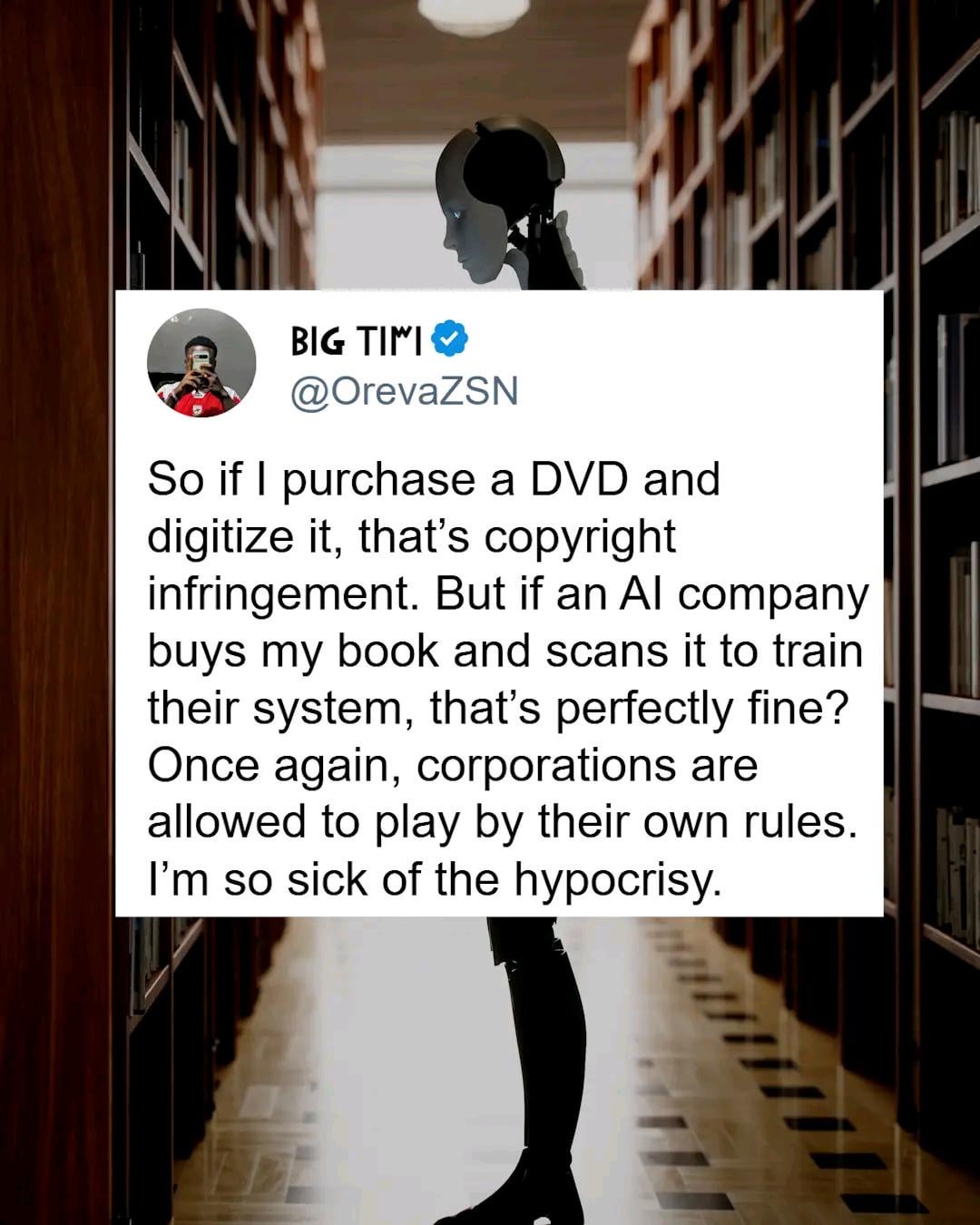
I’m not pirating, I’m building an AI model
Honestly, this sounds like the best test of copyright laws.
If corporations can train models on pirated data, and corporations are persons, then you, as a person, should be able to infringe copyright to train an AI model too.
“The training process [also] implicates the right of reproduction.” – Part 3, III, B, U.S. Copyright Office Guidelines on generative AI.
I agree with the conclusion, but that rationale is wrong. First, you can digitize a DVD. Second, it’s not a double standard. You can grab copies of random stuff and jam it in an AI model too.
Our laws are written such that it’s making a copy outside of reasonable use that’s illegal, and AI training only makes a copy incidentally to what they’re doing and then it’s deleted. It’s the same standard that makes viewing a photo on an artists website legal.It’s not bullshit because they’re breaking the law, but because we need to refine the law to make it clear training an AI model isn’t a reasonable usage anymore than a public broadcast of a DVD is a reasonable use.
Trying to shoehorn it into the existing laws will just create a nightmare of loopholes and complications.AI training only makes a copy incidentally to what they’re doing and then it’s deleted. It’s the same standard that makes viewing a photo on an artists website legal.
That’s not what the U.S. Copyright office says about training. They hold that it does implicate the copyright of reproduction. Meaning: If you train on a protected work without a license you are violating copyright, and if that’s not a fair use then you are breaking the law.
Training ~ viewing might be an analogy used by “AI” brands, but it is not legal reality.
I’m not sure that’s been extensively tested in courts. The document you referenced below appears to be as-yet not officially published, so I don’t believe it actually qualifies as an official position yet, but the bigger issue is that it’s untested in court.
This thread is a response to an AI court case where the ruling was that training on copy written works is fair use.
Alsup ruled in June that Anthropic made fair use of the authors’ work to train Claude, but found that the company violated their rights by saving more than 7 million pirated books to a “central library” that would not necessarily be used for that purpose
Regardless, you do make good points and I think we agree that the end state is “they shouldn’t be able to do that”. I have concerns that using existing standards that take copying too literally results in some unintended ambiguity, and situations where AI training is incidentally blocked, but so is stuff like “opening a news article on a computer”, which does the same things the copyright office report highlights as infringement.
I think we’d be in a much more agreeable place if we just legally state that a commercial AI tools training isn’t fair use. That lets you have nuance like “search engine? It’s a statistical model, but not generative: allowed. AI agent? Statistical model that’s generating content as opposed to classification or ranking: not allowed”.The document you referenced below appears to be as-yet not officially published
Parts 1 and 2 are officially published.
On May 9, 2025, the Office released a pre-publication version of Part 3 […] A final version of Part 3 will be published in the future, without any substantive changes expected in the analysis or conclusions.
Alsup ruled in June that Anthropic made fair use of the authors’ work to train
But, Kadrey v. Meta Platforms, Inc. (Judge Chhabria, June 25, 2025) states that “in most cases,” training LLMs on copyrighted works without permission is likely infringing and not fair use and “this ruling does not stand for the proposition that […] use of copyrighted materials to train its language models is lawful.”
The courts are divided, but the copyright office is not.
I think we’d be in a much more agreeable place if we just legally state that a commercial AI tools training isn’t fair use.
Good luck getting any federal law changes through before 2028, at best. So, for at least a couple of years, we get to use the existing laws to address generative “AI”'s use of works still under copyright protection.
Any change in status before then we be policy changes by the U.S. Copyright Office, but they have already come down against training (mostly; the publications are long because there’s a lot of nuance).
There may be a limitation if the DVD is copy-protected, as is usually the case. There’s too much to read for a single comment in DMCA: https://www.congress.gov/105/plaws/publ304/PLAW-105publ304.pdf
But it does fall under this definition (§1201):
‘‘(a)(3) As used in this subsection—
‘‘(A) to ‘circumvent a technological measure’ means to descramble a scrambled work, to decrypt an encrypted work, or otherwise to avoid, bypass, remove, deactivate, or impair a technological measure, without the authority of the copyright owner;and
‘‘(a) VIOLATIONS REGARDING CIRCUMVENTION OF TECHNOLOGICAL MEASURES.—(1)(A) No person shall circumvent a technological measure that effectively controls access to a work protected under this title.
They hyphenated techno-logical both times in the second paragraph? Was it a line break both times, or was the moron who wrote it really that out of touch with the topic he was writing laws for?
Line break, I’ll fix it.
How do you digitize a DVD when it’s already digital?
Har har.
Different senses of the word digital. The dvd is digital as in “made discrete and not analog”.
I meant in the sense of “to move off of fixed use physical media and translate to a format more agnostic to storage medium or conducive to transfer and immediate processing”.
More succinctly: to copy something to a storage medium that’s harder to loose under the couch.
You can’t hold something in your hand if it’s digital.
Oh?

Okay so how DO you digitize it since you can also hold the SSD in your computer in your hand? In fact I can’t think of a data storage medium in use that you can’t touch physically at all.
The larger part of the infringement is probably its use commercially. I doubt that there would have been such a fuss if it was a fully-open, low-profit operation.
But as-is, the commercial products are being used to make money for the AI company in an unauthorised way.
Similar to how it’s generally frowned upon for fan media to make money, because it starts being infringement. You can have a “support the fan media maker” button, but you generally can’t do things like put your fan media behind a pay wall. The IP owners will come down hard on you for that.
Commercializing a work virtually guarantees it’s creation isn’t “fair use”.
But also, “fair use” is actually quite a bit more narrow than just non-commercial.
First, you can digitize a DVD.
Nitpick: Why would anyone do that, DVDs are already digital mediums with a filesystem. So they first have to convert to analog media first… And that introduces losses…
You just put a DVD in your drive and now you can copy files from it to you HD… If copying files is now called ‘digitizing’ we live in a strange world…
If you have a large number of DVDs, digitising them makes them easier to browse and decouples you from the physical medium (so you don’t have to bring them with you everywhere in order to watch them).
As for the conversion, maybe you’re confusing this with ripping vinyl or tape. Ripping a CD or a DVD is easy and reproducible and gives you a 1:1 digital copy of it.
You’re missing his point, he’s unhappy with the word choice. Ripping a DVD is not digitizing it. Digitizing means specifically turning an analog signal digital.
Ah, my bad - now that I read it again, you’re right. In the same line of thought though “digitising” is sometimes wrongly used in the place of ripping.
Right, that’s it. Though… you probably shouldn’t assume someones gender ;)
You’re right, but I think I got a lucky hit this time.
Maybe because I’m not a native english speaker, but to me ‘digitising’ means converting an analog medium to a digital one. Like with vinyl, VHS, etc. And ‘ripping’ is about an extraction process. Like overcoming a protection or more difficult to access mediums like Audio CDs, which don’t have a real filesystem, and into a easily accessible single file on a harddrive.
DVDs are already digital, and if they don’t have a copy protection, which you have to rip through, you can just copy the files to a hardrive and then, if you want reencode them into one more portable file…
It definitely does have the meaning of making an analog signal discrete, and DVDs are digital in that sense.
There’s also the sense of serializing or enumerating something into a format more flexible or amenable to computer manipulation. More briefly: to put it on a computer.For some things it’s super obvious: a vinyl record has a groove you can see, and you digitize it by sampling the output of the wiggle: analog.
The contents of an SD card are invisible and the only way to observe them is via a computer, where they’re already presented in a flexible format: not analog.Then you have fuzzy things: a printed picture that was taken with a digital camera. Grab a magnifying glass and you can see that it’s got blocks of quantized color, and isn’t continuous. You digitize the photo by shining light on it and capturing the bounce.
Optical media is a disc with a groove in it that you read by shining a light on it to capture the bounce. Instead of a horizontal wiggle though it’s pits creating an interference pattern with a laser.
It’s digital because it’s quantized information that it stores. It needs to be digitized to work with easily because the format is often read-only or write once. It’s analog because the pits themselves are continuous and the system spends surprising amount of nuance correcting errors from things like fingerprints and dust.Books are plainly analog, even though they’re composed almost entirely of discrete, quantized units of structured information. Sometimes even with a lookup table and index for faster search!
Magnetic tape stores analog audio by varying the strength of a magnet with the audio signal. It stores digital information by only setting the magnet to specific strengths. Same for VHS or cable Internet.
To make a long ramble short: digitize also means to stick it on a computer, owing to efforts to digitize things often being focused on items that aren’t continuous, like text.
You got four replies all about just the DVD part, but I want to ask is how you would word things to apply to AI specifically? LLM models? Idk what language would be in legaleese for this and exclusive enpugh to apply.
The traditional method would be to define the scope and intent of the law, and then defer the specifics of enforcement to an executive agency for nuanced application. That way the law conveys “no usage of information passed to a machine learning model for the purposes of generative content production, nor the output of any such system, should be considered fair use under copyright law unless the usage is non commercial and qualifies as fair use for academic or research purposes”. Then someone like the FCC would determine what qualifies as a machine learning model, and can flex to account for changes in technology.
You basically just say what you mean very specifically. I don’t think it’s a problem for Google to download webpages and track how they connect and their words, because that’s how search engines work. So I’m okay with that. I’m okay with individuals downloading chunks of the public web to do normal things. I’m okay with people needing huge swaths of the text for research, as well as the images, even for specific research into generative AI of the type we’re talking about. No one is being harmed by someone at MIT incidentally creating farside comics.
Harm or no harm, the disagreeable part to me is the commercial use of the model trained on inputs from people who didn’t want you to do that, sometimes without even having the most superficial justification to have the content in the first place.
Thank you for the clarification. The topic is growing ever more nebulous.
remember folks: the entire problem is capitalism. it can literally all be solved by dismantling capitalism and …undismantling some guillotines.
Do you think that under State socialism that copyrights will exist and be enforced?
Who/what exactly would grant OR enforce copyrights under libertarian socialism?
Capitalism is a problem, but is not quite parallel with IP rights/protections.
i think also state socialism would be a problem, yes.
Am I misunderstanding something here??? Copyright needn’t exist under socialism because under socialism artists wouldn’t be dependent on the legal fiction of “intellectual property” to make a living.
Without copyright, what LLMs raiding the creative output of whoever (including by destroying and scanning books), and reproducing it, even exactly, wouldn’t have any legal restrictions, but neither would overt piracy.
It would be a very different world. So, depending on what you think is “wrong” with one of the listed activities but not the other, it might be solved by eliminating IP (as part of overthrowing Capitalism or otherwise). Also, the current private justifications of those behaviors would no longer acquiring or obtaining capital, but that doesn’t mean people wouldn’t pursue those behaviors for other justifications.
I think in a socialist world, a great many artists will still find themselves working to make a living; they will work for the community instead of the Capitalists, but there will still be work to be done, and art may not keep your belly full in lean times. But, I also have problems imagining a socialist world.
Now you have upgraded to a more limited number of rich assholes with even more concentrated power. Oh wait, a couple of decades later they reintroduce capitalism too.
It’s unclear that is inevitable, but it does seem to be a common result of State socialism.
In libertarian socialism, hoarding resources will be recognized as an attack on the commons that can be answered with an attack (by the people) on the hoarder.
How in the world is that going to be policed?
In libertarian socialism, the people are the police. There’s no States, so no state-organized and state-privileged police force. I could be wrong though, I still need a lot of education around libertarian socialism; I’m very much used to Capitalism.
That makes no sense. How are a bunch of vigilantes going to be accountable to the rest of society?
Maybe this will help: https://theanarchistlibrary.org/library/the-anarchist-faq-editorial-collective-an-anarchist-faq-full#text-amuse-label-seci58
I haven’t internalized all of it yet.
I think this is the most direct answer:
Simply put, if people impose themselves by force on others then “they will be the government” and “we will oppose them with force” for “if today we want to make a revolution against the government, it is not in order to submit ourselves supinely to new oppressors.” [Malatesta, Op. Cit., p. 99] This applies to defending a free society against organised counter-revolution and against those within it conducting anti-social (“criminal”) activities. The principle is the same, it is just the scale which is different.
The “bunch of vigilantes” will be accountable to the people because they will be the people. They will act to reject anti-social activities, re-educate people that chose to do anti-social acts (so they have a pro-social understanding), and remediate any harms due anti-social activities.
The police, right now, are the people. The state is the people.
False, they never bought your book.
Missed a major part: the AI companies are buying rare books, scanning them and then burning them. It’s not like buying a DVD which can easily be digitally copied with hardware that most people have at home, it’s so mucn worse than that.
Actually, not true. You’re legally allowed to make as many personal copies of anything you like in the USA, from ripping to downloading, as long as you don’t sell or redistribute it outside of fair use.
I have heard in the US is illegal to bypass copy protection or encryption on DVDs which is required to digitize them.
The DMCA prevents breaking encryption but you can still create an ISO from the disk.
For which you need a key to unlock “your” locked copy. Breaking the lock would be illegal. Making your ISO useless.
What? That’s not true at all. You can just burn the iso to disc or use software that’s paid the license fee.
It’s stupid bullshit but perfectly possible.
Not as useful but still perfectly usable. Just not editable
you forget we all practice bird law here
Hey, btw, did you get that thing I sent ya?
Thing? Sorry I didn’t sleep last night and I got Shanghai’d into being in a 3 hour gig/funeral I was not awake enough for this morning. I got to like season 3 I think.
The AI company doesn’t even have to buy it.
This is why I’m just back to pirating shit.
Especially if it’s from Amazon.
Copyright laws are just state’s monopoly on information, at this point.
Digitizing a dvd shouldn’t count as copyright infringement unless you are actively distributing the video or selling it. Bullshit.
It’s not if you own the copy and saved it. The distribution is specifically the problem. Physical media ownership allows for alternative copy ownership depending on where you live.
Oh no no no no you got it all wrong, you have to digitize it and then burn the CD so that nobody can ever see it unless they have access to that digital copy.
Something something who else was it that burned books?
You wouldn’t download a DVD
But digitizing your own content isn’t illegal you have the right to backups. It’s when you choose to distribute those copies to people who did not pay for the original product that you get in trouble. This argument makes no sense.
Removed by mod