Summary
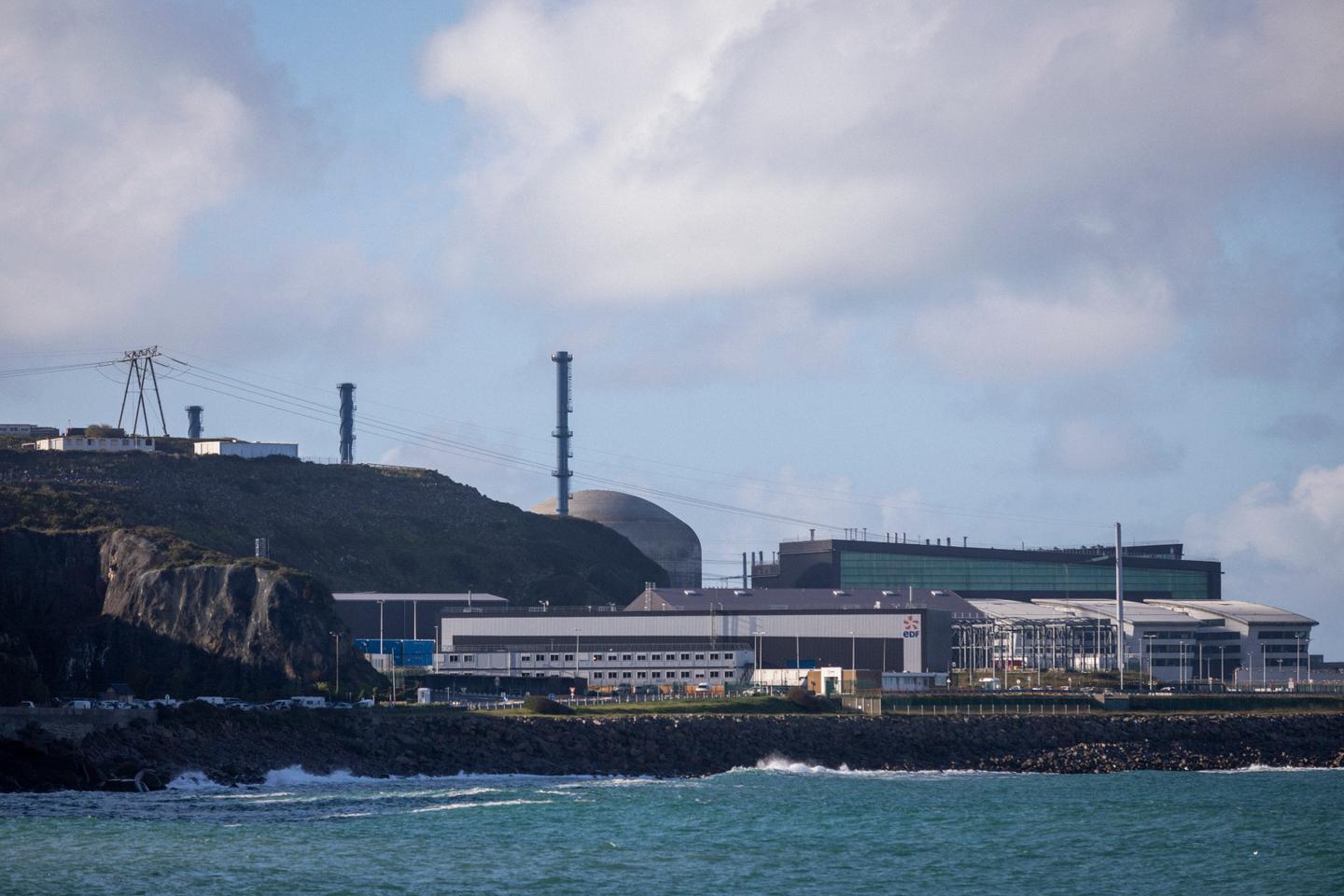
France’s Flamanville 3 nuclear reactor, its most powerful at 1,600 MW, was connected to the grid on December 21 after 17 years of construction plagued by delays and budget overruns.
The European Pressurized Reactor (EPR), designed to boost nuclear energy post-Chernobyl, is 12 years behind schedule and cost €13.2 billion, quadruple initial estimates.
President Macron hailed the launch as a key step for low-carbon energy and energy security.
Nuclear power, which supplies 60% of France’s electricity, is central to Macron’s plan for a “nuclear renaissance.”
For additional context, one of the reason for the delay and cost increase was the absurdly complex design due to French and German companies trying to collaborate on a new design as Germany was turning anti-nuclear, which culminated with Germany deciding to stop nuclear energy after the Fukushima Daiichi event.
Another big reason is the knowledge loss due to almost one generation without any reactor built in between.Now do Georgia’s Vogtle reactors 3 and 4, which came in at 34 billion for 2 x 1200mw plants, 21 billion over the original 14 billion estimate, and took over 14 years to build, 8 years behind schedule.
Im glad these powerplants finally got built. They will help, but nuclear is just not reasonable anymore. Its a slow, expensive tech, especially when we are making such leaps and bonds with solar/battery.
Even if wind and solar make huge progress, they will likely never be as efficient regarding raw materials efficiency and land use. Land use is the main contributor to biodiversity loss.
I don’t think peremptory opinions about technologies are going to help. We should use what ever technology is the most reasonable and sustainable for each specific location.
Total land used for all power to be supplied by solar would be a hilariously tiny percentage of land, so this just reads like a solar version of “its killing birds” to me.
Agrivoltaics also side steps this non issue, as interlacing solar panels into farm land increases yields for many crops while making efficent use of space that’s already spoiled any biodiversity. Can you do that with a nuclear reactor?
Yeah in a perfect world based on some rough data you could supply the entire planet’s energy requirements with a solar plant about 300,000 square kilometers, or basically the size of Arizona, which translates to about 0.2% of the total landmass on earth. That being said, I’m curious what a solar plant the cost of this nuclear plant would look like, and where they’d put it. I think centralized vs distributed land rights and compensation is really tougher than the tech at this point.
Nevada just built a hybrid 1400MW solar/battery plant for 2 billion dollars in 2 years.
That 1400MW is solar panel + battery output, so it doesnt match nuclear’s steady state, but ive done the math on these projects before. We should be able to can build a 3000MW solar generating plant with 1200MW battery supply for 16hrs at roughly a cost of 17 Billion dollars, or 1 Vogtle nuclear plant. My time estimate was 6 years. This would output 2x the power of the Vogtle plant during the day, and output just as much as it over the night.
The above makes solar/battery not only way more productive than nuclear, but way safer, and way faster to built. All of that is just with demonstrated, everyday tech available today. It ignores all the huge advances being made in various batteries and panels. In the decade+ that it would take to open just one more reactor, we will likely be able to 2x-3x the power and speed to build at a lower cost with just solar/battery.
Nuclear was the right answer for the last 50 years. That’s no longer the case.
wtf? Decentralized production is one of solar’s greatest advantages.
Nuclear could take over existing coal plants which would allow use of otherwise unusable land that’s been polluted by coal. It would require regulatory changes though, as the coal plant is already irradiated beyond allowed levels for nuclear.
This is a poor argument. You just did what you explicitly should not do with Life Cycle Assessment (LCA) results.
The ISO 14044 specifically requires life cycle assessment to include all relevant impact categories. In particular in comparative analysis it is crucial to not single out any one category, but look at the impact on the endpoints, e.g. ecosystems or human health.
See page 37 onwards.
Here is the full LCA study, that you drew only one category from
https://unece.org/sites/default/files/2022-04/LCA_3_FINAL March 2022.pdf
Look at the Endpoint indicators, like “Lifecycle impact on ecosystems, per MWh, in pointes”, “Life cycle impacts on ecosystems, no climate change,per MWh, in pointes”, “Life cycle impacts on human health,per MWh, in pointes” etc.
Nuclear power does fare well in these categories, but often only marginally different to Wind Power and Solar Power. It certainly does not offset the cost difference, when you also have to include the opportunity costs of running coal or gas plants longer.
This is a poor argument. You just did what you explicitly should not do when engaging in a discussion: building a straw man argument and cherry picking a part of an answer.
I highlighted two rarely mentioned and non-intuitive points about nuclear vs renewables, I bet a few readers learned about it. But, I didn’t say renewables shouldn’t be used. My conclusion says the opposite, don’t have blocked opinions about technologies, use whatever is most adapted to the location, if it’s renewable, that’s great.
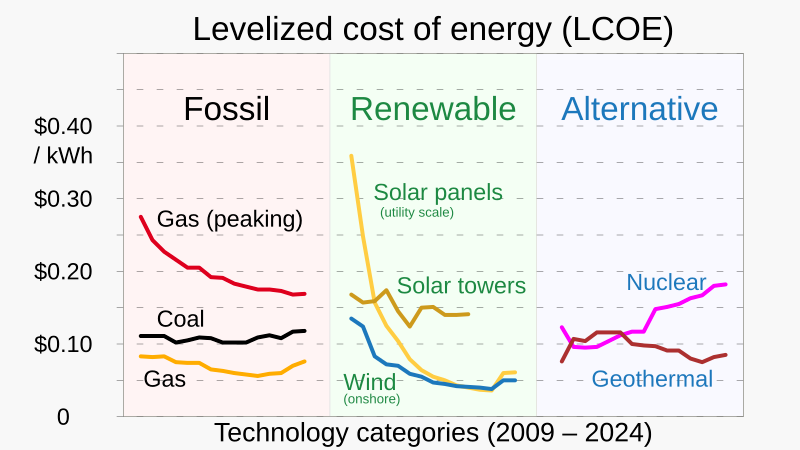
Something to note about this chart is that ground-mount silicon solar PV isn’t considered for sharing land use with activities such as farming in comparison to how onshore wind is (i.e. agrivoltaics).
NREL in the US estimates that there are currently ~10.1 GW of agrivoltaics projects spread across ~62,400 acres (or ~7 m^2 / MW).
Even this being said, I think brownfield or existing structures for new PV is the way of the future for solar PV. There is so much real estate that could be used and has the potential to offset grid demand growth while providing greater reliability for consumers. You’ll need the big players to help with industrial loads, but even then, the growth of Virtual Power Plants (VPPs) has the potential to balance loads at the same scale as the big players for the prosumer market.
Edit: I’ll also make mention of floatovoltaics, or the installation of solar PV on bodies of water, either natural or artificial. This is a burgeoning side of the industry, but this is another area that could present net zero or even negative land use per unit of energy.
Don’t forget solar fences
Something to note about your link to solar fences is that one of the cons mentioned is that panels can’t produce power for half of the day because they’ll be facing away from the sun.
Bifacial panels exist and can collect energy from both faces of the module. We in the utility-scale space use these all the time. You’d want these over monofacial panels for fence applications
Yes. Bifacial seems like the obvious choice. And the fence should be NS orientation not EW.
If you’re trying to maximize energy collection then yes you’ll want to face the fence rows NS.
But there are also some benefits for making use of vertical bifacial panels oriented EW. You get a bimodal energy plot: one in the morning and one in the evening when the sun’s direct rays shine near horizontal (something NS panels can’t collect).
I’d actually be interested in reading the literature on mixing these types of panel orientations to see what the resulting production yields would look like, and if stakeholders like utilities would find any benefit in them to help better manage grid demand in those peripheral times of the day.
Could you compare it to land used for livestock or car parks or low density housing?
If we went 100% solar is that even noticeable compared to mentioned above.
You just making excuses.
Could you not compare unrelated stuff? What you just did is called “whataboutism”.
“Land use is the main contributor to biodiversity loss”
Is that not a quote from what is being talked about.
How much of land use that is contributing to biodiversity loss is solar panels and wind? How much is energy in total?
It’s fuck all. So yea that is relevant.
I am not making any excuse, I’m providing additional points to consider.
Pointless points. It’s a rounding error in the grand scheme of things. You’re just a fossil fuel shill.
Why do you have to reduce a discussion to chilling? What a sad attitude.
I guess you’re not in a listening mood, but in case you are, let me state my opinion: I am in favor of all solutions that will help reduce the ecological crisis, which means reducing dependency of fossil fuels, raw materials extraction, and land usage among other things. I think both nuclear and renewables are good solutions for that, but they both have issues, so let’s use what is most appropriate for every use case.
There is no particular reason solar “needs” to use any new land at all, given that we can just put it on the roofs we already have.
And the fact that we do dedicate land to it instead of only doing rooftop just goes to show that land use isn’t anywhere near as important a problem as you insinuate.
Your comment is pure FUD.
You are very quick to deduct things. The reason land is dedicated to it is that it is not easy to organize with building owners to get it on the roof, compared to buying land building what you want on it, and equipping roofs is obviously more technical than building on the ground. We can’t just think it terms on what could be possible but what the reality is.
Countries who try to stop land artificialization to reduce impact on biodiversity struggle to, because of all the economical pressure where renewables may contribute, it’s not an easy subject.
Please try not to look for negative intentions, I am here to participate in the debate and learn with others.
It’s slow expensive tech because we don’t invest in it.
Every technology is slow and expensive when you have nearly an entire generational gap in knowledge and experience.
You’ll know that I’m not saying solar and wind are not cheaper, they all exist in a different capacity and fill in the gaps they best fit.
We have invested decades and billions into reactor tech. The DOE just announced another 900 million for SMR, on top of previous billion dollar grants. So far, every SMR company has failed to make any progress. The DOE even certified one for use and it still can’t get it done.
Meanwhile, solar/battery research is getting funding from tons of sources, government and corporate, and exploding forward in every direction. Solar arrays are being deployed all over the world at insane rates, propelled mostly by just how inexpensive, safe, effective and easy it is to deploy. Its because of solar/battery that we may even hit some of the 2030 “pie in the sky” climates goals that were set across the world.
Its pretty clear which of the two techs we should be spending time on.
Both. There aren’t enough rare earth materials to build enough solar panels to completely erase power plants. Panels have a devastating mining issue similar to batteries as well. Solar has lots of hidden costs no one talks about. It’s cheap just like batteries but the opportunity cost is huge. Nuclear meanwhile has a high upfront cost which is the real reason it scares away investors. Also political anti nuclear nutters don’t help with financing issues.
Solar panels can be made of many different types and volumes of material. First solar, the largest manufacturer in the US, uses a differenr process than chinese panels for example. Perovskite solar cells, which are not just yet ready for prime time but are advancing rapidly, don’t use any.
Nuclear power has its own mining and rare material problems, in the form of uranium. You have to dig into the earth for it, and then after you use it, poison part of the planet forever. We still dont know what to do with all the nuclear waste we alrwady made.
Not exactly an ecological win.
Perovskite uses rare earth metals too, so while they increase efficiency they are just as destructive
You can fit all the nuclear waste jn the world in one football field. It’s not alot.
Perovskite are iterating through many different materials as the science settles on them, but one of the positives is that the materials aren’t nearly as rare.
you can fit all the nuclear waste in the world in one football field
This is not true because of radioactive waste water, containment vessels and spent fuel rods, all of which are highly radioactive along with your football field of actual spent fuel, but okay.
If we could do this or something like it, why haven’t we? Is it because no one on earth wants that football field? Is it because we tried this at sites like Hanford, Washington and its been a half century of ecological disaster?
People undersell just how destructive the entire radioactive waste cycle is. Nuclear is way, way better than coal and oil, but solar/batteries kick its teeth in here.
Nuclear power has its own mining and rare material problems, in the form of uranium. You have to dig into the earth for it, and then after you use it, poison part of the planet forever. We still dont know what to do with all the nuclear waste we alrwady made.
Thorium is 3-4 times more abundant than uranium, is generally safer to use and would produce less waste that is also less radioactive and can become safe in a reasonable timeframe (few centuries compared to few hundred/thousand? centuries). Historically the main issue with Thorium has been that it’s not as sexy as uranium because you can’t make nuclear weapons out of thorium.
A technology will also continue to be slow and expensive when you have rich and powerful entrenched and ossified business interests (the fossil fuel companies) who BENEFIT from said technology being slow and expensive, and doing everything in their power to KEEP it slow and expensive, up to and INCLUDING fraud, graft, bribery, and blackmail.
Nuclear reactors have always been subsidized by the military. Solar and wind are so much cheaper than anything that came before.
Solar is not sustainable. Maybe one day but today’s panels will all have to be replaced in a few decades. For now it’s a way to bridge the needed to go fully nuclear.
You realize nuclear power plants have steady maintenance and replacements occurring at all times, right? That a machine being used in nuclear power doesn’t make it immune from breaking down? That many of the machines involved have spinning and moving parts working in a high heat environment, whereas PV systems are largely static?
Replacement in a nuclear plant is happening way, way more often than on PV panels, where commodity panels are rated to provide near full power for 25-35 years, and then still provide over 80% power while they very slowly drop off. Solar is the only power source that will continue providing power without constant maintenance.
If “lack of replacement” is your main criteria, you dun fucked up backing nuclear. Solar fits that bill way, way better.
Of course a nuclear reactor needs maintenance and thus also produces infrastructure waste. A lot more than a solar cell. But it dwarfs when you divide by watt-hours. Solar cells produce dozens of times more waste per watt-hour, and stuff that’s worse to handle too. Nuclear plants are mostly concrete and steel. Solar panels are glass and rare elements that we can’t recycle properly yet.
Like, you didn’t really think I was just comparing plants to cells did you? The point is, if the whole world goes solar, how many times over can we replace all of it?
Nuclear plants are mostly concrete and steel.
???
You realize the above is true for basically any building, right? That that’s a crazy metric to judge any maintenance effort by? Total weight of the building and then everything in it?
Do datacenters not have replaceable parts because they are mainly concrete and steel? Sure, they may have 10,000 servers that all need to be fixed and replaced constantly but since a datacenter is mostly concrete and steel, it doesn’t matter because it’s not much by total mass of the datacenter? Same goes for airports, factories, on and on.
I guess if you plonk thousands of maintenance heavy devices into a large enough building then weigh the whole structure, the percentage of the structure that has to be serviced goes down, making overall (by weight) maintenance go down. Airplanes need to be fixed? They weigh basically nothing compared to airports, so “tada!” no they dont!
Skipping over your bizarre metric, solar cell recycling is hitting 95%. That is again, something that isn’t relevant with modern panels for 30-50+ years, as they will still be producing 70-80% of their rated power at that time. That’s easily enough power to just leave them in use.
Lol and the commenter above you is forgetting about the aluminum of the PV module’s frame, as well as stainless steel used for the racking. Those things are super easy to recycle.
Ehh, concrete is very polluting, and nuclear plants need a lot of it. It’s not gonna get recycled either. I thought this was obvious. Dunno how you thought that was a dunk.
But we can keep building them. It’ll always be expensive, but we don’t need much rare material.
I was hoping I’d see cobalt etc in your link, but still not then… For solar cells we need that 5% to be mined over and over. 50 years is nothing if you’re talking about renewables. Might as well not care about sustainability at all if you’re not talking another 5000 years.
Cobalt is more abundant in the earths crust than thorium or uranium by an order of magnitude.
Solar panels are glass and rare elements that we can’t recycle properly yet.
NREL’s Solar PV fact sheet on circularity says that conventional solar PV panels have recovery rates of 80-95% given existing recycling infrastructure.
We know how to recycle these things. The fact that we maybe don’t do so in a widespread way is because it’s still cheaper to throw shit in a landfill or incinerator.
95% doesn’t mean you can turn 100 old panels into 95 new panels. The 5% is cobalt and stuff, that needs to be mined over and over. It’s great that we have such rates but we’re not really lacking in glass.
Just because those panels will need to be replaced in decades time doesn’t mean they won’t have value then.
NREL estimates that PV 80-95% of modules’ materials can be recovered through recycling, and there is constant academic work on refining the EoL process to better delaminate panels so they can be better sorted and their materials better reused.
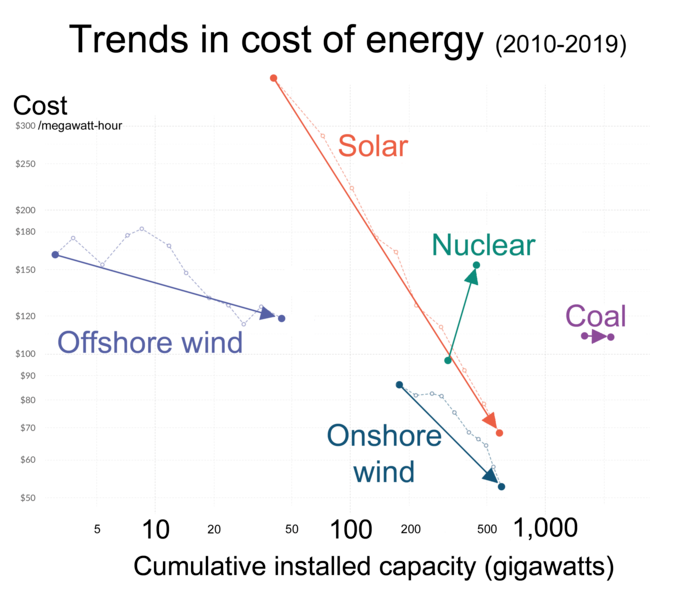
I can’t find the figure, but I believe the IPCC found in their 6th Assessment Report that the cost to deploy renewables + battery storage, and manage the grid more intelligently on the backend, absolutely demonstrate lower costs than it takes to build new nuclear. I want to say that that finding still out value on our existing nuclear fleet, so we definitely don’t want to shut any existing plants down if we don’t have to.
I don’t think fission nuclear will get our energy systems off of fossil fuels. Fusion nuclear has the potential to do this, but by the time that technology reaches commercial operation, renewables alone will likely be in the multiples of TW of generation capacity.
Nuclear should be part of the future if modularity and MSRs/thorium reactors can breakthrough. Until then, solar/wind + storage baby
By replaced, do you mean recycled
No. I mean, hopefully both, but solar panels can’t be fully recycled into new solar panels. A bunch of rare materials need to be mined over and over.
I hope, nuclear means nuclear fusion here…
with Germany deciding to stop nuclear energy after the Fukushima Daiichi event.
Hey, you don’t know where the next tsunami will happen. Have to be proactive.
The real irony being that all Japanese reactors shut down due to the quake as designed, and the tsunami wouldn’t have been a factor had money not been saved by shortcutting backup generator protection from flooding in a FLOOD ZONE.
had money not been saved
This just serves as a lesson to the “failsafe technology” crowd: That also involves failsafe humans. Those, to the best of my knowledge, have yet to be invented.
Oh and relatedly some German reactor ran for decades without a backup power generator. It was there, present, physically, that is, but noone bothered to check whether it actually worked. Merkel justified her flip-flop on the nuclear exit (shortly before Fukushima, she delayed the exit that SPD+Greens had decided on) by saying, more or less, “If the Japanese can’t do it we can’t do it either” but if she had been paying attention, it should’ve been clear that we couldn’t do it. That became clear when the first SPD+Green coalition moved responisibity for nuclear safety from the ministry for economy to that for the environment, run by a Green, and they made a breakfast out of all that shoddy work that the operators had done. Oh the containment vessel is riveted… figures they put the rivets in the wrong way. Shut it down, have fun re-doing every single one of them before starting it up again.
Thus, my conclusion: The only people you can trust to run nuclear reactors safely are people who don’t want nuclear reactors to exist in the first place.
Human failsafes have been invented. Every nuclear silo has one: two, independent people, with unique keys, have to both agree to launch. Otherwise, it fails safe, and no launch. Even with valid launch orders.
It’s totally logical even aside from the economics. The consequences are too great, which is why nuclear plants are uninsurable. You think this French plant and Vogtle were expensive? Imagine if they had to be insured like everything else in our society. But they can’t, because no insurance company is large enough. By default the public ends up footing that cost to the tune of trillions.
If you exclude the early phases of nuclear development, and later accidents that happened due to bad management, how dangerous is well run nuclear energy? Maybe it’s not the form of energy generation that’s the problem.
Maybe if the difference between “just an expensive technology” and “deadly disaster impacting the lifes of millions of people” is some bad management and poor regulatory oversight, it is not a technology fit for the use of current humanity.

Personally, drag is pick-your-battles-nuclear. That is to say, scientifically it’s a good technology, but fighting a political battle to get nuclear cheap enough to compete with wind and solar is pointless. Advocating wind and solar is much more efficient in terms of political effort spent.
Depends on context, which I think is missed in basically all these discussions. Solar, wind, and hydropower are obviously contextually dependent technologies, that are well suited to particular environments. They have to line up with energy demand curves, or else impose expensive and inefficient battery solutions. They don’t have a whole lot of efficiency in terms of land use, which there are some proposed solutions for, but they’re pretty efficient both economically, and are pretty ecologically contentious as long as recycling is being done adequately. Nuclear solves a different problem. It provides base load, which is somewhat important, it’s potentially not as flexible as a technology, but it’s easier to build infrastructure for because it’s more consistent. It can also be somewhat land-use agnostic, though things like water use for cooling towers and tradeoffs such as that are definitely a consideration. It’s also much denser in terms of land use, meaning it’s potentially more efficient for larger cities.
They’re both just different technologies, with different applications, and they both have a place in any sensible structuring of the world. I don’t understand why people become so split along the obvious astroturfed and petrol-funded propaganda that floats around for both sides. You have pro-nuclear people that are saying solar panels like, require exotic materials mines, which is insanely ironic, and you have solar people who are fearmongering about solved problems like nuclear waste and safety concerns and efficiency in terms of economic cost, which is also insanely ironic. The fact that this conflict comes up every time strikes me as kind of horrendously stupid and obviously favorable to petrol lobbies.
Bro, THE FUCKING BACKUP DIESEL GENERATORS FOR THE PLANT WERE BELOW SEA LEVEL.
Make it make sense. If those generators had been above sea level, well probably above 100-year tsunami levels, we likely would not have seen the plant catastrophically fail.
That was part of the problem. Built where it was cheaper, ignoring literal ancient markers saying not to live there because of the past. But they would have still not failed, had they been designed for the potential of being submerged. Again, they were not because that would cost more for a long range risk. It all falls into bad planning and profit, not in any way because it was a nuclear plant.
bad planning and profit are of course words never uttered in connection with German infrastructure projects.
It’s always Germany’s fault when it comes to nuclear, isn’t it?
Probably not anymore, I think they do very good as just being buyers of it and outsourcing its issues to their neighbors.
In the second half of 2022 Germany had to export a lot of energy to France, because french nuclear power plants are so poorly run that a lot of them had to be taken off network at the same time.
FRANKFURT, Jan 5 (Reuters) - Germany exported more electricity to its neighbours than it imported in 2022, even with an energy crisis at home, thanks to more more weather-driven renewable power and greater demand from France.
Due to the technical problems affecting French reactors, Germany for the first time sold more power to France than it received from its neighbour, doubling its year-earlier export volume there. France produced 15.1% less power in 2022 and the volume fell short of national usage by 1%. France faced its own energy crisis amid outages owing to delayed maintenance and stress corrosion.
France failing to diversify its energy production is not a failure of Germany or any other country though.
What a misleading cherry picking, this was an exceptional event due to:
- Maintenance schedules being delayed because of COVID
- A new maintenance issue discovered and triggering a general inspection that created further delay
- Energy crisis related to the Russian invasion of Ukraine which dramatically reduced gas imports in Europe and skyrocketed the price of gas, and as a consequence the price of electricity, as gas is currently required to balance electricity consumption in winter.
As mentioned by the other comment, it has been the other way around for the previous 4 years and will very likely be the case too for this year and for the next years. Not only to Germany, but all inter-connected countries too, UK, Italy, Switzerland, Belgium are benefiting from this stable source. This is not a competition, it’s a good thing Europe can work together with each other strength to make the grid more sustainable. The sudden shift of Germany against nuclear, which increased its electricity dependency on gas, coal and Russia, was not a good for Europe, and not only for energitical reasons. I hope Germany will be able to reduce this dependency as fast as possible and I am happy that French nuclear will contribute to it.
Which exposed a systemic risk of a nuclear focused energy production. Also the energy crisis would have indicated Germany to need more imports. On the contrary the French Nuclear industry failure was so bad, that despite all of it, Germany had to export energy to France.
And why did it make the news when Germany is exporting electricity to France ? Because in 2023, 2021, 2020, 2019 … Germany has been importing electricity from France.
So the poor management of France nuclear power blew a hole into Europes energy production so big, that it out-competed the effects of the Russian invasion.
At least this one is on the coast so it can still run when the rivers dry up.
But holy shitsnacks 3½ times slower than planned and 4 times more expensive. No wonder no new nuclear power plants have been built in a generation when the ones coming online now were all delayed by a generation.
4 times budget sounds more than it is. You have to underbid to actually get contracts for construction and then it also depends on what was actually missing in the specification.
Big projects are never on budget because the budget is just an arbitrary number of lowballing the best case estimate
Also any project that takes longer than the initial estimate will be overbudget, not only because you are paying local workers for longer (fairly good for the economy) but simply because inflation has happened more since the project started.
Yeah, also financing cost for equipment and material sitting around which usually comes as a cost to the contractor.
… but we make decisions about economic viability on that basis??
My state has been building a new interstate highway in segments for the last 1.5 decades and for the segment nearest me the main construction contract was awarded to a major french company. The french company thought the project was an upfront full payout, but the state had it set up as a piecemeal payment system based on hitting specific objectives. Upon finding this out the company halted all work and abandoned the job until the state took over the project 18 months later.
This reminds me of that.
The french company thought the project was an upfront full payout, but the state had it set up as a piecemeal payment system based on hitting specific objectives.
I pretty much just don’t believe you.
“How & when will we get paid” is a core component of tenders even for contracts worth a few thousand dollars. I’m incredulous that a contract worth many millions could be awarded without anyone realising that payments were provided in stages.
What you’re describing sounds much more like a disagreement over a variation. Whatever aspect of the project was going to cost more than anticipated so the contract needs to be varied. Service acquirer refuses to vary, contractor refuses to absorb the cost.
You might be right. It’s a memory from 5-6 years ago and when I did some further digging in response to your comment, I couldn’t find any news stories that explained the exact reason why the company halted work but I did get a major detail wrong in finding that it was a Spanish company and that they were already on the brink of insolvency.
No wonder no new nuclear power plants have been built in a generation when the ones coming online now were all delayed by a generation.
I encourage you to take a look at any infrastructure project.
Going over budget and past deadlines is normal.
The hope of these new small modular reactors is they can cut the time down.
Less land, mass manufactured in a factory and shipped to location.
That should help with estimated costs being closer to real costs.
Even if they’re still expensive, being able to better plan and predict things is huge.
Except that’s all been tried and promised before. The concept of SMRs is nothing new. It’s been tried again and again, every few years since the 1970s. It’s never panned out, and the promised savings from mass production of small reactors never materializes.
It might have been promised for awhile, but we’re finally at the point of certain plans getting government approvals. It takes time. We might start seeing some finally start to get built in the 2030’s
Edit: This ones says 2029 operational, but see, it wasn’t even certified until 2023, and this is the first SMR certified in the USA. Its taken forever to get SMRs certified.
https://www.energy.gov/ne/articles/nrc-certifies-first-us-small-modular-reactor-design
It doesn’t help when all the senior employees from last time you built a reactor have retired and anyone who hasn’t retired was pretty junior the last time around. For projects where you have to get everything right the first time, so can’t just try things to see what works, it’s devastating to stop doing them if you ever might need to start again.
Yeah, that’s the whole joke.
The full price is still less than 1/4 of Doge Coin’s market cap.
4 times for expensive is not too bad, big projects usually overrun. It’s even God considering the time overrun, which is shocking.
In my mother’s hometown, they finally decided which architect would redesign the townhall after it’s roof burnt down. Five years ago. And this is a rich town. France is fucking useless at getting shit done fast. It’s depressing really. This plant finally getting built is a fucking miracle!
Olkiluoto unit 3 took 18 years: https://en.wikipedia.org/wiki/Olkiluoto_Nuclear_Power_Plant?wprov=sfti1
It’s the same French EPR tech and the whole project was plagued with mistakes because the French wanted to cut corners and just get it built as fast as possible.
Sounds like pretty much every software project I’ve ever worked on
The difference here was that STUK (the Finnish Radiation and Nuclear safety org) isn’t a backwater shop like the French kinda assumed. It’s a world-class setup that consults around the world.
They caught so many mistakes that the project went ridiculously over time and budget. The French crew had kids born and go to school in Finland before it was over - it was supposed to be a few years of expat experience 😆
Yeah. I love the French, our dear EU brothers and sisters, but just don’t buy a nuclear power plant from them.
Good. Germany made a huge mistake for themselves and for all of Europe in shutting down their nuclear plants.
Except they were basically beyond design life.
And every new plant comes decades late and 4x the original budget.
But they planned on replacing it with natural gas. Not to mention that it was supposed to be Russian gas. Sweden pays for the shitty decisions in Berlin.
Yeah, but the decision was made in 2011 after Fukushima, and before the Russian invasion in 2014. At this time it did make sense, gas was much cheaper and Germany still had an has no long term plan to deal with the nuclear waste.
How does it make sense to compare yourself to a natural disaster that would be impossible on German land? Central Europe doesn’t lie on one of the biggest fault lines in the world.
However, if you start talking about putting nuclear plant on Iceland you might rise a few eyebrows.
They didn’t stop buying gas until the invasion 2022. Im not even sure that they don’t do it now, just cant admit to it publically. And as a swede, i find it incredibly naive to trust any Russian government ever in the history of ever. There has never existed any trust between russia and Sweden/Finland. Only mutual assurance.
The entirety of all nuclear fuel waste ever produced and that would be produced after 2000 years of fully nuclear energy produce and consumption at current rates wouldn’t fill a mid sized van.
The nuclear waste excuse is oil industry propaganda, and you should feel bad for repeating it without getting a paycheck.
Wow, that’s good news! I guess we can just pay residents some rent to store the 4,925 40-foot containers full of
nuclearharmless waste in their backyards then. Years of planning from scientists and engineers and millions of spending could have been avoided if the experts would have just read the comments on the internet!The estimated amount of nuclear waste in Germany after shutting down all nuclear power plants is 29,000 m3 for high-level waste and 300,000 m3 for low- and intermediate-level waste.
Removed by mod
Sweden pays for having not enough inner country power lines. Look at the differences within their various market zones.
Case in point, base load prices for today:
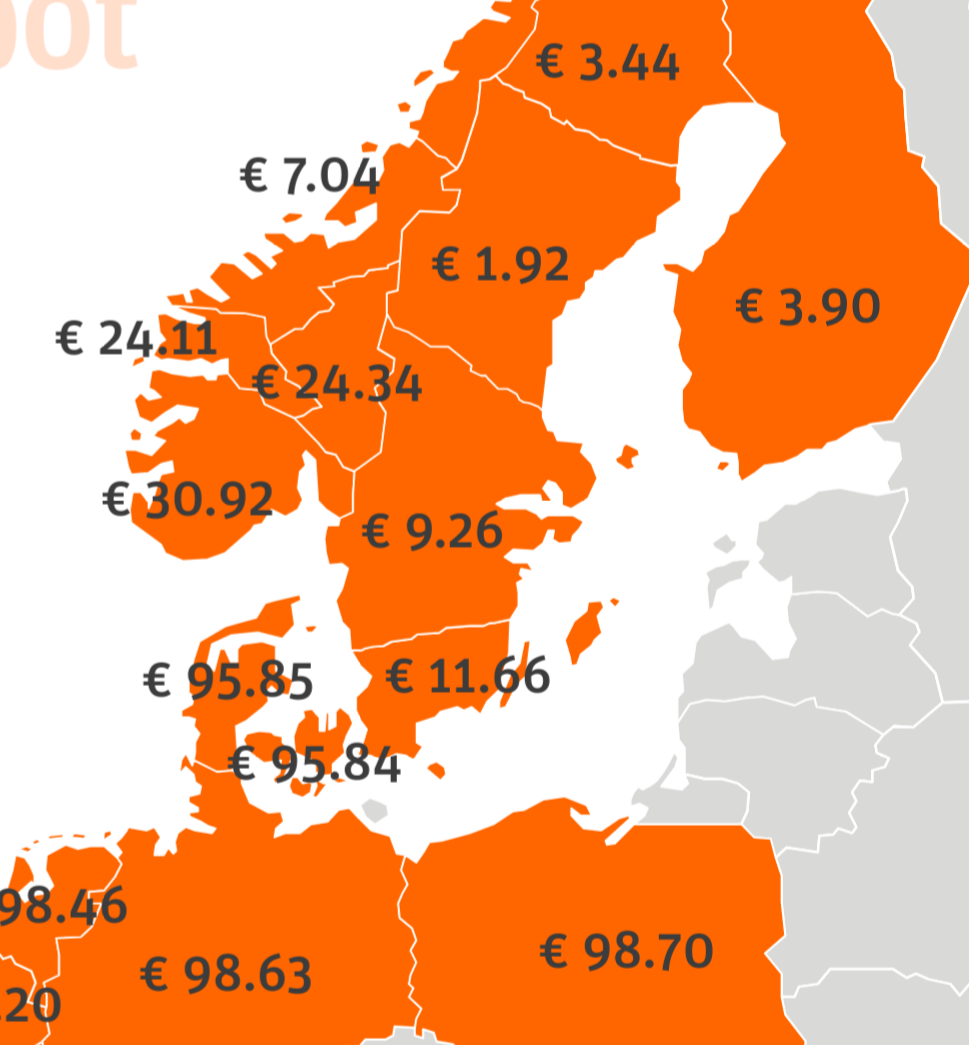
Funny you mention market zones. They are an eu invention and we are forced to match prices because Germany can’t pull they’re own weight in the energy market.
Not to mention that the eu mandated market zones only applies when you aren’t Germany, because of reasons.
EPEX SPOT SE is a company under European law based in Paris (France) with offices in Amsterdam (the Netherlands), Berlin (Germany), Bern (Switzerland), Brussels (Belgium), London (United Kingdom), and Vienna (Austria).[1] It operates the power spot markets for short-term trading in Austria, Belgium, Denmark, Finland, France, Germany, Great Britain, Luxembourg, the Netherlands, Norway, Poland, Sweden and Switzerland.
Not to mention that the eu mandated market zones only applies when you aren’t Germany, because of reasons.
I don’t see yet how one would arrive at that conclusion regarding EPEX. Please explain.
Germany doesn’t have market zones. Cause it isn’t in their interest to have them.
I’m counting nine countries though that don’t have market zones:
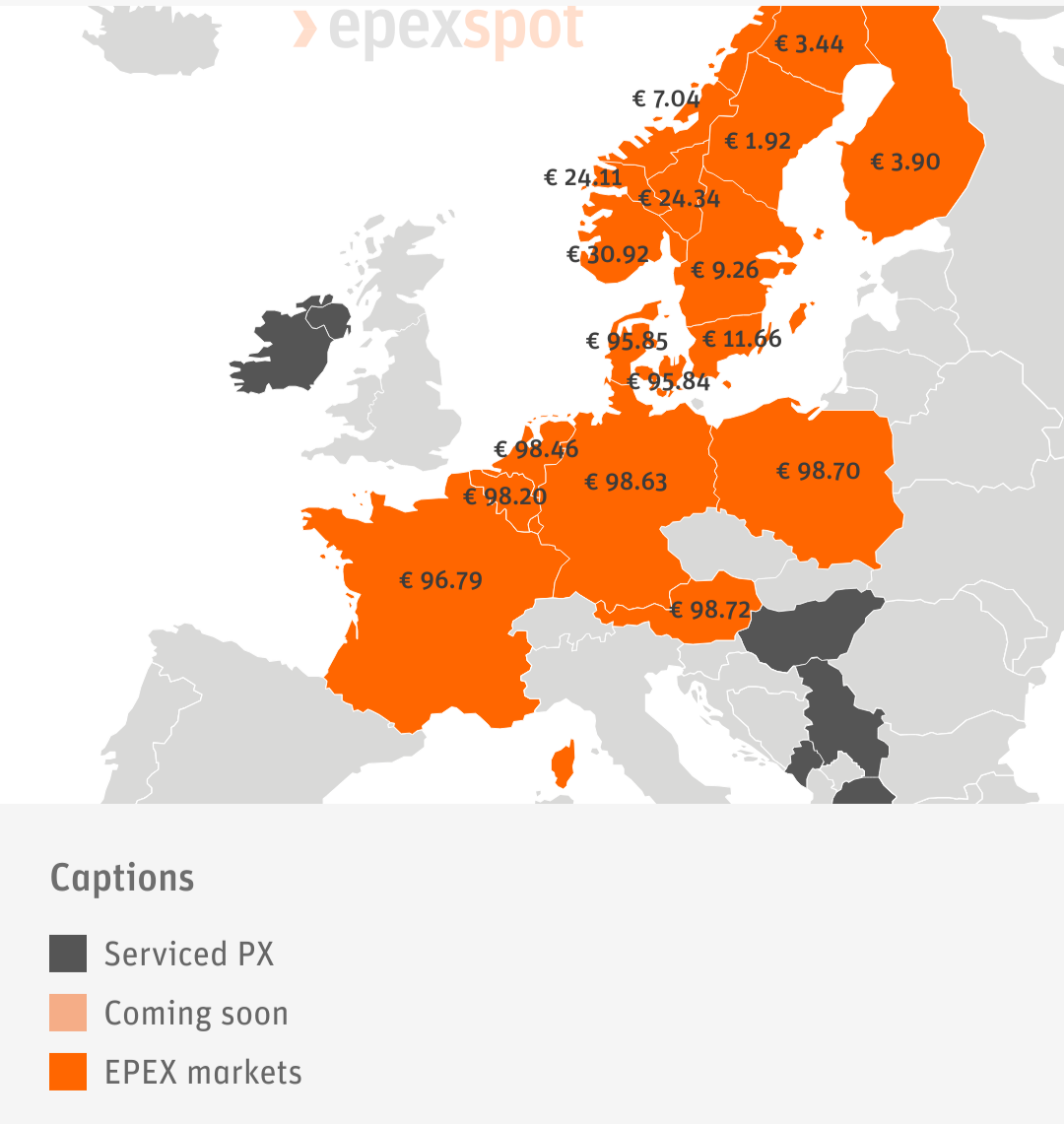
And I’m not sure yet how high prices (or rather not high prices at the time of the screenshot) in southern Sweden are linked to Germany not being separated into more than one zone. If Sweden could transport their energy from North to South, the South would be able to use the cheaper energy from there, but apparently that isn’t possible at the moment.
Expanding the transit lines at this point would only lead to German industry purchasing even more Swedish electricity, driving up the prices in the north of Sweden as well and killing the rest of the industrial base. The German effect deficit is larger than the entirety of the dispatchable electricity capacity in Sweden. In some 5-10 years, the northern surplus there will be used up anyway due to the electrification of the Swedish steel industry.
The ugly truth is that this situation will only be resolved when Germany take responsibility for their own grid, or the transmission lines get cut. The Swedish economy is highly electrified (~70% of energy consumed) and low carbon (~80% of energy consumed), especially when compared to Germany (~35% of energy as electricity, 25% low carbon).
One of the main differences is heating. Economically vulnerable Swedes are literally being driven out of their homes because of German electricity imports, which are enforced by the EU.
Fortunately these aren’t the only options.
They have cheap Russian gas so who nee…
Renewables are far cheaper and can be built faster and if they malfunction, no one is in danger.
France already has enough Nuclear to deal with no-sun and no-wind phases (if they work properly, which is the other problem with nuclear energy in France)…
So, there is literally no reason to waste tax payer money and time like this and to force yourself to import material from Russia. Just build renewables until we get fusion energy…
Even when disasters like Chernobyl are included, nuclear energy kills fewer people per Watt than any of the alternatives. E.g. dams burst and people like building towns downstream of hydro plants. Even with wind where it’s basically only deadly due to accidents when installing and repairing turbines (e.g. people falling off, fires breaking out too abruptly to climb down), it happens often enough that it ends up more dangerous than nuclear. Burning gas, coal and biomass all work out much deadlier than renewables and nuclear, but if your risk tolerance doesn’t permit nuclear, it doesn’t permit electricity in any form.
If the premisse is to avoid possibly every death, photovoltaic on the ground, e.g. on fields (not on houses) would probably be the least deadly solution.
Lots of people die mining the materials for photovoltaics, even with emerging technologies that reduce rare earth usage, especially because the countries with a lot of rare earth mineral wealth mostly have terrible human rights, slavery and worker safety records. In principle, this could be reduced without technological changes, e.g. by refusing to buy rare earth metals unless they’re extracted in line with best practice and that can be proven (it’s typically cheaper to fake the evidence that your workers are happy, healthy and alive than keep them happy, healthy and alive), but then things get more expensive and photovoltaics are already not the cheapest.
That’s not a bad argument.
Keeps the question open whether this is also part of https://www.statista.com/statistics/494425/death-rate-worldwide-by-energy-source/
It’s likely that my data’s out of date, and that graph does include it. If it didn’t, it’s hard to see how photovoltaics could kill enough people to have such a similar death rate to nuclear if accidents like Chornobyl are included.
It’s not either or situation, I hate this logic. Build both renewable and nuclear when the sun don’t shine. Nuclear has far more stability than renewables
It’s not necessarily an either-or situation, but when it comes to allocating public budgets, one can certainly come at the cost of the other.
This is generally what people talk about when advocating focus on renewables over nuclear.
I personally have no problem with privately funded and insured nuclear - if you’re able to swing that, then all the power in the world to you. The issue at hand is that nuclear fundamentally fails here - it’s too expensive to build and insure (not to mention the energy it produces being more expensive than its alternatives), hence public funding and insurance is essentially a prerequisite.
There are other considerations too, like diversification, nuclear know how, load vs on-demand, local geoeconomics, etc
With PBR reactors, nobody is in danger if it breaks down, either. The pebble bed collapses, and fission stops.
Renewables cant produce an on-demand baseload supply without the addition of significant storage capacity.
This is true, and at the same time not really an issue any more at the rate that energy storage systems are progressing. Similarly to how solar and wind have absolutely plummeted in price, so is the case with energy storage systems s well. As of now, the LCOE of solar + storage is at half the price of nuclear (source) and trending cheaper. Nuclear is trending more expensive. Add on a construction time of 17 years for plants and any nuclear plant is basically economically dead on arrival.
That’s what I wrote in my 2nd sentence. That does not justify building more of them, because the baseline is already handled by the existing power plants.
Renewables are far cheaper and can be built faster and if they malfunction, no one is in danger.
No, that’s not true. Solar workers fall off roofs and wind workers get hit on the head with falling turbines at about the same rate that people get cancer from nuclear, per joule generated.
Come one… If it’s really about minimizing death, just build photovoltaik on the ground. But that’s not the priority of humanity anyways.
Sigh. We can’t meet energy demands if we only focus on the cheapest energy sources.
Like it or not, energy is priced based on how difficult it is to deliver to the recipient.
And how does this justify paying a lot more tax payer money to build the NPP instead of renewables?
France does not only focus on renewables BTW. They have NPPs that already handle the baseline. And building more of them is just not useful at all, when there is a better alternative…
Renewables aren’t a viable energy source everywhere.
France won’t shut down fission for the simple reason that they need plutonium for their bombs.
No, we already have it and do not plan increasing our nuclear arsenal.
They aren’t burning coal like Germany? That’s how you go “clean”…
By pouring endless amounts of money down the drain? Great strategy.
It is if your intention is to not introduce carbon into the atmosphere over the 60 year life’s lifespan to 90 year lifespan of the power plant
Then, the priority should still be renewables, because they are far cheaper, can be build faster and if they malfunction, no one is in danger. France has enough Nuclear to deal with no-sun and no-wind phases (if they work fine, which is the other problem with nuclear energy in France)…
We don’t have enough resources yet for all the renewables we’ll need. Like there simply isn’t enough copper being mined fast enough.
Nuclear needs to be part of the solution.
Prices of renewables are dropping for years. If building them becomes difficult because of missing materials, the prices would rise, which is not happening at the moment. Why not just building renewables as long as it’s the far cheaper solution?
I’m not suggesting we stop building renewables. 🙄
If building them becomes difficult because of missing materials, the prices would rise, which is not happening at the moment.
Solar panels have indeed become cheaper and cheaper, and you are right to argue that the materials used to build solar panels are priced in. However, solar requires some infrastructure besides the panels themselves, such as inverters and storage, and that infrastructure needs additional materials, some of which are expensive. Copper, for instance, surged in price in 2020, and there is not enough investment to expand mining operations despite the great profits it has been yielding. This is an ongoing saga in the mining industry, with BHP attempting to take over Anglo American in part for its copper portfolio.
I am not arguing against solar; I just think it cannot be scaled to the extent necessary to cover most of our current and projected future electricity consumption. To get rid of fossil fuels and generate ever more electricity for EVs, the AI black hole and goddamn cryptocurrencies, I think we will need nuclear. I wish we would build more public transportation, break from the AI spell and ban cryptocurrencies, but I’m not hopeful. In any case, the pace solar has picked up these past years is very encouraging and we should do what we can to push it further.
Great! At the current rate it’ll only take them 200 more years to replace all their old time bombs.
And yet their electricity is still cheaper than Germany’s …
French nuclear energy is so heavily subsidised by the state that direct comparison seams hardly fair
Hey, we don’t do common sense here!
They mean cost, not consumer price.
France has old nuclear, Germany has old gas. Neither are leaders in renewables.
Germany has mostly old coal. Gas is relatively new. I totally agree that Germany needs to do more for its renewable production, like many other European countries need to do. However on a cost per energy level, renewables are beating all other production methods currently known.
Yet the prior means that France is one of the least carbon intensive economies in the world. Each German unit of GDP has twice the CO2 emissions compared to France.
Even worse then. Costs per kWH Solar have been sinking faster than some Russian battleships.
Yeah, Germany isn’t a leader in solar energy by a long shot…
What’s your point? Solar getting cheaper and cheaper has nothing to do with Germany. Our booming solar industry got axed by conservatives years ago.
Don’t you understand line must go up, quarterly profits now consequences never .what the fuck is a long-term investment. Get that ideology out of my power plant this instant. /S
Looks like there was an end to it.
Going over budget and missing deadlines is normal for large infrastructure projects.
If anything, seeing people’s shock at this should reveal how little they know about development.
1.6 GW, cool, but everyone knows all you need is 1.21 GW
Those were JW
Jigga what?


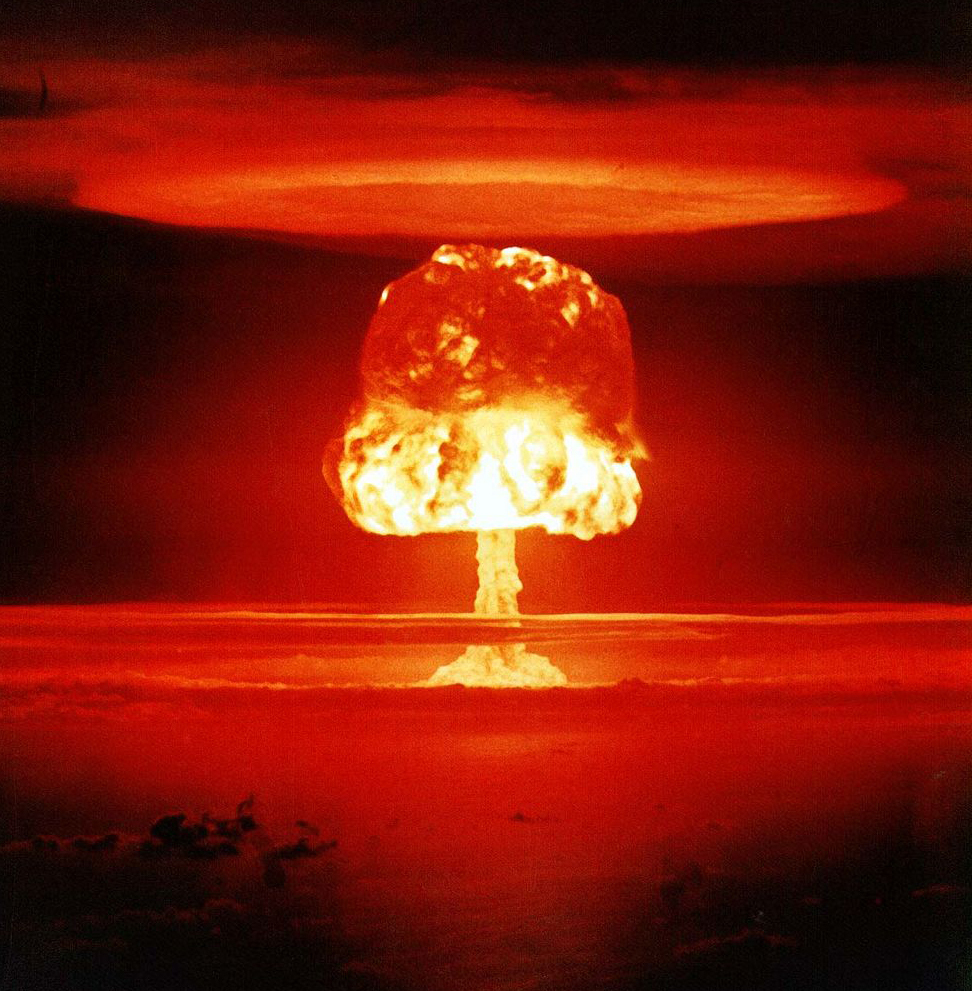
Nuclear plant construction delayed? Budget overrun? Even in one of the most nuclear developed countries in the world? Wooooow, what a surprise!!
Fossil fuel exec calls up his criminal friends in whatever legislative bodies he can reach “hey yeah I need this delayed and I need it to cost more in order to make my own business plans look less stupid and toxic. I don’t fucking care how you do it, rubber stamp some no bid contracts for your cousin in law’s consulting firm or something. Of course your family can expect some very lucrative careers, incidentally…”
deleted by creator
They better retool their power plants to use something other than uranium. Last I read, we had about a century’s worth at the current rate of mining.
There is around a century’s with of uranium with current mines.
But right now uranium is very cheap so most of it is “wasted”. There is plenty of way of recycling used nuclear fuel or improving the productivity of uranium enrichment.
If uranium supply starts to actually be a problem there is a way to “create” more nuclear fuel: breeder reactor.
With breeder reactor France could fuel their reactor for millennia only with the depleted uranium they have in stock (when enriching uranium you end up with a tiny account of enriched uranium on one side and depleted uranium on the other, France is keeping the depleted uranium in stock specifically for this scenario)
Yeah or put another way: All that nuclear waste we occasionally talk about burying under a mountain has something like more than 90% of its energy left.
No.
They speak about it in the article I linked (in French unfortunately). The waste that we talk about burying is what’s left AFTER extracting all the components that could be reused.
I have always wondered how it’s stored… always imagined like 55 Gal drums in some Simpsonsesque way, but that doesn’t really make sense… but maybe it does?
Like that but way bigger. The fuel is still in solid form and stored in giant heavy dry casks that essentially armor that fuel from the outside world.
Also encased in glass, and both the cask and the glass can stop the radiations on their own iirc.
Don’t worry, the consultants are already on the task and invoicing hundreds of millions for their hard work.
No ETA but will keep you posted… in about 12 years.
Uneducated take.
Boo de hoo
Therein lies the problem.
Is that including all known deposits? Or just the amount in current mines?
It’s based on what can actually be used.
The world’s present measured resources of uranium (6.1 Mt) in the cost category less than three times present spot prices and used only in conventional reactors, are enough to last for about 90 years.
https://world-nuclear.org/information-library/nuclear-fuel-cycle/uranium-resources/supply-of-uranium
(Note this is a *pro-*nuclear power organization.)
New technology may change that. We were once told that the oil in the Canadian tar sands was not economical enough to extract and now they’re extracting it. The paper also discusses the possibility of thorium as a fuel source, although it has yet to see commercial viability.
As-is, and with current reactors, we don’t have much we can use. Relying on new technology to change that could be a poor gamble.
When I was at school in the early 90s I was told oil would run out in 30 years, yet here we are, 30 years later and not only did it not run out, but people aren’t even talking about it running out.
100 years is a long time, and I suspect that nuclear will seem very old fashioned by then, and today’s power stations will have been long since decommissioned. If we’re not getting close to 100% of our power from wind and solar and tidal by then, we’ll be shafted anyway.
When I was at school in the early 90s I was told oil would run out in 30 years
No you weren’t. If you were, then you had a terrible teacher.
What you’re probably thinking about “peak oil.” https://en.m.wikipedia.org/wiki/Peak_oil
Nah man. I also heard this back when I was a kid in the 90s. It came from our news channels, not teachers in school.
I literally covered this in my post.
deleted by creator
You probably read about U-235, but yes. There are soviet BNs, their chinese clone, french experimental reactor and I think topic reactor, which can work on plutonium, which is side-product in regular reactors.
Seems like a waste investing so much in the U-235 cycle. Aren’t the thorium and U-238 cycles better? Like, more compact footprint, simpler design, more scalable, doesn’t need to be located near a large body of water etc.
France doesn’t care about fuel cycles which don’t produce plutonium.
The U-235 fuel cycle produces way more plutionium than the U-238 cycle, though.
EDIT: Aw, fuck, I typed it wrong. U-238 produces more plutonium than U-235. My criticism still stands.
That’s what they said
I know just about noting about nuclear fuel cycles, but yes, more plutonium sounds exactly like what the French want. They have an arsenal to feed.
The military nuclear is the main reason behind our civilian nuclear infrastructure, which was planned during the cold war. It looks like once per century the military can have an unintended positive effect, yay.
With the side effect of almost destroying the world multiple times.
Don’t get me wrong, I’m in no way advocating for military nuclear (or even for anything military).
France stopped production of military fuel 30 years ago.
The current goal is about recycling the existing nuclear waste, to reduce the need for long term storage and natural uranium.
Thorium is still umproven, and was even more so in 2007. Until (or if?) the Chinese TMSR LF1 really takes off no private company will risk trying a thorium reactor
Extracting its latent energy value in a cost-effective manner remains a challenge, and will require considerable R&D investment.
The physics are sound. It’s the economics that are apparently still a problem.
Good news!
fuck yeah
Lets hope this one stays in better condition than their other nuclear plants lol
its most powerful at 1,600 MW,
Fuck, that’s 100 more MW than VVER-1500(project). Or 400 more than VVER-1200(working).
post-Chernobyl
???
is 12 years behind schedule
VVER-1500 is still project for 40 years. Most modern we have now is VVER-TOI (1300 MW).
Aaaaand, the objective it to add 1000 new reactors in the next 25 years… we ded
Just start building a thousand today, and it’s done in 17 years