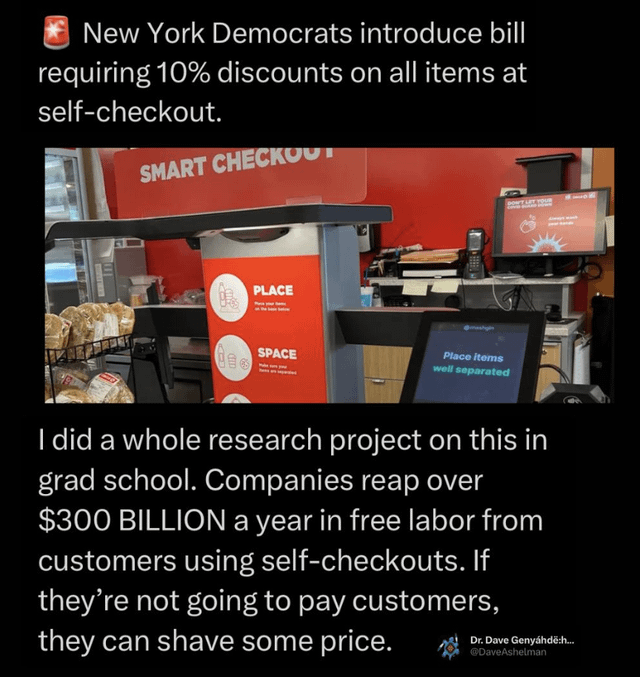
It seems like they will just mark everything up by 10% and then give that discount at self checkout. So they will pocket even more while harming those who don’t use self checkout.
Or eliminating cashiers altogether.
It also doesn’t really make sense to do it as a percentage. A cashier’s wage is typically hourly, and the labor market has settled on a particular wage for cashiers in this area - say $15/hr.
If I have a $150 grocery bill, a 10% discount would be $15. For maybe 5 minutes of work. Working out to an hourly wage of $180/hr (60/5 = 12, 12 * 15 = 180).
So if they’re saying “we should be compensating customers for being made to do labor”, they’d be compensating them at roughly 12x the going rate for cashiers in this example.
Now if it’s just meant to be punitive, OK. But then why not actually address the real issue: displacement of workers by technology and passing the labor burden on to unpaid consumers - either make that illegal or tax the company to help mitigate the harm it’s causing by eliminating jobs.
For the last point, it is easier to tax unfavored behavior into the ground than it is to outright forbid it. That’s why sin taxes exist after all.
I don’t think it would be difficult to outright forbid self-checkout at all, actually.
There’s a difference between enforcing laws on individuals and enforcing laws on businesses. Businesses can’t exactly run and hide, if they’re using self-checkout they’re going to get found out. That’s distinct from something like the drug trade, which is all underground and hidden.
Some people fucking love self checkout. If you ban it, you’ll have disability advocacy groups up your arse on behalf of autistic people and others with social anxiety.
ADA compliance will kill the entire thing. You can’t charge someone for accommodation of a disability that prevents them from using the self checkout. All the human-staffed registers will be posted as handicap accessible, and they will default to the “discounted” self-checkout price.
Sure, I’m just saying, this wouldn’t be a hard law to enforce.
It would be a very dumb law that has zero chance of passing. It would be like banning cars to keep horses employed.
Except horses aren’t allowed to vote, so actually, it’s nothing like that.
We’ve given up so much as consumers. There was a time when people would be pissed that the store was making them do unpaid labor. Now we don’t bat an eye.
My concern here is less about enforcement and more about getting the law passed and through the court system in the first place.
You don’t think they’ll drag such a tax through the court system? Our enemies don’t want any restraints on businesses, anything we try to do will be fought.
Do sin taxes really stop anything though?
They definitely have some effect, simply because they push prices up.
or tax the company to help mitigate the harm it’s causing by eliminating jobs.
Well. Discounting items in self-checkout is actually a tax on the company for using self-checkout.
But not one that relates to the thing that we’re trying to stop them from doing. Cashiers aren’t paid per item scanned, they don’t get commission. They are paid an hourly wage.
If you wanted to pay customers a rebate for their labor at the market rate for a cashier, or one set by the state, that’d make sense to eliminate the gains the company receives from automation.
So 5 minutes of work at $15/hr = $1.25. So not much, but it mitigates the benefit of not hiring people.
Though, it’s still a benefit because you pay a person whether they’re actively working or not and you have to pay tax on human labor (contributing to social security, etc) so maybe hiking it higher than whatever the typical wage is for cashiers would make sense.
But either way, 10% doesn’t make sense.
Can you imagine if they discounted it based on time? People would be scanning .4 items per minute lol
If I have a $150 grocery bill, a 10% discount would be $15.
If you have a $150 grocery bill, it’s being hiked to ~$166.66 before you get to the checkout. Then the 10% discount is bringing it back down to the $150 you were paying before. The net discount is zero: you’re paying exactly what you’re paying now.
If you keep going to the cashier after this, you’re paying the company the hiked price, which gives them an extra $16.66 for maybe 5 minutes of cashier labor. The company turns around and pays the cashier $1.66, netting an extra $15 from you for their shareholders.
Cost of labor, overhead, and profit are already accounted for in that $150 price of the goods. That’s why the store charges $150 for them - because that’s what covers the wages, overhead, and includes the maximum markup they can get away with (~3% margin for grocery stores afaik).
All I’m saying is, they do have to be able to cover costs. So because of that and their thin margins, they’d just hike prices (probably more than they’d need to take advantage of the situation).
So it makes more sense to either tax them for avoiding using human labor and passing that labor on to customers (to help pay for the drain they’re placing on the economy by not hiring people), or just ban the practice outright. Couple that with price controls to ensure they can’t unfairly inflate prices. Things they can’t avoid rather than a fee they can hike prices to avoid.
Imagine the lines at self checkout for ~$10(+) off on decent-sized carts
$100 isn’t much of a big cart these days. That’s a week or less of food for many.
The problem with your logic is that I can scan the items slower and make the compensation more fair, if I scan the items 12x slower then I’m being paid a fair wage for that 150$ purchase.
So am I being punished for being fast?
That’s the only way it could work.
Grocery stores average margins of ~3%. They can’t do universal 10% discounts.The CEO of Kroger made $15.63 million in 2024. Pretty sure there are lots of ways they could make it work. They choose not to.
That’s not how math works.
2024
Revenue was $147B
Profit was $3.8B or 2.8%The lowest estimate I found of sales volume through self checkout is 38%.
So a 10% self checkout discount is 3.8% hit to revenue. When profits are only 2.8% they’ll take a 1% loss.The CEO pay being only 0.4% of that $3.8B profit. Isn’t remotely enough to matter.
This won’t lower prices.
Do you think the CEO compensation is the only place they are siphoning off funds to the oligarchs? And even with all the greed, they are still admitting to robbing $3.8B from the working class. That’s all profits are.
The system rewards greed and corruption. So that’s what they do. They conspire with other corporations to inflate prices. They take advantage of disasters to gouge consumers. These aren’t conspiracies, they are things that have been admitted to under oath and discovered through investigation.
We’re looking a 2 different things here. I’m doing the math on a specific policy and how it would effect a specific company. You come back with generalizations and broad conceptions.
You are right generally. We agree generally. But here specifically, this policy won’t do anything to help that. It’s bad policy-making. We’re both right.
Sure they can. They hike prices 11.11% and the 10% discount brings them right back to their original price. Their 3% margin stays a 3% margin. They can even post the “discounted” price on the shelves to make it seem like customers are getting a good deal.
Yah. That’s what was already pointed out.
You’re pretending that stores can just arbitrarily raise prices. They already set their prices as the maximum the market will bear. And yes, ultimately the point is to make self-checkout cheaper than regular.
They arbitrarily raise prices all the time. Have you not noticed? And are you going to just stop eating food if it suddenly costs 10 percent more?
You think that was arbitrary? Do you have any idea how much work stores put in to setting prices? It’s more complex than this, but to illustrate, companies will maximize for total revenue, so quantity sold times price. And they know that whenever they raise the price, even by ten cents, some number of people will not purchase that item. They only raise prices if they predict the decline in sales will be more than offset by the increase in revenue per item.
It may seem arbitrary to you, but it’s anything but. The prices in the store are already at what the company estimates to be the optimum total revenue level.
yeah you’re right about your point so far, but this is different. if every grocery store in town were forced to raise prices by 5%, then they could all do it because all their competition does it too.
but if only one store decides to do it, then the customers would change to the other store nearby who offers lower prices.
That “$300 billion” number is just completely made up. The math doesn’t even remotely work.
The entire US grocery industry does somewhere around $1 trillion in revenue per year. For self-checkout to save $300 billion, that would mean roughly a third of every dollar spent on groceries was going directly to cashier wages. That is obviously not how grocery stores operate. Total labor costs for a store are only a fraction of their expenses.
And the idea that self-checkout was some massive money-saving miracle ignores the other side of the equation. Those systems cost a lot upfront, require maintenance, and they increase losses from theft, missed scans, and mistakes. A machine replacing a cashier doesn’t magically eliminate costs; it just moves them somewhere else.
There is a reason companies like Walmart, Target, and Dollar General have started putting limits on self-checkout or bringing back more staffed lanes. If self-checkout was saving them hundreds of billions, they wouldn’t be walking it back. They would be installing them everywhere they could.
This is the kind of post that hurts any community built around open discussion and critical thinking. A sensational claim gets repeated because it supports a certain viewpoint, while nobody stops to ask if it is actually true. The truth should matter regardless of whether it supports corporations, consumers, or anyone else. Being intellectually honest means checking the facts first, not just accepting information because it confirms what we already believe.
On a side note, totally support the bill in every way.
I really thought leaving Reddit would reduce the occurrence of this but honestly it was naive of me. This sort of clickbait crap is everywhere including Lemmy. Its unfortunate
Reddit is a cesspool but unfortunately so is the wider media ecosystem for the most part.
To further add some numbers (and their source) to this, the average grocery cashier makes $15-16 an hour, or liberally $35k a year. Note that this isn’t the entire cost of a cashier, the checkout equipment and POS systems cost money too - let’s assume that and the automatic checkout system are in the same order of magnitude. There were about 800k grocery store cashiers in the US in 2017 (source) so that’s about $28 billion, or ~3% of that proposed $1T revenue.
Many factors not included in this calc, more importantly regional variations in costs. Food prices and wages are higher than average in NY, 10% might not be pretty well calculated for that state. Also, human employees must be insured/have benefits, and machines do not require this. That cost savings on stores isn’t in the calculus here.
Also a huge fan of holding food chains accountable for fair pricing. Hope this becomes effective!
Also a huge fan of holding food chains accountable for fair pricing. Hope this becomes effective!
Most grocery stores are running at 2% profit margins. There isn’t anything for this to be ‘effective’ for, except you just raise prices 10% across the board and pocket the extra from actual cashiers still being used. It sounds great on paper until you dig in and realize it’s a completely asinine idea.
deleted by creator
Not OP, but a 2 second Google search turns up that it is in fact about 1 trillion. https://www.fmi.org/our-research/food-industry-facts
I didn’t see your comment until after I deleted mine. But yeah I saw a comment below that actually had statistics from datausa.io.
I still say that they should back up their rebuttal with their own sources instead of just spitting out a number.
I’m not arguing my own dissertation here. And I’m definitely not doing an MLA format on a Lemmy comment.
But feel free to actually verify the information on your own if you want to take up your time doing that.
For the record, I did actual research for the information stated above but you don’t have to take my word for it.
I frequent a DG Market in a rural area. They shut the self checkouts down pretty quick due to theft.
honestly just cap executive pay. nothing they can do then
In fact, let’s just screw the whole thing and seize the means of production…
Bang up idea, when have you ever seen the government run something correctly/efficiently?
There’s tons of examples if you actually care to look. Trash pickup is an easy example. I’ve lived in places where it was managed by the city and places where it was run by private companies. The city always showed up on time and never raised prices without justification.
Guess what the private companies did on a regular basis? And if you want to talk about efficiency let’s consider whether or not it would be better to have four different companies running four sets of trucks on four overlapping routes through the city as opposed to one entity handling the whole thing. The only thing efficient about the private companies running things is the way the money is siphoned off to some rich asshole instead of being managed by accountable local officials.
If its so efficient why do trash companies exist? I live in a city that has municipal pickup and all my friends that own apartments/restaurants all have private business dumpsters because the city sucks at doing a simple job…
The government needs to stay in its lane and out of business.
If its so efficient why do trash companies exist?
If private companies are so efficient then why does the government exist?
Do you see why framing the question that way doesn’t help you address the actual problem? I’m guessing you don’t since you seem unwilling to consider the possibility that private ownership is not the ideal solution to every service problem. I don’t think you need more than a cursory glance at the state of the US to throw that idea out the window but things must seem pretty good to you if you’re still stuck in that mindset.
Not stuck in any “mindset”. Been around the block a couple of times, not my first bbq, and every time any government gets involved they fuck it up and steal. Nope not on my watch.
And government exists as (and was intended) to hold the social contract we all have with each other together by the rule of law. Otherwise it entropy.
Been around the block a couple of times
So has your 5 trash companies
whether your government only makes chaor or actually helps, depends a whole lot on the government and especially on the people in it. there are good governments, for example here in austria.
the issue is more, whether your government represents you and whether they care about you. that is something that depends on your local context.
so i can tell you from an example why private companies exist that do things that are typically done by public companies … here in austria, there’s a railway operator called WestBahn. They provide passenger trains on the route from vienna to innsbruck (roughly). That’s the only route that they service. Why do they do it?
because it’s one of the most provitable routes in all of austria. it has many, reliable passengers. servicing that route turns a profit. servicing many other routes, for example bus lines in some remote village, is still necessary, but obviously doesn’t turn a profit as it has maybe 3 passengers at a time.
so, they pick the 1 route that’s actually very profitable, only service that, and leave every other route to the state-owned alternative. that’s what’s happening.
The police and most three letter agencies, when you understand their purpose is to protect the wealthy.
Works for me.
the government
Who said shit about the government?
We should seize the means of production. Us.
seize
in other words, steal. i’m actually fine with that if it’s for the greater good. the question is: would it work? do you have any idea how to run a company on that scale? there’s a whole lot of companies that have business connections all around the world. what happens to those? can you handle these connections? what if other companies think that you’re not trustworthy anymore and refuse to do business with you? how do you handle these cases?
also what about money? just that the company is now held by workers does not somehow suddenly make it have much more money. especially grocery stores maybe have 3% profit margins, that means, even if no CEO siphons off wealth, the company’s ability to spend money increases by maybe 3%, so wages could go up 3%. just to inform you, about what’s realistic here. it’s not as if you’re suddenly having a 3x wage increase.
in other words, steal.
Not quite. “Steal” would imply that the people you’re taking it from have a legitimate claim of ownership over it.
do you have any idea how to run a company on that scale?
Some of us do. And maybe it doesn’t need to be such a large scale in the first place.
what if other companies think that you’re not trustworthy anymore and refuse to do business with you?
Seize them too.
also what about money? just that the company is now held by workers does not somehow suddenly make it have much more money. especially grocery stores maybe have 3% profit margins, that means, even if no CEO siphons off wealth, the company’s ability to spend money increases by maybe 3%, so wages could go up 3%. just to inform you, about what’s realistic here. it’s not as if you’re suddenly having a 3x wage increase.
What about money? If we have the labor, the tools, the farms, and the factories … what do we need money for?
i think you’re unreasonably assuming here that a revolution would happen everywhere on the planet at the same time. realistically, that’s not the case. you start with one place, then another, etc. and in the meantime you have exactly the problems that i cited. how to interact with other entities, etc?
Good luck with that bub.
The difference is that the government has no shareholders or incentive to turn a profit, unlike companies. However it can sell luxury goods at a high price, to subside other goods like food or housing from the markup.
No share holder, we are all share holder in the US government if you pay taxes, are you daft?
Oh wow, where are my us government shares? When are the dividends getting paid out? Can I vote to invest more of my taxes into public schools so the education system does not fail it’s shareholders?
You have safety, food standards, drug standard, medical standards, social safety nets, roads, etc.
Thats the shit they are ok at, the rest leave it to companies.
And how does this work out? Do companies not lobby against safety or environmental regulations if it hurts their profits? Is the water safe to drink everywhere? Is medical care available to everyone who needs it, regardless of income? Does everyone get social security, even if he could not pay in because of health issues, accidents or other reasons that prevented him from working full time for 40 years?
You have safety, food standards, drug standard, medical standards, social safety nets, roads, etc.
And they’ve all been gutted starting with Nixon.
Try harder troll.
A lot more frequently than I see private industry run something correctly/efficiently.
train networks, schools, healthcare, heck even social housing, here in central europe
It’s not the government who would control the means of production, it’s the workers. In theory they might use a vanguard party to seize it non-violently and then redistribute it, so in that case it may pass through the government’s hands. But that’s not the only way to seize the means of production. When properly done though, it would end up in the hands of the workers, every laborer owning their own tools and equipment so they can work for themselves instead of some faceless corporation.
“seize the means of production” as if that’s an easy/good thing to do. then what, the employees own the company? and they get paid depending on company profitability? well, not every company turns a profit. what if the company has a bad year? will the employees go hungry? who says that it will turn a profit next year?
Then the employees decide what to do themselves in those situations. If it fails it fails, but they would be laid off or not be making money even if they didn’t own the company because their boss wouldn’t be able to pay them.
Arent they often paid in stock?
Define pay such that it includes stocks, bonuses, rebates, real estate, food, clothing, transportation, or any other item that can be exchanged, borrowed against, or otherwise converted to cash money. When they find a loophole just close it.
The problem with this isn’t the concept. It’s getting politicians to implement it.
It’s a pretty good loophole though. A stocks value is considered an unrealized gain when you receive it but don’t sell it. My company gives me stock, but I don’t sell it. If I had to pay taxes on that, I’d be fucked. Maybe they could create some kind of untaxed minimum based on some index. And possibly even brackets.
But of course there’s a reason they like it this way.
Stocks are not a necessary piece of compensation for anyone. Besides, if you can borrow money from a bank using stocks as collateral then it is effectively a liquid asset that you absolutely should pay tax on. The simplest solution to that problem is to disallow stocks from being used as collateral.
Every loophole can be closed if we decide we want to. The ones that are still open were intentionally left open to benefit the rich.
I think if they handled it in such a way that you borrow against it in any fashion, what you borrow is taxed. Kind of stupid it isn’t that way already, but here we are.
Yep, this is one of the reasons we need a tax on wealth. If you’re wealthy enough you can also just borrow against your stocks at very low interest rates.
Surely the us president will get right on it drafting an executive order!
This is a good intentioned, well-principled idea, but it’s a ham-fisted implementation that isn’t going to have the intended effect and extremely easy to work around.
Doesn’t seem that easy to work around. A checkout is either self checkout or it isn’t. Write the law to define a self checkout as “a check out where the majority of items are scanned by a customer rather than an employee.”
That’s because you don’t have the mindset of a sleazy corporate lawyer who is paid $500,000 a year.
Try this: Raise all the prices by 10 per cent. Give the 10 per cent discount to self-checkout customers, as required by law. Pocket the extra for people who are stupid enough to use the self-checkout. Don’t forget to give a middle finger to your local elderly people or disabled people. They’ll now pay extra for the privilege of shopping.
You do realize that the prices in the store right now are already the maximum the stores can charge, do you not?
Corporations are soulless and greedy. They don’t set their prices by buying from a supplier and increasing them by a fixed percentage. There is no point where a company will go, “well, we could charge more and still have the product sell, but that would be improper.” They already set their prices to the maximum the market will bear. They cannot raise prices further without a net loss of income. They set their prices for the maximum product sales cost and quantity sold.
And why can’t the elderly or disabled use self-checkout? If you’re capable enough to walk through a store and grab items from shelves, you’re capable enough to slide them past a scanner. If they’re shopping with a caretaker, then the caretaker can run the check-out instead. The level of dexterity required to use a self-checkout is the same as needed to grab items from shelves, inspect and bag produce, etc. Sure, some people are too disabled to use a self-checkout, but those folks are also too disabled to shop for themselves at all. That was literally how these systems were designed. The companies didn’t want to have to deal with scores of people who were dexterous enough to shop, but not dexterous enough to run the self-checkout.
What do you mean maximum? There’s no cap, as we’ve seen from the way prices have already been rising.
Why doesn’t your grocery store charge $20 for a gallon of milk then if they can just raise prices as much as they want? Have you never even heard of supply and demand?
Let me spell this out for you.
Discount on self-checkout passes.
Stores raise prices so that the price after the discount is the same as it was before.
Consumers continue to pay the prices they’ve been paying.
‘Discount’ evaporates into the aether.
the thing that you may not be considering here is the increased competition from the new city-run grocery stores that are also being proposed will somewhat limit the traditional store’s pricing power since presumably the city stores only need to break even, not turn a profit, and the city stores might not need to pay some set of taxes. we’ll have to see if this actually plays out, but that’s the proposal.
my guess is that large manufacturers like proctor & gamble may not want to supply the city stores, so they may be stocked with lesser known brands, at least at first.
You do realize that the prices in the store right now are already the maximum the stores can charge, do you not?
The market doesn’t see the price hike. You pay $100 today, before I hike the prices. I hike the prices to $111.11, but my shelf labels show you the “discounted” price of $100. You keep paying the $100 price that the market currently bears.
And why can’t the elderly or disabled use self-checkout?
That point was completely irrelevant. If someone can’t use the self checkout, ADA compliance requires accommodation, and the business can’t charge them extra. They get the same discounted price as the self-checkout. So, they put a handicap placard on the cashier stand, train the cashier not to ask any questions about disabilities, and give the same “discount” to anyone who uses the register.
4.90
Includes self-checkout discount. Price without self-checkout discount: 5.44
I don’t think this addresses anything I said. Market constraints prevent them from raising prices, not math. I perfectly understand the math you’re describing. You’re failing to understand the economics.
I’m saying the economics don’t matter because you can trick people into thinking prices haven’t gone up.
For ADA compliance purposes, the human cashiers have to give disabled customers the same rate as the self checkout. If I’m running a store, all my staffed checkouts will have handicapped placards, and cashiers will be trained not to inquire as to disability status, but merely “accommodate” everyone in line.
Now everyone is getting the “discount”.
The Amazon Fresh technology is already a loophole to that.
And why do you figure you can’t write a law to accommodate that as well? Some of you guys are looking for so many nits to pick that you think it would be impossible to ever write a law regulating anything whatsoever.
I’m pretty well read in economics. This is a well known concept called unintended consequences. People who are familiar know that there are endless ways to game any system and we tend to prefer very simple rules.
How is this a principled idea? There are countless examples across the economy where we have these labor tradeoffs. Building your own IKEA furniture. Picking up food yourself instead of getting it delivered. Yet we almost never have politicians come in and try to impose price controls on this deferred labor.
Can we go for upcharges on food items for modifying them next? If you are going to charge me $0.30 for adding tomatoes to a sandwich, you better damn well reduce the price by $0.30 when I remove tomatoes from a sandwich.
This is getting so out of hand in the USA.
Oh that’s one of my gripes. My son likes to get an egg mcmuffin with no meat, extra cheese. You’d think the slice of meat and cheese would cancel each other out. And I think they are up to charging $1 for a slice of american cheese. And its been this way for over 15 years.
It’s not just the US. The race for the biggest profit has hit its limits on the best value front. Now it’s pretty much all on deception and enshittification.
Fun fact: With very little effort, you can give yourself a discount at checkout!
Unethical corporations are humanity’s predators and we should hurt them however we can.
I grab my zero dollar curtesy gum every time I am at one.

I didn’t have to do a whole research paper on this to know that if I’m doing somebody else’s job as a customer, the company is saving money.
Agreed, some things are logical enough to see that; however, a study does help out in a way - reinforcing the common knowledge.
And quantifying it.
This is why I try to avoid self checkout. If I’m getting like 2 things and there’s already a line, sure, maybe… But if the lines are short, even if I only have a couple of things, I’ll visit a real cashier.
Not because I need help with it, and not because I want to “stick it to the man” or anything. I want to be part of the metric that continues to justify that a cashier is still a position to keep, and pay someone for. I do it so that there will still be cashier’s in the future, and someone can put food on their table because I didn’t choose to do free labor for the 0.1%.
I know, I know. I’m so selfish, I should tHiNk oF ThE sHaReHoLdErS…
“Cashier” has pretty much always been a heavily exploited, poverty-wage position. Cashiers might be putting food on the table, but their dickhead bosses aren’t paying them a living wage. They aren’t putting roofs over heads, or kids through college. Turnover is ridiculously, criminally high. People aren’t getting fired when the position is eliminated. They are leaving just as fast as they already were, and they aren’t being replaced.
The position is used to systematically exploit workers. Eliminating that position is a net positive.
I’m going to disagree with you there.
If your cashier’s are not making a living wage, then maybe the minimum wage should be increased?
Where I am, if a minimum wage worker worked 40 hours a week consistently, they would go home with the equivalent of $26k USD. The US Federal minimum wage at 40hrs/week will net you $15k USD.
The job isn’t always for the impoverished, and if it were, and you were to eliminate it, you just put people who are already impoverished into homelessness because they no longer have any viable means of employment.
The people leaving the job is a net positive because they should be, in theory, moving on to better paying positions. Freeing up jobs for people who need the work and can’t find it elsewhere.
It’s better than working in an Amazon warehouse.
Also, I worked at grocery stores a lot when I was a younger person and I was never a cashier, but I knew most of them and I was able to go back there years and years after I left and see the same faces at the tills. A lot of wives with empty nests helping to save up for retirement, or simply to do something during the day while their kids are off at school or whatever…
A lot of people working to help pay their way through college or university.
There were a lot of people working at those jobs for years and years because they needed something to help make ends meet until they could graduate, retire, find a job in their field, pay off their mortgage… Whatever it was.
You having this opinion indicates to me that you haven’t worked at a major retailer, or you’ve never worked as a cashier. I’m not sure which and bluntly I don’t really care. My lived experience disagrees with your pessimistic world view.
If your cashier’s are not making a living wage, then maybe the minimum wage should be increased?
Minimum wage is certainly too low. It should be more than double its current hourly rate, but that’s not the main problem here.
Where I am, if a minimum wage worker worked 40 hours a week consistently,
Cashiers are rarely allowed to work full-time hours. Management keeps the position open only for part-time workers. Cynically, the reason for this is so they don’t have to provide benefits to those workers. Giving retailers the full benefit of the doubt, this keeps a surplus of workers on the payroll, allowing the retailer to schedule everybody during major shopping events like Black Friday. Regardless, these workers are typically denied sufficient hours to be able to earn a living wage.
The job isn’t always for the impoverished,
You’ve got it backwards. The job isn’t for workers who happen to be impoverished. The impoverishment is because the job does not compensate workers adequately.
Also, I worked at grocery stores a lot when I was a younger person and I was never a cashier, but I knew most of them and I was able to go back there years and years after I left and see the same faces at the tills. A lot of wives with empty nests helping to save up for retirement, or simply to do something during the day while their kids are off at school or whatever…
So, you’re saying that these workers are holding these jobs for something other than gainful employment? They are using them as some sort of hobby or recreation? They are willing and able to accept exploitative conditions because they aren’t actually trying to live off the fruits of their labor?
The people you are talking about are, ultimately, enabling this exploitative behavior from employers. They are competing for work with people who do need actual gainful employment. Their recreational participation in the workforce devalues the labor of everyone else. I’m not saying they shouldn’t be allowed to work recreationally, or that employers shouldn’t be able to hire them. I’m saying that this practice should be strictly regulated, so that the employer can’t use their willingness to be exploited to justify exploiting everyone.
I think we need to establish both a “minimum wage” and a “standard wage”. The minimum wage would be the fixed, hourly minimum rate that we already have . The “standard wage” would multiply the minimum wage by 40 hours a week. Employees who aren’t paid at least that weekly amount are on “substandard employment”. A 40-hour/wk worker earning minimum wage makes a standard wage. A 20-hour/wk worker earning 2x minimum wage makes a standard wage. Substandard wages should be allowed, but restricted. An employer should not be allowed to compensate more than 10% of its labor with substandard wages.
I see what you’re driving at, but all employment is exploitative. There’s always a measure of the work that any low-level employee does that they will not get compensation for, that’s how business operates. That’s profit.
Whether someone is able to work at a position full-time or not, isn’t really the point I’m making here. Long gone are the days of the minimum wage being a living wage, no matter how much we try, we’ll never catch up to the inflation that’s happened since the minimum wage was set. Companies won’t let it happen. As minimum wages go up, so will prices, and you’ll always be in a never-ending cat-and-mouse game of raising wages, vs raising prices. The two will never be at the same ratio of earnings again. Minimum wage earners will never have the same buying power that they did when the minimum wage was put in place.
Our buying power will continue to be eroded away, in small amounts, forever. Minimum wage positions will always be, by definition, more exploitative than other positions, but all jobs are going to continue to exploit the work that people do. That’s capitalism in a nutshell though. I’m not proposing a better system, just stating facts. That fact makes a lot of what you’re driving towards, apply to a much broader group of people than just the exploited minimum wage, impoverished workers. The lowest earners will always need to be supplemented by something, whether that’s a food bank, food stamps, rent control, government programs to reduce costs, taxes, or other fees associated with living, or by the income of another person. I don’t think Minimum wage earners will ever be able to be financially independent, even if they could have been at one point or another.
By cutting any job, you’re shrinking the pool of jobs available for entry level workers. A pool that’s continually shrinking already. I will happily do whatever I can to reduce how much that’s shrinking as often as I can.
If you need a hammer or a torque wrench or a truck to do an ongoing job, compensation for that job must be sufficient to pay for the continuing maintenance and eventual replacement of that hammer, torque wrench, or truck.
If you hire a human to do a job, compensation for that job must be sufficient to fully meet that human’s basic needs. They need to be earning enough to be a fully functional member of society, not an impoverished charity case. They need at least a living wage, where they don’t have to choose between excessive employment or going without. A living wage (or better) is not exploitative.
Generally speaking, cashiers aren’t earning a living wage, let alone a gainful wage. Cashiers are generally exploited.
As minimum wages go up, so will prices,
There’s a glaring flaw in your analysis. Increasing minimum wage increases effective purchasing power much faster than it increases prices.
Ok, but since they’re too cowardly to implement real price controls they just raised the price of everything by 10%.
Exactly.
Another increase in the cost of living because of self serve checkouts. Can we just nationalize all corporation right now and divvy them up later?
Can we just nationalize all corporation right now and divvy them up later?
Depends, are you a member of a militant communist group that’s training and drilling for street to street fighting? Do you have a few hundred thousand members?
If yes to both, then yes. If no to either, then we have to do a lot of building class consciousness and organizing first.
What does it feel like answering rhetorical questions?
That’s why he signed up for .ML lol
training and drilling for street to street fighting? Do you have a few hundred thousand members?
JFC you might be the ONLY person on .ML that gets it.
Like I am SOOOOOO SICK of internet edgelords with zero combat skills demanding we burn down society and roll the dice that whoever survives will do a better job.
On the flip side, if you aren’t raising class consciousness at every opportunity and training and drilling for street to street fighting in an attempt to build that movement of a few hundred thousand armed commies, then you don’t get to criticize how anyone else is choosing to go about it, either.
Lenin was still right, and a revolution is still absolutely beyond necessary.
So are we the only 2 people allowed to criticize others? Or only me? lmao
If you’re as serious about raising hundreds of thousands of armed commies(lmfao) as I am than perhaps you’ll accept my criticism and go easier on that no true scottsman fallacy.
I mean kinda? There’s a natural price cap in place for basic needs like this because of their relationship to labor. People need to eat to live and work, and if they can’t afford to, must riot or die. This places a limit on the allowable range of grocery praces in relation to wages. If there was 10% slack to raise prices, they would’ve done it already. 'course, that doesn’t account for the effects of benefits like SNAP, if those rise to match.
(Not that can’t do it, if they’ve morons. it would just turn out to be an enormous mistake. 💀)
I guess they could still do it “safely” if everyone switches to using the self-checkout? Then the rise would only hit people on normal checkout. I guess what this does is unevenly distribute the cost of groceries between people that can use the self-checkout and those that can’t. So it like, harms old and disabled people mostly? And people that shop during peak hours when there’s a self-checkout queue.
And also it incentives supermarkets to fire cashiers, like a Pigouvian tax on hiring them. Fuck.
There’s a natural price cap in place for basic needs like this because of their relationship to labor.
We passed that cap years ago. People have been using pay over time credit to buy groceries since the pandemic.
In any other society the riots would have started before that. But USians are domesticated enough that I genuinely believe most of us will starve and die before we lift a hand in self defense.
There may be an unintended consequence of this. Corpos love to optimize to minimize any hits to their bottom line.
I could see any of these possibilities as a reaction:
- Self checkouts become overwhelmed so stores remove remaining paid cashiers to add more self checkout lanes.
- Self checkouts are reduced or removed to avoid giving any discounts.
- I believe I read that grocery margins are thin at the store and are much higher for manufacturers. I could see stores increasing prices across the board to recoup costs.
Hard to know for sure, the people seem to just rarely get a W these days that isn’t immediately wiped out by something else.
Hmm… I’ve read the opposite about margins: grocery store chains centralize purchasing so that they have a huge leverage on manufacturers.
For NY in particular, they shouldn’t be able to raise their price easily as the city will have its city-owned stores to compete with them.
There may be an unintended consequence of this.
The consequences will be a flood of lobbying money into the next legislature races
Yes price increases seem the most likely for pharmacies but not grocery stores. There is still sufficient competition in grocery stores, and enough of them without self checkout lanes. It would be hard to get away with a price increase when a cheaper alternative exists.
Pharmacies however… As much as I prefer small pharmacies, they often are tooo small for everything. Simply can’t find everything one might need. There’s basically just CVS and Walgreens, and they both are big into self checkout. Those two would collude for sure.
If a bill requiring 10% discounts at self checkout comes into law, they will all think the same thing: Increase the prices so the price at self checkout is the same, and people have to pay extra for a cashier.
The only way to realistically encourage corporations to reduce their margins within the current system is by establishing an alternative which is cheaper, and thus acts as competition which pushes the price down. So basically what Mamdani is doing with city-owned grocery stores.
The same goes for housing. Provide decent but simple housing at low rates, and the slumlords will either need to lower their margins or compete on quality instead.
I mean when it comes to grocery stores, most have little profit margin to begin with.
Yeah, you just raise prices 10% and pocket the difference when people end up having to use more cashiers because the self checkout is too full from fools thinking they are getting a discount. It’s no different than all the stores with ‘reward’ programs where you get cheaper or better prices. They track everything you buy and sell it, making more than the amount you are saving. Seems better to recognize that automation of things like checkout is here to stay and incentivize alternative methods to keep people you know, fed, housed and alive.
Hard to know for sure, the people seem to just rarely get a W these days that isn’t immediately wiped out by something else.
fun fact: the winning and the losing are not causes of each other. if you win, you will probably lose some of it later. however, if you don’t win, you will probably still lose something later. so it’s not better to not win just to avoid losing later. you lose anyways, the question is only whether you also win some.
The discount comes from entering the code of the cheapest type of item no matter what item I picked up. Organic lady finger bananas? Looks like bulk Cavendish to me. I’m not being paid enough to know the difference when I’m using self checkout, a banana is a banana.
Most self checkout machines rely on weight, so you have to find two items that weigh the same for that trick to work.
1lb of expensive bananas is indistinguishable from 1lb of cheap bananas in most of the self checkout machines I have used. Maybe one day they will get advanced cameras
How about food is a human right and should be free at point of purchase, lol.
Edit: lmao at the three American or Israeli downvoters. Eat shit, fuckers.
i think it would be better to give universal basic income (money) and people buy food with that. why is it better? because it ensures that while people can afford food, one person does not buy 20 bread when they only eat 2 “because it’s free”.
The problem with UBI is that the ones who decide the price of things still will have a control over things.
as i said in another comment, you lose anyways, the question is just whether you also win some.
I don’t care how it happens.
I do think that people should be able to line up to get soup/stew/oatmeal/etc. low-cost food as much as they want.
Kids shouldn’t be distracted from their schoolwork and even having their brains and bodies develop poorly because they don’t get fed at home.
Adults shouldn’t be distracted at work and/or committing crime to feed their families.
yeah especially the food-at-schools issue is just so obvious. just provide free breakfast / lunch etc. doesn’t even have to be complicated, even if the schools just provided a liter of milk a day, it would be something and better than nothing.
there’s a whole lot of things that schools could provide even if they don’t have a cafeteria / kitchen in the building. stuff like lunch boxes: bread with vegetables, cheese, jam, etc.
I can at least understand where people come from when they claim that adults who can work don’t have a right to food. I don’t necessarily have to agree with it, but I understand it.
But why doom their kids? An 8 year old shouldn’t have their studies affected because they’re hungry because their parents are poor. That’s antithetical to the American Dream they tend to talk so much about.
Careful, they’ll call you a tankie for this sentiment, lol.
Naw, people get called tankies for pretending the USSR/China/DPRK were perfect and did no wrong.
Your comment translated to the right would be “People will call you a nazi for saying you think we should have borders.”
Nobody but the absolutely deranged stretches that far, but people who are that extreme do like to pretend that their entire half of the political spectrum is labeled equally extreme; strength in unity by inventing enemies, I guess.
How many bombs has China dropped in the last 50 years? There’s a reason so many people prefer China over America.
I never said America was free of problems.
That’s the issue with people like you; you see zero nuance and you refuse to participate in discussions in good faith. Any criticism of any (pseudo-)socialist group must be met with Whataboutism or other bad faith arguments.
Answer the question or fuck off, lol.
I’m happy to concede it’s zero without looking it up; it makes no difference to either of our positions here.
It’s just a Red Herring for you to mount a soapbox to tell me and anyone who hasn’t blocked you yet how China Did Nothing Wrong and America Did Nothing Good.
That’s why people evidently keep calling you a tankie, and that’s how you and I differ so I never get called a tankie.
TL;DR: Not All Socialists Are Tankies, but All Tankies Think All Socialists Are Tankies.
so many people prefer China over America.
(citation needed)
also, yeah, bombs are one thing, and i see your argument there.
however, what moves people is largely the economic situation. people get dissatisfied with the US today because incomes are declining for the masses.
Hellooooo
No response to the pew research article? Just downvotes? Interesting.
I sure as heck don’t prefer China. America and China are both awful.
I think you’ve been drinking too much Chinese gutter oil.
I think you’ve been mainlining American propaganda for your entire life. How many illegal wars has America started in the last 50 years? What about China?
Hardly. I’m not American nor do I live in America. I will happily agree with you that America sucks, and yes I am fully aware they have illegally or unethically interfered with other countries in many ways, including starting wars, for a long time.
However, China is not some wonderful utopia you seem to be trying to paint it as. There are many problems with China too, obviously not exactly the same problems as America, but they exist, and to claim otherwise just makes you look like a CCCP shill.
Edit: lmao at the one American or Israeli downvoter. Eat shit, fucker.
It’s 5 now, after you started going wild below. Not everyone who dislikes toxic people is an “American or Israeli.”
well, they were not saying the “american or israeli” thing without reason. i remember a few years ago there was an UN vote whether food should be considered a human right … and every country in the world voted in favor, except two … america and israel.
(since america is a veto power, the proposal didn’t pass)
Yeah that’s one of many black marks on America’s sanity, and as you remind us, particularly relevant in this way.
One of those classic “A shitty person has a point” moments (not you, them).
I will say that I’m pretty sure they had 0 downvotes until they started going Tankie Mode in the discussion I mentioned, so people seem to be downvotng based on that, not so much supporting the US or Israel.
Hell yeah. A sane man to an insane society must appear insane. Also I’m showing -3. I wonder why it’s -5 for you? I don’t block users or instances.
Also I’m showing -3. I wonder why it’s -5 for you? I don’t block users or instances.
federation issues. you might not block instances but your instance does block some other instances.
Interesting, thanks for the info!
Does ml have instance blocks?
There ain’t no such thing as a free lunch, son.
Someone has to do work to produce that food. Those people need to be compensated somehow. You can go ahead and make hyperbolic declarations about “rights”, but that doesn’t mean economics just disappears.
The government already subsidizes food production. We’re just asking for a slightly bigger subsidy
How much bigger?
nah the reason why people are working full time in the US today is not because food production requires that much work input, it’s because of everything else.
to produce food, according to some calculations, you need about 1.2 hours of labor per person per week on average. source: read it a while ago. 2% of population produce enough food for 200% of population, assume these 2% work 60 hrs/week, that makes 1.2 hours per week if 100% of people were working in agriculture.
the reason why the people work full time is not because food production takes that much effort, but because agriculture is not the only thing that people are busy in. so you don’t have 100% of people working “for food”. it’s everything else that takes the 98% of effort, not the food production.
Communism Killed 850 Zillion People
so did the manifest destiny.
Two things can be bad at the same time.
That many!? Holy shit. I thought people being gunned down on the streets by inbred government goons was bad, but that means if we don’t support that then every single human on earth will die more than once!
FYI capitalism kills 10 million people a year due to artificial housing and food scarcity alone, let alone wars.
Eh. I’m not really big on focusing on terms for political ideologies. I prefer boiling things down to “don’t be a cunt.”
The people who bitch communism or capitalism killed so many people aren’t really bitching about the concepts. The concept didn’t do anything. The corrupt people in charge willing to twist things to their own benefit and accept people dying so they or their friends/allies can have more than they need killed loads of people under every political ideology.
I don’t care if I live under either of those systems, but any system should have sane and fair caps to keep any individual or organization from amassing too much money, power, or control over the whole.
Say if the US had a 99% tax on every dollar a person earns per year over 1 million, and that was all inclusive of official income, stock options, bonuses, etc, then that would be a great change. Likewise with corporations. There should be a hard cap on valuation to keep corporations from owning each other in a giant pyramid so that the bulk of companies in the nation are all under the same actual control.
The tax code should clearly be fixed to keep companies from shifting money and values on paper and never paying anything. Tax breaks for companies shouldn’t exist. If we’re calling it capitalism than a company should be able to exist in fair competition with the rest without that socialist handout for them.
Private equity groups shouldn’t exist. They create and provide nothing, they simply purchase existing businesses and lower product cost/quality and increase prices to create false profit. Since the consumer would start going to any competing business that didn’t do that, it encourages buying entire industries to enshittify them and leave people no options but the higher prices and lower quality.
Some industries should not be run for profit. There should be laws and oversight in place to ensure the things that all humans need as a basic part of life are as accessible as possible. The things that come to mind offhand are medical care, a base level of housing for individuals and families, and basic foodstuffs. As the necessities of human life, those things would be kept profit free and made available at the lowest possible cost with heavy to complete tax subsidization.
Companies would be free (and encouraged) to deal in things medical care not actually necessary such as elective plastic surgery not done to correct a physical deformity, higher tiers of housing so people have more luxurious and spacious potential options, and cooked and heavily processed foods. The base level of these things being available cheaply or free would naturally limit the amount they could charge and so their profit, which would help keep any but the most insane homes from having insane costs. People would be able to get meat and potatoes and veggies and the like cheaply and not need to worry about starvation, but Oreos, frozen pizzas, and microwaveable frozen taquitos would cost more.
You could do all of that in a “capitalist” society. Base ideology isn’t an issue. Virtually every base ideology we bicker about was created to try to help make something better. The problem is that they need to be applied with sane, rational limitations and regulations and strictly kept free from corruption.
K
I’m sorry that someone taking the time to type out a thoughtful response is such a bother for you.
They obviously can’t engage, that could be a confrontation.
BTW I’m with you that any system can be abused, and it’s that abuse that is the true issue. However capitalism does seem to encourage greed and the consolidation of resources, which has to be actively regulated. It feels like it’s a losing battle as those who accumulate power will try to sidestep or remove any obstacles that prevent them from gaining more power.
I feel like we’re currently seeing some particularly egregious examples currently and I welcome the discussion of other systems because open and unbiased discussion could hopefully lead us somewhere better.
Do I seem bothered? I’d say Indifferent at best.
😦
What kind of food? Only the cheapest supermarket type of food or gourmet restaurant too? What about food delivered from another continent? Should all of them be free? How would that be possible?
I don’t care, lol. We throw out thousands of tons of food every day.
We throw out thousands of tons of food every day.
which btw is good. imagine the opposite: if we threw away no food, that means that we consume about 100% of our food. now, if any environmental disaster hits (think of hurricanes, wildfires, etc.) then the amount of food produced will take a bump by maybe 10% in that year, ok? so now we produce 90% of the food we need … disaster.
a positive excess in production capability is the only thing to prevent shortages when risk inevitably happens.
but, what if instead of lowering the amount of food production to match what you said, we just outlaw throwing still good food out, and instead enforce a donation style regulation where leftover food that is still safe to eat must be donated or given, not wasted.
Like I used to watch the dunkin employee at the store I used to work at throw away dozens of perfectly fine doughnuts daily, or the bagels that wern’t used. It’s so wasteful for something that could have easily just been set outside as a “free for the taking” and then anything that wasn’t taken can then be tossed the next morning.
No establishment does it because they know it would likely lower their customers, cause they would just wait for closing. but at least then its not wasting it all.
Lmfao. Literal capitalist brain at work. We have to let people starve so that people don’t starve when we have an emergency, lmao.
Good job, little buddy!
300 billion in pure profits to executives… that could have ended hunger in the US last year.
So the next time you use the self checkout, remember to glance over at the lone cashier who lives in your neighborhood, look them in the eye and make sure they know about your excitement to be working for the shareholders for free now instead of their former colleagues. And if on the drive home you see their former colleague is getting evicted because they were laid off, make sure to honk, lean out your window and let them know how much you enjoyed the sweet song of “unexpected item in the bagging area.”
Worlds smallest violin. Jobs get replaced or unneeded.
If Dems actually gave a fuck instead of this bullshit ineffective horse shit that makes service worse; they’re offer real training and education programs. Instead we get sob stories like this trash any how I should feel bad.
Holy shit, that’s more than the employee discount I got working in retail.
I used to get 30% when I worked retail.
deleted by creator
I’d say that self-checkouts are fundamentally a good thing, just like other forms of increased productivity are a good thing – but in today’s society they can both lead to unemployment and lower wages. That is unnecessary.
Employment for the sake of employment isn’t a good thing, though. The problem that’s trying to solve is people not having enough money to live, which has multiple better solutions than makework.
sure, yeah, I would say that if our problem becomes that there’s too little work to be done, we should solve this by having a shorter work week, not by inventing unnecessary work
I have some similar feelings to AI here. The advantages of self-checkout are only present because we’ve made existing systems worse to the point where something not-great is now a better option.
In the 1980s, a grocery lane would have a check-out clerk and a bagger. Sometimes two baggers. You would put your items on the belt and they’d be scanned and bagged (well, so that eggs weren’t crushed, freezer items were together, etc) about as fast as you took them out of the cart.
By lowering wages and reducing staff, this got worse. Now the check-out clerk is poorly-trained and probably quitting/being laid off soon and the bagger has been laid off. Mysteriously, the human-checkout line is now kind of slow and frustrating!
Having individual customers do the check-out themselves is even worse (so frequently, someone gets the machine stuck yelling about putting items in the bagging area, or just stares vacantly at the screen), but by parallelizing the process it comes out to usually slightly faster.