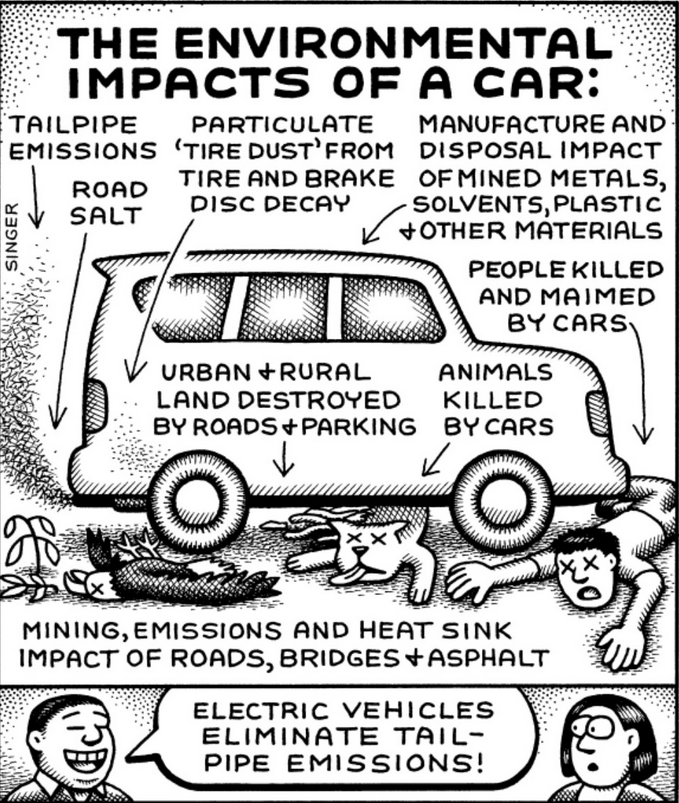
I hate this car-centric society, but let’s be real cars aren’t going anywhere. Moving away from fossil fuels is a good thing. Not sure why we’re criticizing progress here.
Its because EVs are being marketed as a green solution, not a stepping stone. If a car must exist it might as well be electric but we should be asking how do we reduce the cars that exist and their frequency of use. Building electrified transit and keeping ICE cars would as a whole be more beneficial than just converting all cars to EVs.
Because it’s progress that needed to happen 30 years ago. While we’ve been transitioning to electric cars, progress also needed to happen on every other issue but it doesn’t happen because we’re all in on electric cars instead of doing something about car dependency as a whole. It’s not moving forward, it’s moving sideways.
Speaking from the US, we’re clearly not yet all in on EVs and we just killed funding for transit and intercity rail. And they’re trying to remove fuel efficiency standards altogether. We are 30 years ago and regressing fast.
Transit and intercity rail are receding into some future utopian fever dream but some of us can still choose EVs
Moving away from fossil fuels is a good thing.
Yes, but not if it promotes destructive behaviours such as increased car dependency.
EVs are like low-calorie sweeteners: they do nothing to stop obesity, and actually encourage more eating (and more obesity).
You want electric buses? You want battery electric trains? Electric airplanes?
Cars are your path to research and development for these modes of transportation.
I wish that happened. It’s very difficult to convince an EV owner to take a train or bus, even if they are electric.
The more convenient we make driving in cars, and the better drivers “feel” about driving an EV, the more difficult it is to move away from car dependency.
Here’s a survey from CAA (Insurance company in Canada, like AAA in the States):
Drivers were more likely to drive more in a battery-powered EV than even a Hybrid.
And this part kills me: “The majority of trips for both BEV and PHEV drivers are relatively short, typically staying within 10 kilometers of home. This pattern reflects the convenience of electric driving for routine commutes and local errands.”
UCDavis Institute of Transportation Studies also found that EVs are driven more than gas cars (SOURCE).
The majority of trips for both BEV and PHEV drivers are relatively short, typically staying within 10 kilometers of home.
As a side note, I’m especially annoyed that every BEV “needs” a 300 mile range when 50 miles would be more than enough for the average American (assuming they can charge at home). Those additional batteries make the vehicles larger, heavier, and more expensive, and the batteries could be better used elsewhere.
But still, electric cars were a gateway to electric bikes and scooters.
The 300-mile-range req is just ridiculous. However it’s easier to pad the margin on a 60K vehicle by adding this or that for another 5-10K. It’s harder to do that on cheap vehicles and they can’t sell a 100-mile-range EV for a lot of money. Am working in automotive and emphasizing big expensive models is key for creating shareholder value.
10 km is pretty far. Walking 1km isn’t bad, but 3 is a decent chunk of time and energy. 10 is a pain in the ass by bus and a relatively quick trip by light rail assuming you didn’t have to walk that far to the station.
Like, I’m not contesting that a lot of drivers should walk for errands more, or that evs encourage car focusing, but that metric fails to account for the fact that few people will walk 2 hours one way for an errand.
10 km is pretty far.
That’s “up to 10km”, not that every trip is 10km.
In that context, it’s going to be easier/faster to bike or take an e-scooter to your destination.
If it’s under 2km, then walking really shouldn’t be a problem.
And if public transportation is available for medium distance trips, that should be first (as it is in cities/countries that are not built around car-dependency).
but that metric fails to account for the fact that few people will walk 2 hours one way for an errand.
Look at the bigger picture. We should be walking a minimum 10,000 steps a day (something like 8,000 to 12,000, realistically). That’s 8km a day as a bare minimum for minimum basic health.
Driving costs more time, because you now have to allocate time to drive + time to get those steps in. Why not walk that 2km errand instead?
At those short distances, we aren’t talking about massive differences in time to destination. And I think anyone can use the mental health benefits of movement, too.
Not sure if you’re aware but we’ve had electric buses and trains for well over half a century. We don’t need them to carry long range batteries. We have them in Europe and even in some places in North America. Batteries haven’t been needed for electrifying public transit for a very long time. In fact some of the first public transit was electric. Some places just choose the cheapest upfront option instead of spending a bit more on infrastructure in order to realize environmental and efficiency benefits.
As for planes, yes probably. Although I’m not sure whether there’s a viable route to electric planes that goes through batteries or whether that use case would necessitate synthetic fuel.
I’d argue that at least where I live, the amount of electric vehicles that has appeared over the precious decade is very clearly a majority bikes, scoots and other personal transport, instead of a car.
But yes I know for this conversation you meant EV as in electric cars.
And while the rent-a-scoots are pretty obnoxious at times, they do support the public transport insanely well in a city like mine, which has good bike paths and good public transport, but sometimes you’ll find yourself a few kilometres from the best connection or smth and take a scoot. (Although less so now, public transport just improved drastically last month, city started so many new cross-city routes, fking awesome for me.)
I’d argue that at least where I live, the amount of electric vehicles that has appeared over the precious decade is very clearly a majority bikes, scoots and other personal transport, instead of a car.
Me too, and I love it! Just the number of private e-scooters out this year has blown my mind! I’m not sure if it’s due to accessibility (they are <$1000) or if our rental e-scooter program showed people the value in micromobility, so they invested in a personal e-device.
And while the rent-a-scoots are pretty obnoxious at times, they do support the public transport insanely well in a city like mine
My city does not have great public transportation, however, the data from our first year of rental e-scooters has shown that people are using them for trips that would be “car first” at any given time. This is positive, and that’s with an enormous amount of push-back, lacklustre infrastructure, and the growing-pains that come from such a new and highly regulated form of transportation.
people are using them for trips that would be “car first” at any given time
When my personal EV has been broken or I’ve not come from home or something, I used to used them to go to some large shops relatively nearby, but now I have a direct bus connection, which is faster and more pleasant in the winter.
This is positive, and that’s with an enormous amount of push-back, lacklustre infrastructure, and the growing-pains that come from such a new and highly regulated form of transportation.
Very true. They’re definitely here to stay. I’m just waiting on the day that they’ll progress to cars, with hopefully reasonable pricing. (Fucking capitalism ruining everything in the long run.) Some small electric cars, I’d just like to be able to lug a bit of stuff and perhaps have protection from the weather. Be able to drive to places a bit further away that buses don’t go to.
Although they would need breathalyser locks I think, but that’s not a massive added cost compared to the car.
Thank you for saying that
We’re not criticising progress. Moving away from ICE cars is a good thing. Moving away from cars when and where possible is an additional, better thing. This is !fuckcars@lemmy.world where people tend to look beyond moving from a worse car to a better car.
Removed by mod
Yup, which is why the policies to ban the sale of new gas powered vehicle is a good thing.
My 2 favorite cities that is lived in were San Francisco and Rio de Janeiro. Apart from both of them being gorgeous and fun, one of the best things was that I did not need a car.
Moving away from fossil fuels is a good thing.
That depends on where the electricity comes from. Instead of ‘EV’ we should really be calling these things Natural Gas cars.
People can only think in binary terms.
Electric vehicles
- eliminate tailpipe emissions
- cut brake dust emissions in half
- pollute less as we transition to renewable energy
- let us work toward elimination the huge polluting industries for gasoline refining and distribution
- let us shrink the huge polluting industries of oil extraction and refining
- are a huge step toward slowing the growth of climate change.
While I completely agree transit, and walkable cities are much better, EVs are not nothing. More importantly, given the amount of time to build transit and walkable cities, EVs get us many of the advantages NOW
Yeah, this comic is putting perfect in the way of good.
Not to mention, there are people who do need vehicles, the trades being one example.
They also increase tyre wear particles due to their greater weight and torque
Also important to remember that not everywhere can be made walkable or makes sense to make public transit. You don’t want a bus route that picks up 2 people every day. That’s just worse than those 2 people having their own electric car.
A lot of people in the world are living in rural places where public transit is worse for the environment and bikes aren’t a realistic way to get from a to b. In these places electric vehicles are the only better alternative.
Yes and no. The problem is too much of the world is unnecessarily built that way. This is one of the fundamental reasons why it will take so long to implement: we need to change where people prefer to live.
Note I said “prefer” before y’all get up in arms about forcing people to move. We’ve spent way too many years giving rural people a lot of the same infrastructure as urban people and it’s just not sustainable. The thing is that even relatively small towns can have denser walkable areas and useful transit. Without forcing anyone to uproot, we ought to be able to get a good 80% or more of the population to not require a car.
They still kill animals and people, so… Toot the horn elsewhere.
let us work toward elimination the huge polluting industries for gasoline refining and distribution
Unlikely. If we keep doubling-down on vehicle infrastructure, the remaining ICE vehicles will see greater vehicle-miles traveled (VMT). It’s not just the number of cars out there, it’s the number of cars multiplied by the distances that they travel.
let us shrink the huge polluting industries of oil extraction and refining
Unlikely. The industrial processes and materials used to produce EVs use copious quantities of petrochemicals.
are a huge step toward slowing the growth of climate change.
Unlikely. EVs still need the same infrastructure as ICE vehicles, and the chemical process of curing concrete alone is one of the major sources of CO2 emissions. As well, the ecological destruction wrought by automobile infrastructure is a significant contributor to climate change.
EVs still need the same infrastructure as ICE vehicles
Hmmm, I haven’t taken mine to a gas station in two years. I must be way overdue.
Now I know you’re moving the goalposts to roads when I was talking gasoline industry, but let me point out where I started
While I completely agree transit, and walkable cities are much better, EVs are not nothing.
More importantly I do live in a partly walkable town. I do use transit when I can. And yes I have the privilege of living in one of the few parts of the US where intercity rail is decent
Talking only about the gasoline industry when considering climate change is, at best, ineffective. What’s more, that’s exactly what the cartoon is calling out, i.e. touting the reduction in tailpipe emissions while ignoring all the myriad other ways that EVs are just like ICE vehicles. (Which includes large contributions to climate change.)
While those are great improvements over fossil fuel based cars, they also exasperate existing issues.
Almost all of these EVs are in the SUV category. These vehicles take up more space on the road and parking lots. This results in less capacity for our road systems causing traffic engineers to incorrectly add more and more lanes to roads. Additionally combined with parking minimums, more and more land is developed into parking lots, which in term increases pollution and increases the heat island effect.
The increased weight and instant torque both causes increased tire dust (as another commenter mentioned) as well as accelerated wear to the roads. The high power figures results in inattentive selfish drivers being able to reach high speeds quickly adding risk for pedestrians.
I understand that the SUV craze existed before EVs were popular however as EVs are normalized it’ll only further enforce people buying oversized dangerous sub-4s 0-60 bricks.
This, to me, just seems like it’s trying to give permissions to ICE car owners not to change anything.
Removed by mod
This, to me, shows cars are more damaging than what just comes out of their tail pipes. Maybe the illustration could have included impacts of cycling and transit to help illustrate the point it is trying to make by comparing the impacts.
I think that would have made a huge difference… just showcase how literally none of these concerns are relevant with a bicycle.
Well technically some parking space and asphalt might be needed. And the odd snail or small snake may get hit by bicycles, and tires still shed particles off of bikes, but the scale is vastly different in comparison to cars.
Yeah I suppose that’s the point. There is no world without cars entirely, but we can certainly deprioritize them drastically
They don’t need permission. They won’t change anything unless their material conditions make it likely for them to change. That is lower EV prices, lower maintenance, better utility, good public transit, etc. They would buy a RAM 1500 if they wanted to whether they saw this meme or not. It’s unlikely that someone was sitting thinking whether to go with an EV or ICE, sees this meme and goes like - nah fuck that, I’m getting a gas guzzler. Meanwhile the ones that are active in the spaces that advocate for car alternatives had a bit of fun reading it, and got a small boost in motivation to keep pestering our politicians to expand transit.
I’m not sure if I’m convinced on the efficacy of a post like this to boost political motivation, but I am glad it was fun at least
Ah, well if an improvement isn’t perfect, we should definitely reject it and continue using the worst possible version until a perfect one is created
You forgot your /s.
Car culture evangelist in fuckcars community missing the point as always.
The point is that EVs are not a good solution to the problem with cars - they are just a better car. This individualizes what is a collective problem.
My city is adding six new lanes for cars in the coming years, meanwhile there are already intersections that a person has to jog to get across in time. Cars have their use, but it’s far far far less than people realise.
Valorizing EVs leads to perpetuating car centric designs, which is a negative across many dimensions - not only ecologically.
Electric cars also reduce particulate dust. Because of regenerative braking they need to brake less often and less agressive. There was a study published just kadt week.
Also noise pollution. Under 35 mph, most car noise is engine noise.
So much this. Car noise is a huge problem.
But they increase particulate tire dust due to being heavier.
Yes, but it seems from the study that the increase in tire dust is smaller than the refuction in brake dust
Brakes are iron and copper, the latter is an environmental contaminant. But tires pollute zinc and a hundred other petrochemicals. One is causing big problems with fish - 6PPD, but there are likely others causing yet unseen damage. Between the two brake dust seems more manageable in stormwater.
Ooh cool, would love to see that paper.
Here you go: https://www.eiturbanmobility.eu/wp-content/uploads/2025/05/41-EIT-Emissions-Report-5a-Digital-1.pdf
Battery Electric Vehicles reduce brake dust by up to 83%
Yay! Thank you! Adding it to the archive. I keep my car in the level 3 regeneration, so mostly “coast” up to the stop. I’m glad to see such significant reduction. Also because I breath a lot of that dust when I’m cycling, less particulates = better.
Edit: Some key findings from the paper:
Key finding #3.8: As the level of electrification of a vehicle rises, the dependence on regenerative braking also increases, thus lowering PM emissions from brake wear. Based on recent evidence [30], regenerative braking can reduce, in the worst- case scenario (i.e. highest usage of mechanical brakes or equivalently lowest usage of regenerative braking), brake wear emissions by 10-48% for hybrid electric vehicles (HEVs), 66% for plug-in hybrid electric vehicles (PHEVs), and 83% for battery electric vehicles (BEVs)
Key finding #3.13: Vehicle weight is directly proportional to tyre wear emissions. For example, a car with a 20% higher mass demonstrated a 20% increase in tyre wear [13]. Electric cars are around 20% heavier than the equivalent conventional cars, so they emit around 20% more tyre wear [40], [42], [43].
Im curious if the additional weight of EVs causes more tire wear and ends up negating any savings from the brake dust. We also have to consider manufacturing and disposal of both vehicles to be truly fair.
That and the increased road wear which grows exponentially (with the fourth power of axle weight) with the weight of the vehicle. That means a 2 ton car does 16 times more road damage than a 1 ton car. And before someone takes this to mean I prefer to not have EVs on the road, NO, I mean that this is a fact and we have to deal with it somehow while eliminating ICE. For example by making lower range EVs more attractive, since they already are acceptable in practice for a large proportion of road users. Going from ICE cars to ICE trucks, a common trend, is even worse in this regard since it adds significant emissions on top.
The additional weight, yes, as posted by @avidamoeba. Tho’ those are different things, apples to oranges - brake dust and tire dust are not the same. With the power that some EVs have it’s really easy to accelerate rapidly leading to faster tire wear. That is a choice made by the driver. I put my EV in eco mode, and gently accelerate. And try to ride my bike as much as possible, instead of my car. On the bike, I often try to accelerate as fast as possible, for cardiovascular and other health reasons, including just plain having fun!
It doesn’t solve all the problems, so instead, let’s solve none of the problems!
Get an electric car if you want, but you should still support society moving away from needing them in the first place, no?
Imagine a school cafeteria is serving kids the option of 5 hershey’s chocolate bars, or a slice of pizza. You can acknowledge the pizza is better, but you should still be asking where the god damn vegetables are.
That’s pretty much exactly the point I was trying to make. Incremental improvements are better than no improvements.
People shit on electric cars because they aren’t the perfect solution, ignoring the fact that they are better than what we have now.
It took us 150 years to get in to this mess. We aren’t going to fix it completely overnight.
How dare you not install your own commuter train out to your rural property.
How many people living on their rural property build their own roads to get there, as compared to relying on taxpayer subsidies?
Running a grader over their many-kilometer unsealed dirt road once a year after the wet season is how a lot of rural places do it.
If it’s roads on/within their own property they do have to pay for it (I cannot speak globally, but in Australia). If it’s on government land then of course it’s govt cost and responsibility.
Trains are great for high density. They don’t make sense to small towns or widely-dispersed populations - electric vehicles will always be needed and it’s dumb to pretend one size fits all.
A report from the Pew Charitable Trust found that 78 percent of ocean microplastics are from synthetic tire rubber. These toxic particles often end up ingested by marine animals, where they can cause neurological effects, behavioral changes, and abnormal growth.
Meanwhile, British firm Emissions Analytics spent three years studying tires. The group found that a single car’s four tires collectively release 1 trillion “ultrafine” particles for every single kilometer (0.6 miles) driven. These particles, under 100 nanometers in size, are so tiny that they can pass directly through the lungs and into the blood. They can even cross the body’s blood-brain barrier. The Imperial College London has also studied the issue, noting that “There is emerging evidence that tire wear particles and other particulate matter may contribute to a range of negative health impacts including heart, lung, developmental, reproductive, and cancer outcomes.”
Cool beans, I’ve got “Tire Brain”.
Stuff like this doesn’t shock me anymore. I just assume the worst case for everything and I’ve already accepted that we are fucked. I’m just hoping to die without pain.
Had the right idea but lost me at the end. Better is better. We can both electrify and work to move away from automobiles at the same time. We should not divide a group of people with common interest in a better tomorrow. To do so is how we lose.
Most of the fuckwads in this comment section missed the point of the post
The point is to get in your daily bitching quota lol
Yeah. They are actually furthering the point by imagining there is no solution apart from EVs and ICE cars. Also, have they seen the name of the conmunity lol!
On one hand, I like that EVs are leaps and bounds above gas guzzlers. On the other, it does still reinforce our current car culture.
Electric cars are the best solution available for people who live in car centric areas and can’t afford to build their own train line.
We should also be trying to get walkable neighborhoods and adequate public transport, but I will very rarely tell someone not to replace their car with electric. It really is much better than the available alternatives.
This cartoon is almost easy to mistake for satire making fun of the anti-car people.
Y’all have to face the reality that cars are not going away. The roads will outlast every human being that reads these words. People will continue to travel on those roads in vehicles of some kind. EVs are the best option we have yet for making the roads’ usage have less environmental impact.
You do realize those roads are only driveable because of extensive maintaince. If we stopped maintaining a specific road and built tracks instead, many people would choose the tram/train as the road would be too rough to travel at any decent speed after a few years. The infrastructure we build and maintain directly impact the mode people use. And currently many places exclussively build and maintain roads, often not even including the option of a sidewalk.
Yeah that’s pretty funny because I’ve driven on unmaintained roads for decades. In my area we are lucky if they do any maintenance when there are road problems. Sometimes people have to clear trees from the road after storms, and it may be done by the county or a random guy with a chainsaw.
Also I learned to drive on gravel roads, drifting around corners to learn the innate balance of maintaining stability without traction. Even if the paved roads were ground down to gravel, we would still drive on them.
Arent roads useful for more things than cars? Biking on a road that is filled with small rocks is not fun
Streets can also allow kids play if there arent cars on them
A road is more than a smooth, flat surface. A road that’s designed for cars has to have an extensive roadbed of gravel and soil laid down, as well as a thick base of pavement on which to lay the surface, because of the weight of vehicles. A bike path, or a street where children can play, is comparatively speaking just some asphalt.
ish, but without cars you don’t need a 20 lane highway. and streets can also less lanes,
Definitely don’t need streets to play. A couple paved areas for basketball, skating, etc is nice - but that’s just a park.
Busses and trains cause many of those same issues. What is the message here? Fuck all transportation and just stay at home?
Those issues from trains and busses are less impact per person than a private automobile. Also pretty sure they don’t need to salt train tracks and trains don’t use tires (except a few very rare examples).
And those issues from EVs are also less impactful than ICE.
Maybe not everything is black and white?